Review
. 2020 Oct 30;21(21):8138.
doi: 10.3390/ijms21218138.

DNA Methylation in Nonalcoholic Fatty Liver Disease

Affiliations
Review

DNA Methylation in Nonalcoholic Fatty Liver Disease

Jeongeun Hyun et al. Int J Mol Sci. .

Abstract

Nonalcoholic fatty liver disease (NAFLD) is a widespread hepatic disorder in the United States and other Westernized countries. Nonalcoholic steatohepatitis (NASH), an advanced stage of NAFLD, can progress to end-stage liver disease, including cirrhosis and liver cancer. Poor understanding of mechanisms underlying NAFLD progression from simple steatosis to NASH has limited the development of effective therapies and biomarkers. An accumulating body of studies has suggested the importance of DNA methylation, which plays pivotal roles in NAFLD pathogenesis. DNA methylation signatures that can affect gene expression are influenced by environmental and lifestyle experiences such as diet, obesity, and physical activity and are reversible. Hence, DNA methylation signatures and modifiers in NAFLD may provide the basis for developing biomarkers indicating the onset and progression of NAFLD and therapeutics for NAFLD. Herein, we review an update on the recent findings in DNA methylation signatures and their roles in the pathogenesis of NAFLD and broaden people's perspectives on potential DNA methylation-related treatments and biomarkers for NAFLD.

Keywords: 5-hydroxymethylcytosine (5-hmC); 5-methylcytosine (5-mC); DNA methylation; DNA methyltransferase (DNMT); biomarker; cytosine-phospho-guanine dinucleotide (CpG); epigenetics; nonalcoholic fatty liver disease (NAFLD); nonalcoholic steatohepatitis (NASH); ten eleven translocation (TET).


Conflict of interest statement

The authors declare no conflict of interest.

Figures
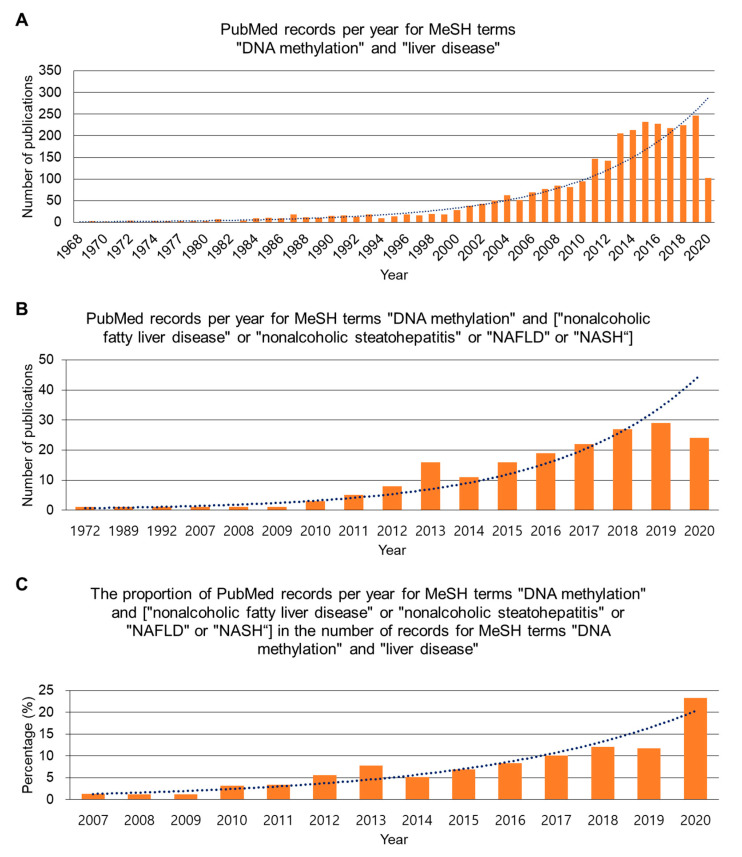
Figure 1
Figure 1
The number of publications on DNA methylation in nonalcoholic fatty liver disease/nonalcoholic steatohepatitis (NAFLD/NASH) is increasing. (A) The number of publications in PubMed per year for the terms of medical subject headings (MeSH), “DNA methylation” and “liver disease”. X-axis scale is displayed every 2 years. (B) The number of publications in PubMed per year for the terms of MeSH, “DNA methylation” and (“nonalcoholic fatty liver disease” or “nonalcoholic steatohepatitis” or “NAFLD” or “NASH”). (C) The proportion of PubMed records per year for MeSH terms shown in panel B in the number of PubMed records for MeSH terms shown in panel A. The records until September 2020 were included.
Figure 2
Figure 2
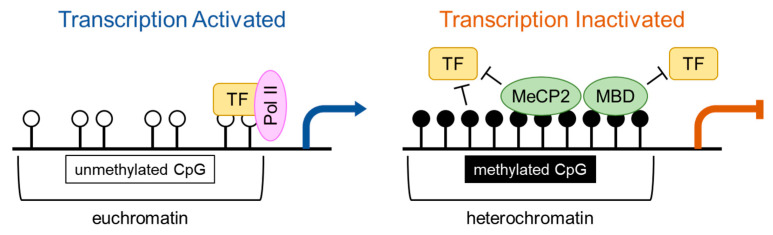
DNA methylation mediates gene silencing. In euchromatin (loose or open chromatin), cytosine-phospho-guanine dinucleotide (CpG) sites are generally unmethylated in promoter region and accessible to transcription factors (TFs). Methylation of cytosine in CpG sites is associated with heterochromatin (tight or closed chromatin) that typically results in silencing of gene transcription. Methylated CpG prevents the binding of TFs directly or indirectly by interacting with readers of DNA methylation, such as methyl CpG binding protein-2 (MeCP2) and methyl-CpG-binding domain (MBD). Pol II indicates DNA-dependent RNA polymerase II.
Figure 3
Figure 3
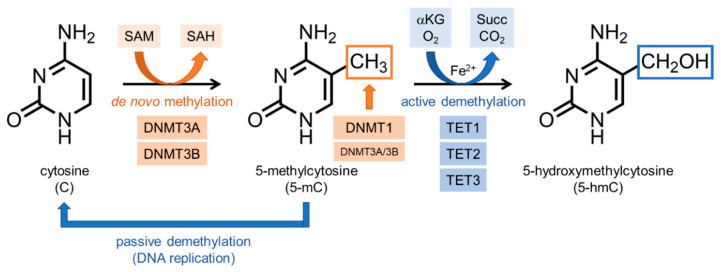
Enzyme-mediated DNA methylation and demethylation processes. DNA methylation occurs at the carbon 5 of cytosine in CpG dinucleotides. DNA methyltransferases (DNMTs) catalyze the methylation reaction by transferring a methyl group to cytosine (C) using S-adenosyl methionine (SAM) as methyl donor and producing S-adenosyl homocysteine (SAH). As a product, 5-methylcytosine (5-mC) is generated. DNMTs also maintains the status of DNA methylation. DNA demethylation is a multi-step oxidation process mediated by ten-eleven translocation (TET) methylcytosine dioxygenases (active demethylation). TET enzymes use Fe2+ and α-ketoglutarate (αKG) as co-substrates, and generates succinate (Succ) and CO2. In the first step of demethylation process, the 5-mC is converted to 5-hydroxymethylcytosine (5-hmC) (shown), and further TET-dependent oxidation leads to the conversion of 5-hmC into 5-formylcytosine (5-fC) and 5-carboxylcytosine (5-caC) (not shown). After several oxidation reactions mediated by TET enzymes, the methyl group is removed by base excision repair mechanism. 5-mC or 5-hmC can also be converted to unmethylated cytosine during DNA replication, through a passive DNA demethylation.

References

    1. Younossi Z.M., Koenig A.B., Abdelatif D., Fazel Y., Henry L., Wymer M. Global epidemiology of nonalcoholic fatty liver disease—Meta-analytic assessment of prevalence, incidence, and outcomes. Hepatology. 2016;64:73–84. doi: 10.1002/hep.28431. - DOI - PubMed
    1. Valenti L., Bugianesi E., Pajvani U., Targher G. Nonalcoholic fatty liver disease: Cause or consequence of type 2 diabetes? Liver Int. 2016;36:1563–1579. doi: 10.1111/liv.13185. - DOI - PubMed
    1. Nalbantoglu I., Brunt E.M. Role of liver biopsy in nonalcoholic fatty liver disease. World J. Gastroenterol. 2014;20:9026–9037. - PMC - PubMed
    1. Singh S., Allen A.M., Wang Z., Prokop L.J., Murad M.H., Loomba R. Fibrosis progression in nonalcoholic fatty liver vs nonalcoholic steatohepatitis: A systematic review and meta-analysis of paired-biopsy studies. Clin. Gastroenterol. Hepatol. 2015;13:643–654.e9. doi: 10.1016/j.cgh.2014.04.014. - DOI - PMC - PubMed
    1. Michelotti G.A., Machado M.V., Diehl A.M. NAFLD, NASH and liver cancer. Nat. Rev. Gastroenterol. Hepatol. 2013;10:656–665. doi: 10.1038/nrgastro.2013.183. - DOI - PubMed