


Developmental associations between joint engagement and autistic children's vocabulary: A cross-lagged panel analysis
- PMID: 33143458
- PMCID: PMC8284930
- DOI: 10.1177/1362361320968641
Developmental associations between joint engagement and autistic children's vocabulary: A cross-lagged panel analysis
Abstract
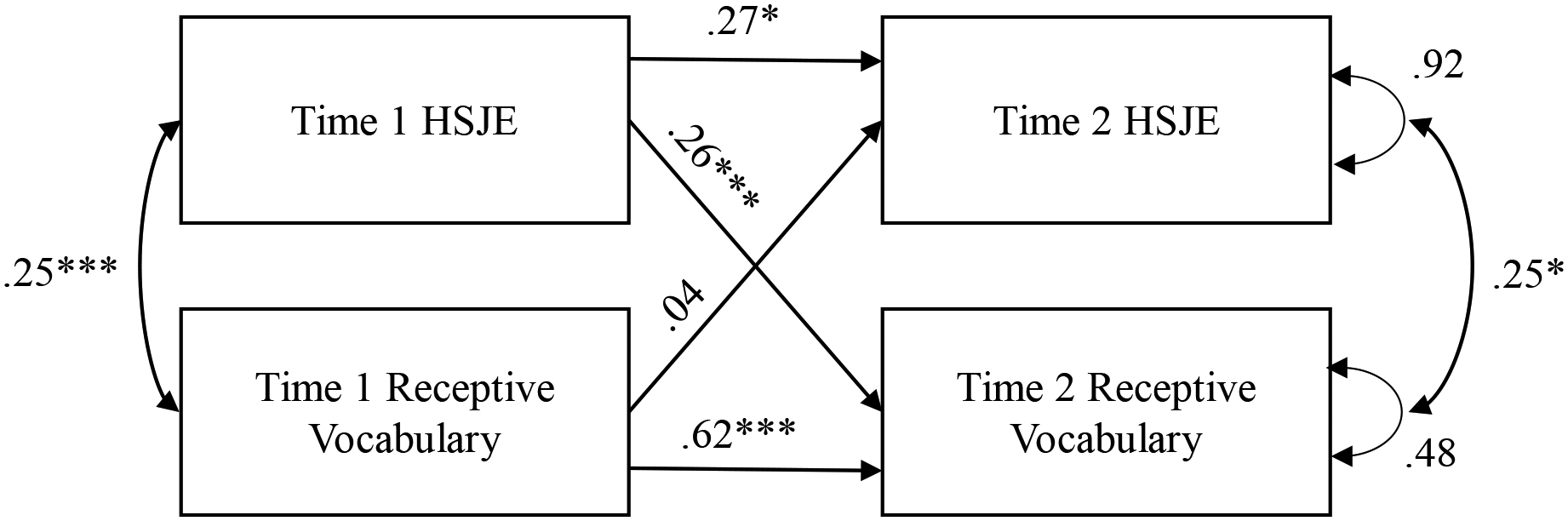
In this study, we used a cross-lagged panel analysis to examine correlations over time between two types of engagement between children and their parents and children's later expressive and receptive vocabularies. This kind of design can help researchers understand which early developmental achievements "drive" later developmental achievements. It is important for intervention researchers to know which developmental achievements happen first, so that they can set intervention goals appropriately. The two joint engagement variables we examined were (a) higher order supported joint engagement, which occurs when caregivers influence their child's play with toys and the child reciprocally responds to the caregiver, but does not manage the interaction by shifting gaze between the toys and the caregiver, and (b) higher order supported joint engagement that co-occurs with caregiver's follow-in talk (higher order supported joint engagement + follow-in). Follow-in talk occurs when the caregiver talks about objects and events that the child is focused on. Ninety-one autistic children (n = 91) with language delay (mean chronological age = 39 months) participated, along with their primary caregivers. Each of the four variables was measured twice, 8 months apart. Our statistical procedures showed that early higher order supported joint engagement and early higher order supported joint engagement + follow-in were significantly associated with later expressive and receptive vocabulary. In contrast, associations between early vocabulary variables and later joint engagement variables were not significant. Our results suggest that higher order supported joint engagement and higher order supported joint engagement + follow-in may be useful initial intervention targets, for developmental interventions aimed at promoting language development in autistic children who are initially language delayed.
Keywords: autism; caregiver–child interaction; follow-in talk; joint engagement; language; responsivity; vocabulary.
Figures


References
-
- Adamson L, & Bakeman R (2006). Development of displaced speech in early mother-child conversations. Child Development, 77(1), 186–200. - PubMed
-
- Allison PD, Williams R, & Moral-Benito E (2017). Maximum likelihood for cross-lagged panel models with fixed effects. Socius, 3, 2378023117710578.
-
- American Psychiatric Association. (2000). Diagnostic and statistical manual of mental disorders-IV-TR. Washington, DC: Author.
Publication types
MeSH terms
Grants and funding
LinkOut - more resources
Full Text Sources
Medical
