


Incidence of and risk factors for post-parathyroidectomy hungry bone syndrome in patients with secondary hyperparathyroidism
- PMID: 33143476
- PMCID: PMC7646547
- DOI: 10.1080/0886022X.2020.1841655
Incidence of and risk factors for post-parathyroidectomy hungry bone syndrome in patients with secondary hyperparathyroidism
Abstract
Background: Hungry bone syndrome (HBS) following parathyroidectomy is associated with severe hypocalcemia and increased morbidity. This study aims to determine the incidence and risk factors of post-parathyroidectomy HBS in dialysis patients with secondary hyperparathyroidism (SHPT).
Methods: A retrospective cohort study was conducted, and medical records of patients with SHPT requiring parathyroidectomy between January 2014 and January 2020 were reviewed. HBS was defined as the requirement of intravenous calcium administration due to hypocalcemia-related symptoms and/or reductions in serum calcium concentration (<8.4 mg/dL) within 72 h after parathyroidectomy.
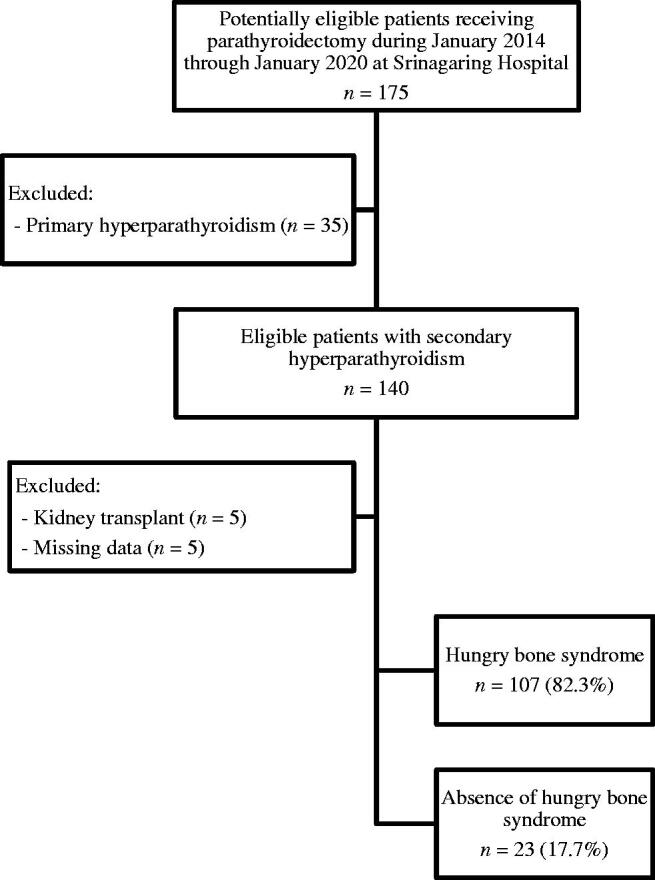
Results: A total of 130 dialysis patients were enrolled. The majority of patients (85.4%) received hemodialysis and the remaining patients (14.6%) received peritoneal dialysis. Ectopic parathyroid glands were identified in 6.6% of patients by preoperative parathyroid scintigraphy. Diffuse parathyroid hyperplasia was the most common histopathological characteristic of SHPT (90.8%). HBS occurred in 82.3% of patients following parathyroidectomy. Preoperative serum intact parathyroid hormone (iPTH) concentration was significantly correlated with serum calcium (r = -0.48, p < 0.01) and alkaline phosphatase (ALP) concentration (r = 0.71, p < 0.01). Patients with HBS had significantly longer hospital stays than patients without (8 versus 3 days, p < 0.01). Based on multiple logistic regression analysis, young age (≤45 years), high preoperative serum ALP (>420 IU/L) and iPTH (>1,000 pg/mL), and absence of preoperative hypercalcemia (>10.2 mg/dL) were significantly associated with HBS.
Conclusions: Post-parathyroidectomy HBS is common in dialysis patients with SHPT. Young age, high preoperative serum ALP and iPTH, and low preoperative serum calcium concentrations were important risk factors for HBS.
Keywords: Dialysis; hungry bone syndrome; hyperparathyroidism; hypocalcemia; parathyroidectomy.
Conflict of interest statement
No potential conflict of interest was reported by the author(s).
Figures
References
-
- Jofré R, López Gómez JM, Menárguez J, et al. Parathyroidectomy: whom and when? Kidney Int Suppl. 2003;63:S97–S100. - PubMed
-
- Jamal SA, Miller PD.. Secondary and tertiary hyperparathyroidism. J Clin Densitom. 2013;16(1):64–68. - PubMed
-
- Okada M, Tominaga Y, Ichimori T, et al. Surgical outcomes of parathyroidectomy for secondary hyperparathyroidism resistant to calcimimetic treatment: a retrospective single-center cohort study. Ther Apher Dial. 2020;24:1–9. - PubMed
-
- Ketteler M, Block GA, Evenepoel P, et al. Executive summary of the 2017 KDIGO Chronic Kidney Disease-Mineral and Bone Disorder (CKD-MBD) guideline update: what's changed and why it matters . Kidney Int. 2017;92(1):26–36. - PubMed
MeSH terms
Substances
LinkOut - more resources
Full Text Sources
Medical
