


Comment
doi: 10.1073/pnas.2020200117.
Epub 2020 Nov 3.
Predicting an epidemic trajectory is difficult
Affiliations
- PMID: 33144506
- PMCID: PMC7682412
- DOI: 10.1073/pnas.2020200117
Item in Clipboard
Comment
Predicting an epidemic trajectory is difficult
Proc Natl Acad Sci U S A.
.
No abstract available
Conflict of interest statement
Competing interest statement: C.T.B. consults on COVID testing for Color Genomics. C.O.W. has no competing interests.
Figures
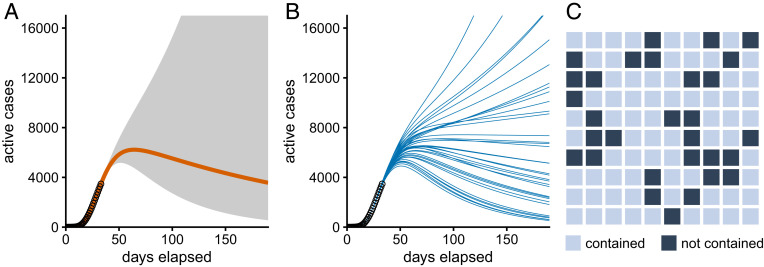
Visualizing uncertainty in predicting epidemic outcomes. All three panels display the same scenario, an epidemic that has been developing for 33 days. In this particular example, given the observed caseloads for the initial 33 days, there is a 70% chance that the epidemic is contained, and thus a 30% chance of unbounded growth. (A) Median outcome (solid orange line) with uncertainty cone indicating the range of outcomes that have 95% probability. (B) Sample of 35 independent, equally likely individual outcomes. (C) Frequency framing. Each square indicates one possible outcome. Light squares represent epidemics that are contained, and dark squares represent epidemics that are not contained. Simulation data courtesy of Mario Castro.
Comment on
-
The turning point and end of an expanding epidemic cannot be precisely forecast.Proc Natl Acad Sci U S A. 2020 Oct 20;117(42):26190-26196. doi: 10.1073/pnas.2007868117. Epub 2020 Oct 1. Proc Natl Acad Sci U S A. 2020. PMID: 33004629 Free PMC article.
References
-
- Juul J. L., Græsbøll K., Christiansen L. E., Lehmann S., Fixed-time descriptive statistics underestimate extremes of epidemic curve ensembles. arXiv:2007.05035 (9 July 2020).
-
- Bauer P., Thorpe A., Brunet G., The quiet revolution of numerical weather prediction. Nature 525, 47–55 (2015). - PubMed
Publication types
MeSH terms
LinkOut - more resources
Full Text Sources
