Innovative customized CAD/CAM nickel-titanium lingual retainer versus standard stainless-steel lingual retainer: A randomized controlled trial
- PMID: 33144526
- PMCID: PMC7642231
- DOI: 10.4041/kjod.2020.50.6.373
Innovative customized CAD/CAM nickel-titanium lingual retainer versus standard stainless-steel lingual retainer: A randomized controlled trial
Abstract
Objective: To compare computer-aided design and computer-aided manufacturing (CAD/CAM) customized nitinol retainers with standard stainlesssteel fixed retainers over a 12-month study period.
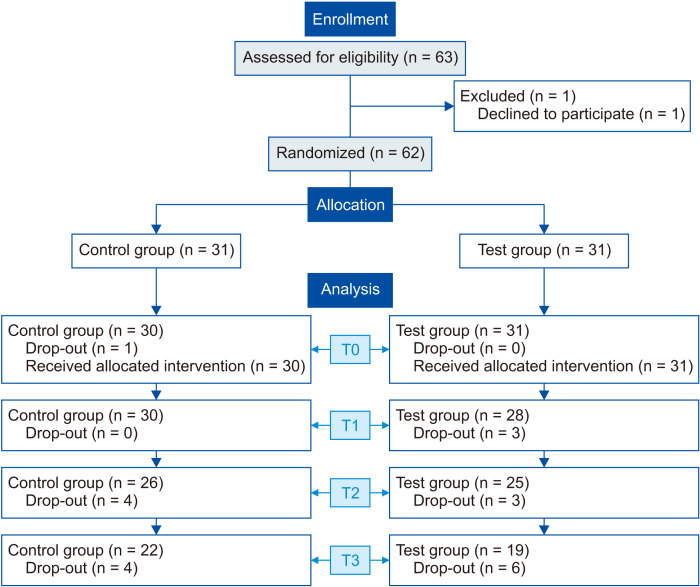
Methods: This randomized controlled trial (RCT) was conducted on 62 patients randomly allocated to a control group that received stainless-steel retainers or a test group that received customized CAD/CAM nickel-titanium retainers. Four time points were defined: retainer placement (T0) and 1-month (T1), 6-month (T2), and 12-month (T3) follow-up appointments. At each time point, Little's irregularity index (LII) (primary endpoint) and dental stability measurements such as intercanine width were recorded in addition to assessment of periodontal parameters. Radiological measurements such as the incisor mandibular plane angle (IMPA) were recorded at T0 and T3. Failure events (wire integrity or debonding) were assessed at each time point.
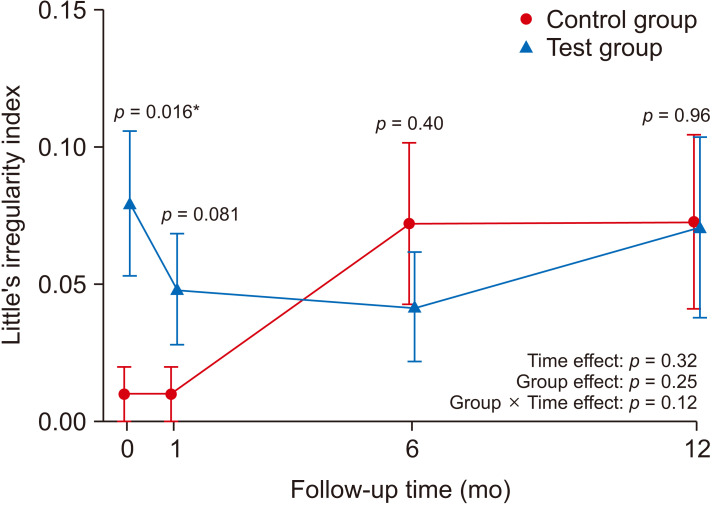
Results: From T0 to T3, LII and other dental measurements showed no significant differences between the two groups. The data for periodontal parameters remained stable over the study period, except for the gingival index, which was slightly, but significantly, higher in the test group at T3 (p = 0.039). The IMPA angle showed no intergroup difference. The two groups showed no significant difference in debonding events.
Conclusions: This RCT conducted over a 12-month period demonstrated no significant difference between customized CAD/CAM nickel-titanium lingual retainers and standard stainlesssteel lingual retainers in terms of dental anterior stability and retainer survival. Both retainers eventually appeared to be equally effective in maintaining periodontal health.
Keywords: CAD/CAM; Digital models; Randomized clinical trial; Retainer.
Conflict of interest statement
No potential conflict of interest relevant to this article was reported.
Figures
References
-
- Kravitz ND, Shirck JM. Bonded lingual retainers [Internet] Orthodontic Products; 2015. Nov, [cited 2020 Jul]. Available from: http://www.kravitzorthodontics.com/assets/pdfs/bonded-lingual-retainers.pdf .
LinkOut - more resources
Full Text Sources
Miscellaneous