. 2020 Nov 3;11(1):5553.
doi: 10.1038/s41467-020-19426-0.

Efficient population modification gene-drive rescue system in the malaria mosquito Anopheles stephensi

Affiliations

Efficient population modification gene-drive rescue system in the malaria mosquito Anopheles stephensi

Adriana Adolfi et al. Nat Commun. .

Abstract

Cas9/gRNA-mediated gene-drive systems have advanced development of genetic technologies for controlling vector-borne pathogen transmission. These technologies include population suppression approaches, genetic analogs of insecticidal techniques that reduce the number of insect vectors, and population modification (replacement/alteration) approaches, which interfere with competence to transmit pathogens. Here, we develop a recoded gene-drive rescue system for population modification of the malaria vector, Anopheles stephensi, that relieves the load in females caused by integration of the drive into the kynurenine hydroxylase gene by rescuing its function. Non-functional resistant alleles are eliminated via a dominantly-acting maternal effect combined with slower-acting standard negative selection, and rare functional resistant alleles do not prevent drive invasion. Small cage trials show that single releases of gene-drive males robustly result in efficient population modification with ≥95% of mosquitoes carrying the drive within 5-11 generations over a range of initial release ratios.


Conflict of interest statement

V.M.G. and E.B. have an equity interest in Synbal, Inc. and Agragene, Inc. companies that may potentially benefit from the research results, and serve on both companies’ Scientific Advisory Board and on the Board of Directors of Synbal, Inc. The terms of this arrangement have been reviewed and approved by the University of California, San Diego in accordance with its conflict-of-interest policies. Remaining authors declare no competing interests.

Figures
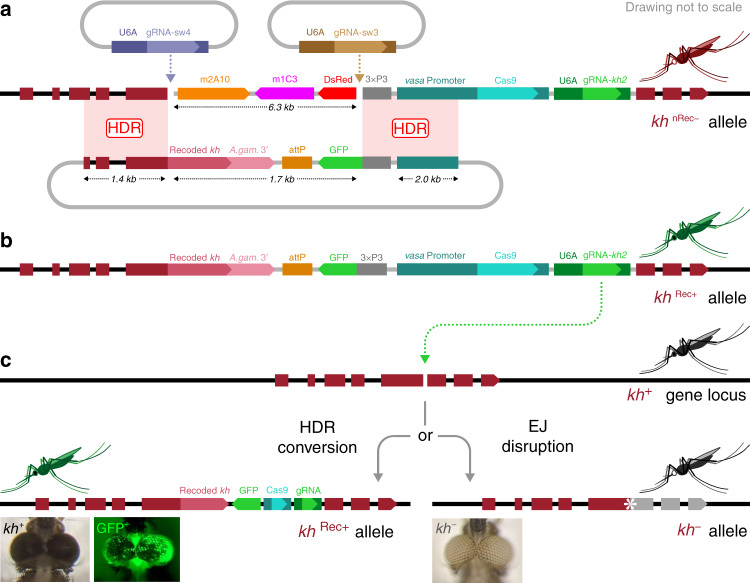
Fig. 1
Fig. 1. The Reckh gene drive.
a Swap strategy for Cas9/gRNA-mediated cassette exchange. Two plasmid-encoded gRNAs (top) guide cleavage in the genome of the white-eyed nRec mosquito line (khnRec–) (middle), leading to the excision of a fragment including the DsRed eye (3xP3) marker and the two antimalarial effectors m2A10 and m1C3. The HDR template plasmid (bottom) carries homology arms flanking either cut site, promoting the insertion of a GFP-marked donor template that carries a recoded portion of the kh gene followed by the 3′-end sequence of the An. gambiae kh gene including the 3′UTR (A.gam.3′) to minimize homology. b The insertion of this unit restores kh gene function while creating a sequence (khRec+) that is uncleavable by the endogenous drive components. c The Reckh gene-drive includes an An. stephensi codon-optimized Cas9 driven by the germline-specific vasa promoter from An. stephensi and a gRNA (gRNA-kh2) directed to the fifth exon of the unmodified kh+ gene (top) regulated by the ubiquitous promoter of the An. stephensi U6A gene. The cut in the kh gene of the Reckh mosquito germline can be repaired by drive integration via HDR (homology-directed repair) or by the less desirable EJ (end-joining) pathway (bottom). HDR results in the integration of the drive cassette that maintains kh gene function at the integration site (khRec+), while EJ usually causes the formation of loss-of-function alleles (kh). When function is lost in both copies of the gene, individuals with white eyes are produced. kh, kynurenine hydroxylase gene; attP, φC31 recombination site; U6A, RNA polymerase-III promoter; gRNA, guide RNAs; Cas9, Cas9 open reading frame; vasa, vasa promoter; 3xP3, eye-marker promoter; GFP, green fluorescent protein; dominant marker gene. The horizontal dimension of the mosquito heads at the eyes in the images is ~1 mm.
Fig. 2
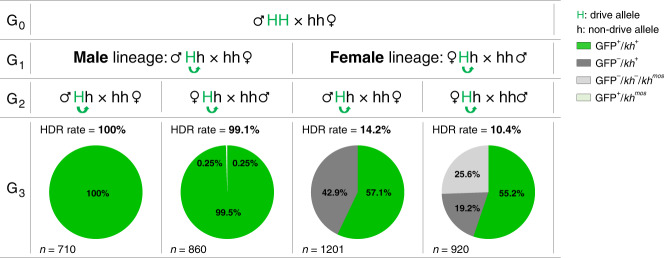
Fig. 2. Inheritance of Reckh through paternal and maternal lineages.
Charts represent the proportion of individuals inheriting the Reckh drive element (GFP+, in green) from heterozygous parents originating from drive males or drive females. The proportions of individuals that have not inherited the drive (GFP) element and have WT black eyes (kh+) (dark grey) and those with white (kh) or mosaic (khmos) eyes (light grey) are also shown. Rare (n = 2) drive individuals with mosaic eyes (GFP+/khmos) are depicted in light green. “H” and “h” refer to the mosquito genome at the kh locus, where “H” is the Reckh drive allele and “h” is a non-drive allele. The green arrows show the potential for conversion of the h allele in the germline. The corresponding HDR rate, i.e., the proportion of h alleles converted to H alleles is reported. Each cross was performed en masse (30 females and 15 males) in triplicate cages using drive individuals mated to WT and by screening a representative subset of individuals (n) generated in the progeny. The numbers reported are pooled from the three replicate cages. Raw data for these crosses are reported in Supplementary Table 2. Data on transmission and HDR rates reported in the “Results” section refer to the averages of progeny from both mothers and fathers originating from a male or a female drive individual.
Fig. 3
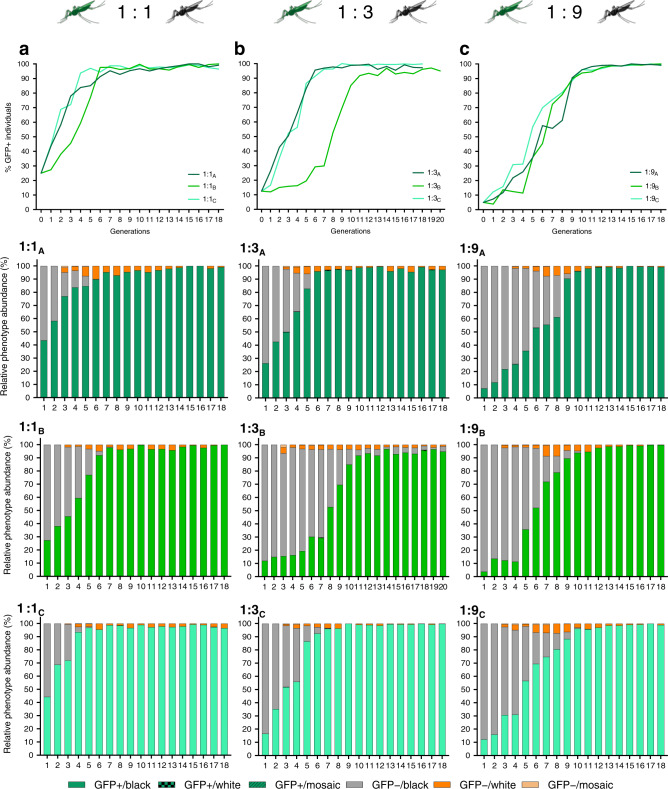
Fig. 3. Dynamics of Reckh over 18–20 discrete generations in caged populations seeded with three release ratios of Reckh:WT males.
Top row: drive efficiency shown as percentage of GFP+ individuals (Y-axes) at each generation (X-axes) in triplicate cages seeded with 1:1 (a), 1:3 (b), and 1:9 (c) Reckh:WT male ratios. Bottom three rows: relative proportion of eye phenotypes (Y-axes) observed in a sample of ~500 individuals reported for each generation (X-axes) for all cages. Individuals containing the drive are shown in green, those with WT phenotype in grey, and non-drive individuals with white or mosaic eyes in dark and light orange, respectively. A schematic of the protocol used is reported in Supplementary Fig. 2 and raw data for each cage in Supplementary Tables 6–8.
Fig. 4
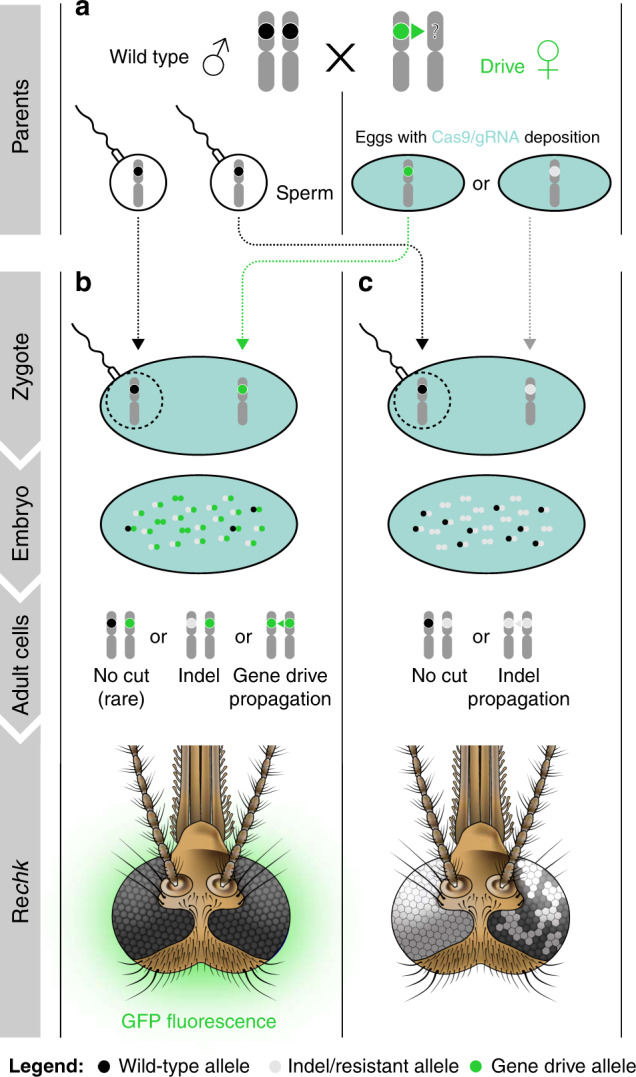
Fig. 4. Effects of lethal/sterile mosaicism on the Reckh gene-drive system.
a A female heterozygous for the drive can produce eggs carrying a copy of the drive (green circle, khRec+) or eggs carrying an EJ-induced nonfunctional resistant allele (white circle, kh). Both types of eggs carry maternally deposited cytoplasmic Cas9/gRNA complexes (light blue filling) that can act on the incoming WT paternal allele (black circle, kh+). b The soma of individuals inheriting a copy of the drive from their mothers is a mosaic of cells with varying proportions of genotypes khRec+/kh, khRec+/kh+, and khRec+/khRec+. Reckh individuals emerging from such embryos have at least one functional copy of kh provided by the drive system (khRec+), therefore have GFP+/black eyes and females are fit for reproduction. c The soma of individuals inheriting an EJ nonfunctional mutation from their drive mothers is a mosaic of cells with genotypes kh/kh or kh/kh+. The ability of females emerging from such embryos to survive and reproduce depends on the proportion of somatic cells with genotype kh/kh. These individuals may display mosaic or white-eye phenotype if mutations affect the cells forming the eyes. Diploid cells in (b) and (c) that become germline progenitors also may be affected by mosaicism, which can affect drive capabilities.
Fig. 5
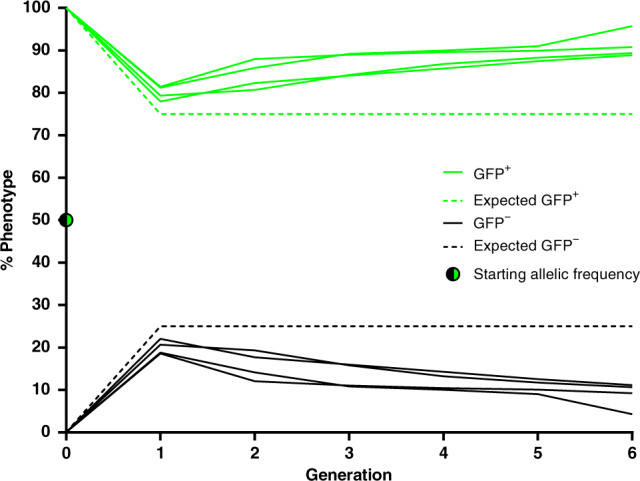
Fig. 5. Competition between the drive khRec+ and the resistant functional kh+R alleles in caged populations.
Four independent cages were set up using 100 male and 100 female khRec+/kh+R mosquitoes each, which corresponds to an initial allelic frequency of 50%, marked using a half green-half black dot at generation G0. Eye fluorescence (GFP+ or GFP) and color (black, white, or mosaic) frequencies associated with each modified kh allele were scored at every generation for six consecutive nonoverlapping generations. The proportion of GFP+ individuals (genotype khRec+/khRec+ or khRec+/kh+R) in the replicate cages is depicted by green lines and its expected frequency in the presence of equal competition between the two alleles (75%) as a dashed green line. The proportion of GFP individuals (genotype kh+R/kh+R) is depicted as black lines and its expected frequency in the presence of equal competition between the two alleles (25%) as a dashed black line. All individuals screened exhibted  fully WT black eyes. Raw data for these crosses are reported in Supplementary Table 13.
Fig. 6
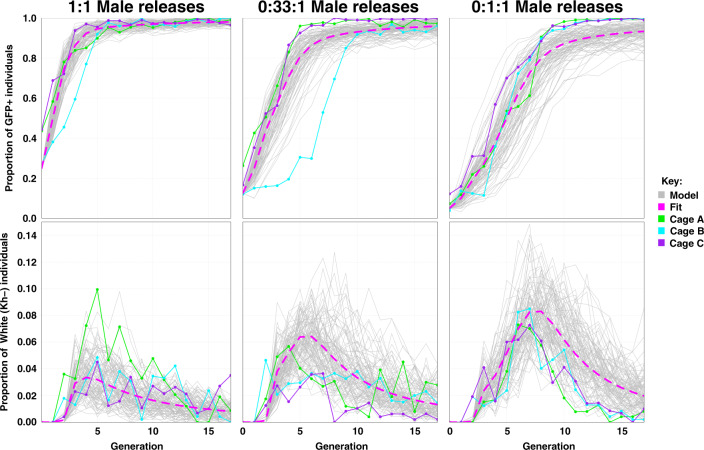
Fig. 6. Observed and model-predicted dynamics of GFP+ and kh phenotypes in the Reckh cage experiments.
Solid green, blue, and purple lines represent the experimental data over 18 generations observed in 3 replicates (Cages A–C) with release ratios of Reckh:WT males of 1:1, 1:3, and 1:9, respectively. Dotted pink lines represent the fitted deterministic model (Fit), and grey lines are 100 stochastic realizations of the fitted model for each release ratio (Model). X-axes report the generation number after release and Y-axes the proportion of each eye phenotype. The GFP+ phenotype results from having at least one copy of the drive allele and hence reflects the spread of the gene-drive system to full or near full introduction for all experiments. The kh phenotype is associated with having no copies of the WT, Reckh, or functional resistant alleles (i.e., having two copies of the nonfunctional resistant allele) and reflects the low-level emergence and gradual elimination of this allele from the population due to its load in homozygous females. The stochastic model captures the variability inherent in the experimental process and reflects some of the variability observed in the early stages of the spread of the gene-drive allele.

References

    1. Walker PGT, Griffin JT, Ferguson NM, Ghani AC. Estimating the most efficient allocation of interventions to achieve reductions in Plasmodium falciparum malaria burden and transmission in Africa: a modelling study. Lancet Glob. Health. 2016;4:e474–e484. - PubMed
    1. Gantz VM, Bier E. The dawn of active genetics. Bioessays. 2016;38:50–63. - PMC - PubMed
    1. Gantz VM, Bier E. The mutagenic chain reaction: a method for converting heterozygous to homozygous mutations. Science. 2015;348:442–444. - PMC - PubMed
    1. Macias VM, Ohm JR, Rasgon JL. Gene drive for mosquito control: Where did it come from and where are we headed? Int. J. Environ. Res. Public Health. 2017;14:1006. - PMC - PubMed
    1. Hammond A, et al. A CRISPR-Cas9 gene drive system targeting female reproduction in the malaria mosquito vector Anopheles gambiae. Nat. Biotechnol. 2015;34:78–83. - PMC - PubMed

Publication types

Substances