. 2020 Nov 3;10(1):18899.
doi: 10.1038/s41598-020-76043-z.

Pooling RT-qPCR testing for SARS-CoV-2 in 1000 individuals of healthy and infection-suspected patients

Affiliations

Pooling RT-qPCR testing for SARS-CoV-2 in 1000 individuals of healthy and infection-suspected patients

Yosuke Hirotsu et al. Sci Rep. .

Abstract

Severe acute respiratory coronavirus 2 (SARS-CoV-2) testing reagents are expected to become scarce worldwide. However, little is known regarding whether pooling of samples accurately detects SARS-CoV-2. To validate the feasibility of pooling samples, serial dilution analysis and spike-in experiments were conducted using synthetic DNA and nucleic acids extracted from SARS-CoV-2-positive and -negative patients. Furthermore, we studied 1000 individuals, 667 of whom were "healthy" individuals (195 healthcare workers and 472 hospitalized patients with disorders other than COVID-19 infection), and 333 infection-suspected patients with cough and fever. Serial dilution analysis showed a limit of detection of around 10-100 viral genome copies according to the protocol of the National Institute of Infectious Diseases, Japan. Spike-in experiments demonstrated that RT-qPCR detected positive signals in pooled samples with SARS-CoV-2-negative and -positive patients at 5-, 10-, 20-fold dilutions. By screening with this pooling strategy, by the end of April 2020 there were 12 SARS-CoV-2-positive patients in 333 infection-suspected patients (3.6%) and zero in 667 "healthy" controls. We obtained these results with a total of 538 runs using the pooling strategy, compared with 1000 standard runs. In a prospective study, we successfully detected SARS-CoV-2 using 10- to 20-fold diluted samples of nasopharyngeal swabs from eighteen COVID-19 patients with wide ranges of viral load. Pooling sample is feasible for conserving test reagents and detecting SARS-CoV-2 in clinical settings. This strategy will help us to research the prevalence infected individuals and provide infected-status information to prevent the spread of the virus and nosocomial transmission.


Conflict of interest statement

The authors declare no competing interests.

Figures
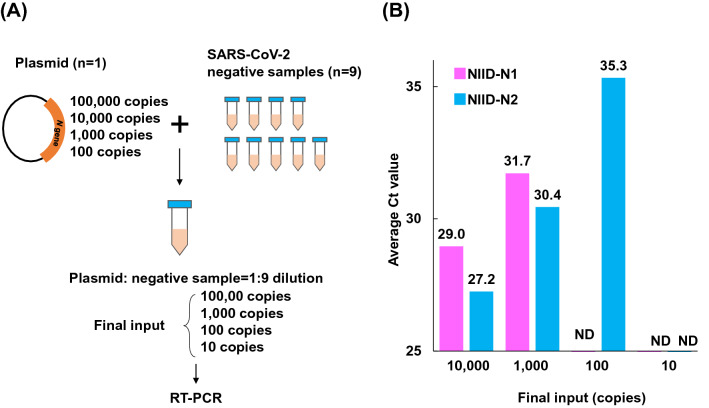
Figure 1
Figure 1
Serial dilution analysis with synthetic plasmids and nasopharyngeal swabs from SARS-CoV-2 negative individuals. (A) Scheme of preparing serial dilution solutions. The synthetic plasmid containing the N gene of SARS-CoV-2 were diluted to concentrations of 100,000, 10,000, 1000 and 100 copies. These plasmid solutions were then tenfold diluted with nucleic acids extracted from nasopharyngeal swabs from SARS-CoV-2 negative individuals (n = 9). RT-qPCR analysis had already validated that no amplification was observed in these negative patients in advance. RT-qPCR analyses were conducted using serial dilution solution with final input copy numbers (range 10–10,000). (B) Average threshold cycle (Ct) was determined by RT-qPCR. Two sets of primers and probes (pink, NIID-N1; blue, NIID-N2) were used according to the NIID, Japan, protocol. The experiment was conducted three times in duplicate.
Figure 2
Figure 2
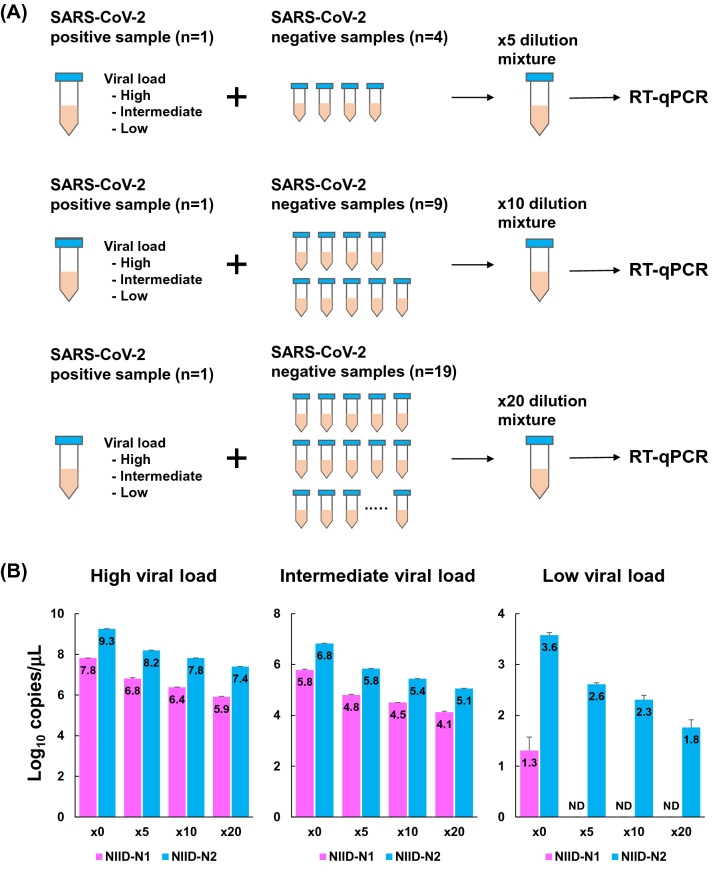
Spike-in assay using SARS-CoV-2-positive and -negative nasopharyngeal swabs from patients. (A) Scheme of preparing spike-in solutions. SARS-CoV-2-positive samples with high, intermediate and low viral copies were used. These different viral loads were diluted with 4, 9 and 19 SARS-CoV-2-negative samples. The final solution was made at × 5, × 10 and × 20 dilutions and used for RT-qPCR analysis. (B) RT-qPCR analysis determined the copy numbers in the spike-in solutions. Each of the three patients had a different viral load corresponding to low, intermediate, and high. These SARS-CoV-2 positive samples were diluted with negative samples. The assay was used with NIID-N1 (pink) and NIID-N2 (blue). Bar plot shows the copy number (log10 copies/μL) in original (× 0) and diluted (× 5, × 10 and × 20) samples. All data represent the mean ± SD.
Figure 3
Figure 3
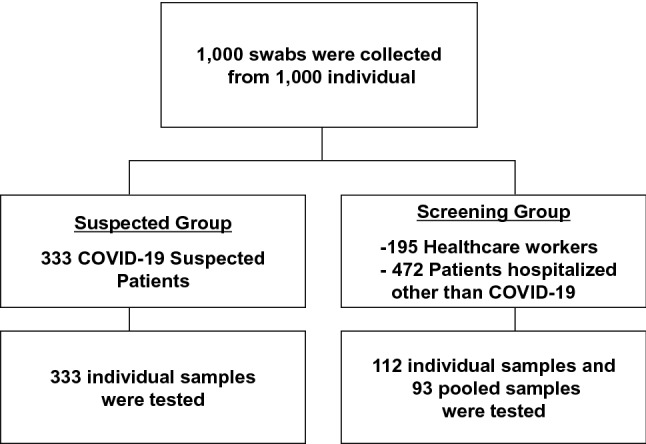
Flow diagram for testing of 1000 individuals. The flow diagram illustrates the 1000 individuals who were divided into suspected or screening groups. The suspected group included 333 suspected COVID-19 patients. The screening group included 195 healthcare workers and 472 patients hospitalized for conditions other than COVID-19.
Figure 4
Figure 4
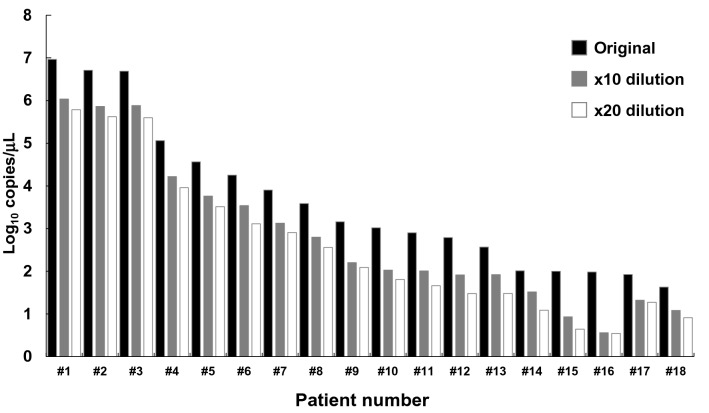
Pooling strategy detected SARS-CoV-2 in samples with a wide range of viral load. We diluted SARS-CoV-2 positive samples with negative samples. The original sample (black box), × 10 diluted (gray box) and × 20 diluted (white box) samples were tested by RT-qPCR. All samples were collected from 18 patients (#1–18) with high to low viral load.

References

    1. Li Q, et al. Early transmission dynamics in Wuhan, China, of novel coronavirus-infected pneumonia. N. Engl. J. Med. 2020;382:1199–1207. doi: 10.1056/NEJMoa2001316. - DOI - PMC - PubMed
    1. World Health Organization, Coronavirus disease (COVID-2019) situation reports. https://www.who.int/emergencies/diseases/novel-coronavirus-2019/situatio....
    1. Onder G, Rezza G, Brusaferro S. Case-fatality rate and characteristics of patients dying in relation to COVID-19 in Italy. JAMA. 2020;323:1775–1776. - PubMed
    1. Li R, et al. Substantial undocumented infection facilitates the rapid dissemination of novel coronavirus (SARS-CoV2) Science. 2020;368:489–493. doi: 10.1126/science.abb3221. - DOI - PMC - PubMed
    1. Moghadas SM, et al. Projecting hospital utilization during the COVID-19 outbreaks in the United States. Proc. Natl. Acad. Sci. U. S. A. 2020;117:9122–9126. doi: 10.1073/pnas.2004064117. - DOI - PMC - PubMed

Publication types

MeSH terms