


Intrinsic brain activity associated with eye gaze during mother-child interaction
- PMID: 33144655
- PMCID: PMC7642303
- DOI: 10.1038/s41598-020-76044-y
Intrinsic brain activity associated with eye gaze during mother-child interaction
Abstract
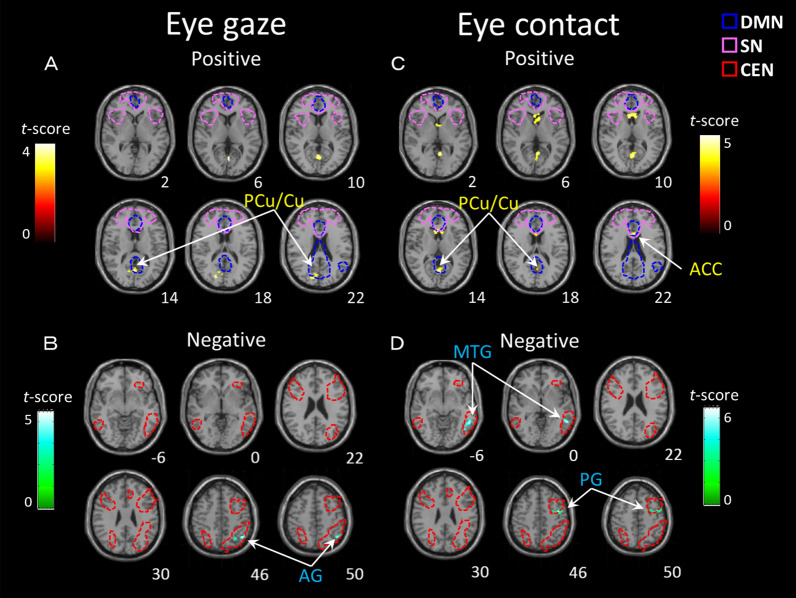
Mother-child interactions impact child social development and psychological health. This study focused on eye-gaze interactions, especially eye contact as synchronized gaze, which is an important non-verbal communication tool in human interactions. We performed brain-image analysis of mothers and children using resting-state functional magnetic resonance imaging and quantitatively evaluated the quality of mother-child interactions using the Interaction Rating Scale to investigate how it is related to the frequency of mother-child eye contact. As a result, we found a positive correlation between the frequency of eye gaze and the right anterior insula (AI) or middle frontal gyrus in children and a positive correlation with the anterior cingulate cortex (ACC) and precuneus/cuneus in mothers. Especially, when eye contact was made, the association with the right AI in children and ACC in mothers was retained, suggesting the involvement of the salience network responsible for modulating internal and external cognition. In addition, the frequency of eye contact was positively associated with the quality of mother-child interaction. These results suggest that the salience network is a major candidate for the neural basis involved in maintaining efficient eye contact and that it plays an important role in establishing positive mother-child interactions.
Conflict of interest statement
The authors declare no competing interests.
Figures

References
-
- Hooper LM. The application of attachment theory and family systems theory to the phenomena of parentification. Fam. J. 2007;15:217–223. doi: 10.1177/1066480707301290. - DOI
-
- Schilbach L. Eye to eye, face to face and brain to brain: novel approaches to study the behavioral dynamics and neural mechanisms of social interactions. Curr. Opin. Behav. Sci. 2015;3:130–135. doi: 10.1016/j.cobeha.2015.03.006. - DOI
Publication types
MeSH terms
LinkOut - more resources
Full Text Sources
Research Materials
