. 2020 Oct 28;6(10):1789-1799.
doi: 10.1021/acscentsci.0c00680. Epub 2020 Oct 5.

Synthetic Elaboration of Native DNA by RASS (SENDR)

Affiliations

Synthetic Elaboration of Native DNA by RASS (SENDR)

Dillon T Flood et al. ACS Cent Sci. .

Erratum in

Abstract

Controlled site-specific bioconjugation through chemical methods to native DNA remains an unanswered challenge. Herein, we report a simple solution to achieve this conjugation through the tactical combination of two recently developed technologies: one for the manipulation of DNA in organic media and another for the chemoselective labeling of alcohols. Reversible adsorption of solid support (RASS) is employed to immobilize DNA and facilitate its transfer into dry acetonitrile. Subsequent reaction with P(V)-based Ψ reagents takes place in high yield with exquisite selectivity for the exposed 3' or 5' alcohols on DNA. This two-stage process, dubbed SENDR for Synthetic Elaboration of Native DNA by RASS, can be applied to a multitude of DNA conformations and sequences with a variety of functionalized Ψ reagents to generate useful constructs.


Conflict of interest statement

The authors declare no competing financial interest.

Figures
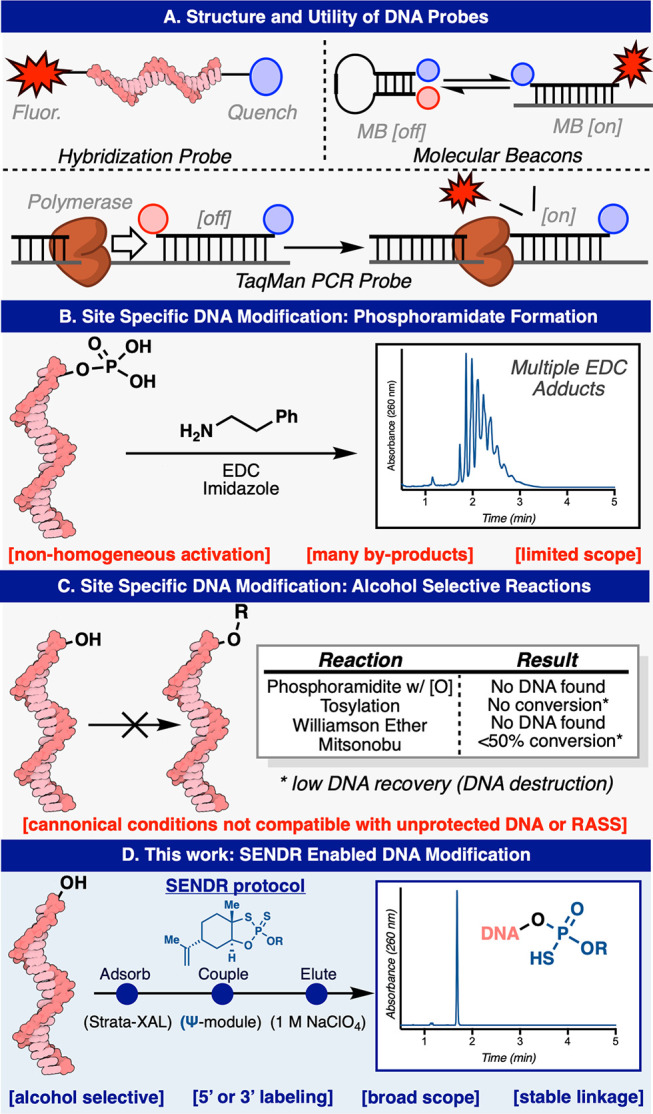
Figure 1
Figure 1
Modification of native DNA. (A) Structure and utility of some DNA hybridization probes (B) State of the art in site selective chemical DNA bioconjugation: Phosphoramidate formation. (C) Classical organic alcohol selective reactions. (D) This work: SENDR.
Figure 2
Figure 2
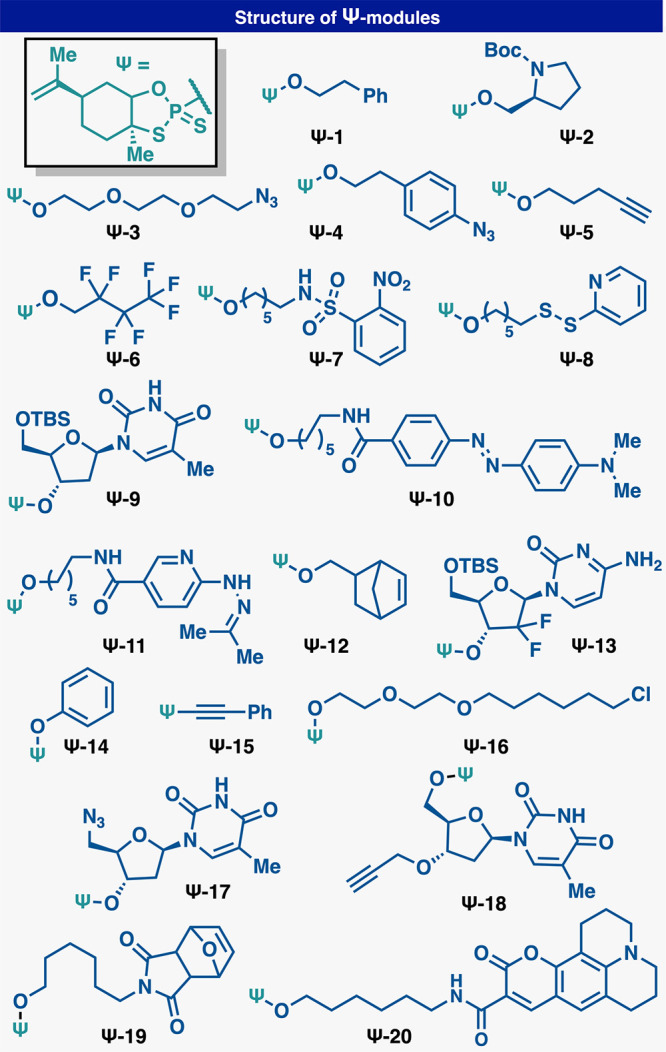
Ψ-modules synthesized for this study.
Figure 3
Figure 3
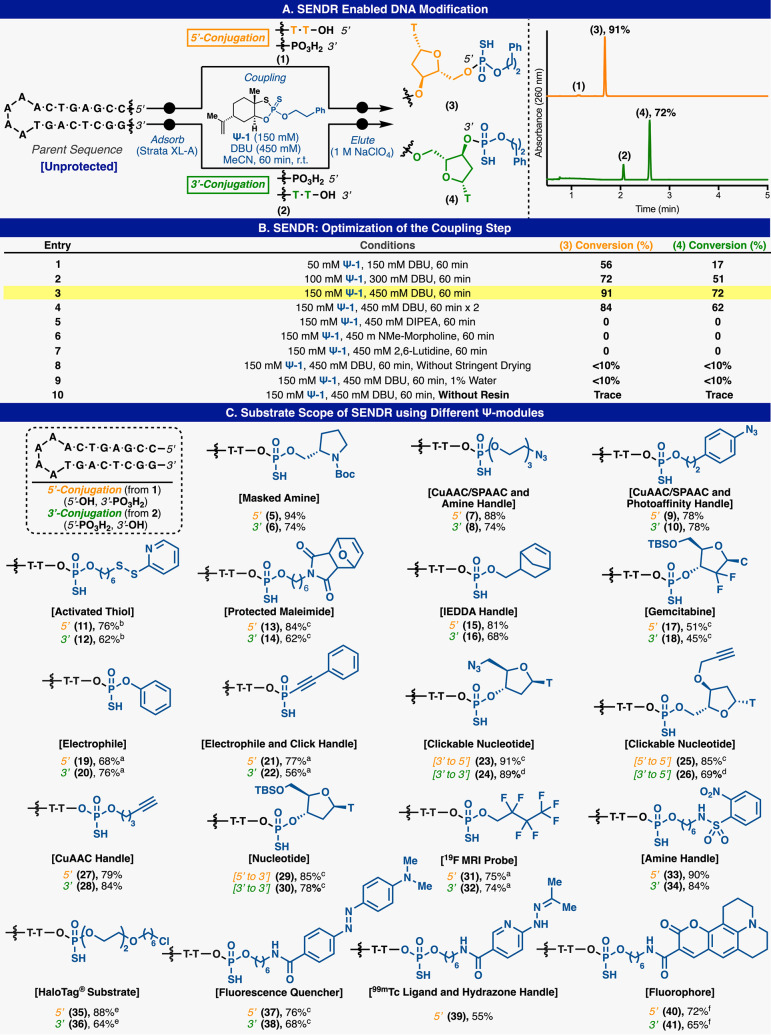
P(V) based DNA modification. (A) SENDR enabled DNA modification. (B) Optimization of the coupling step. (C) Substrate scope. Conversions based on HPLC integration of a total absorbance signal at 260 nm. Unless otherwise noted, standard reaction conditions were applied; Ψ-module (150 mM), DBU (450 mM), in dry MeCN (250 μL), 60 min, r.t. while adsorbed to Strata XL-A. a75 mM PSI and 225 mM DBU, b45 °C,c37 °C. d200 mM PSI at 50 °C. e300 mM PSI at 37 °C. DNA loading (adsorption step) performed in PBS. Resin washed with DMA (×2) and THF (×3). Resin dried under a vacuum 2 h. Elution was performed using elution buffer 1 M NaClO4, 40 mM Tris pH 8.5, 20% MeOH. fIn-situ protocol (see Supporting Information for details).
Figure 4
Figure 4
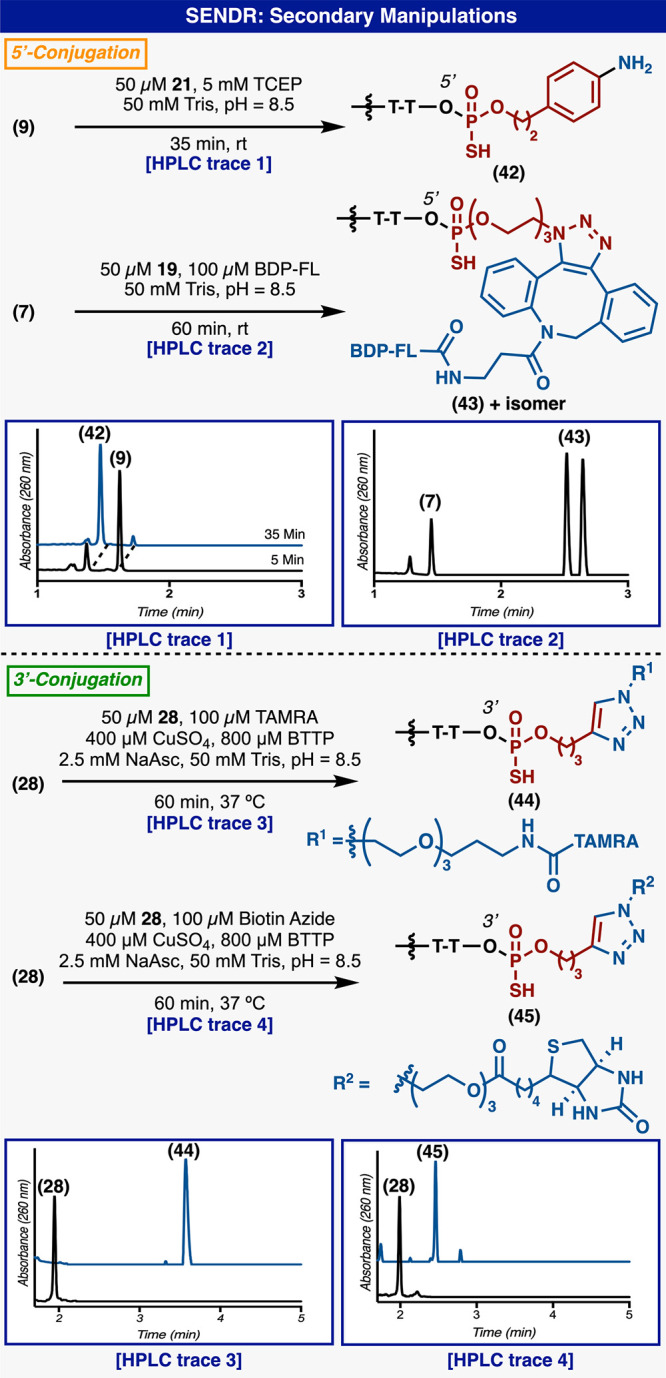
Downstream synthetic manipulations of SENDR-derived DNA-small molecule hybrids (ligated at 3′ or 5′).
Figure 5
Figure 5
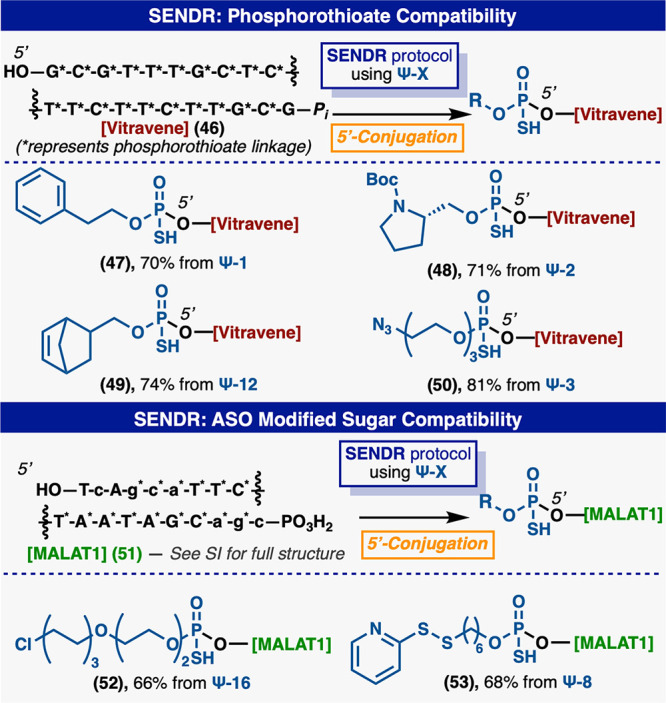
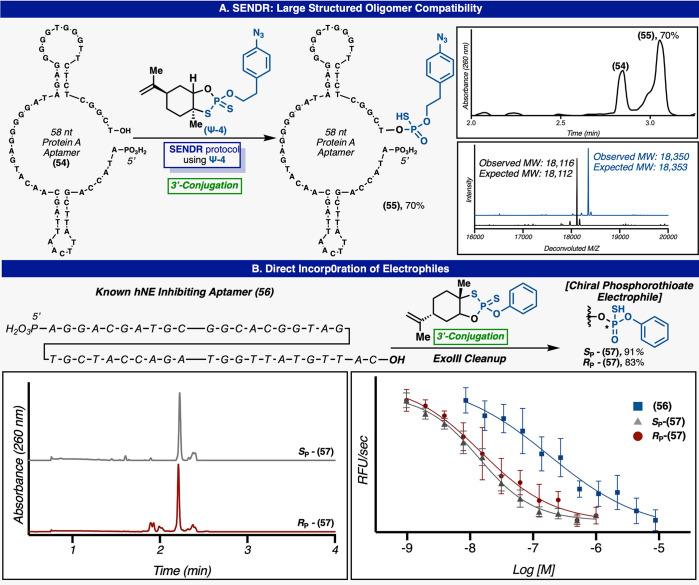
(Top) SENDR compatibility with PS DNA. (Bottom) SENDR compatibility with larger structured oligomers. Standard reaction conditions were applied; Ψ-module (150 mM), DBU (450 mM), in dry MeCN (250 μL), 60 min, 37 °C while adsorbed to Strata XL-A.
Figure 6
Figure 6
SENDR aptamer modification. (A) Standard reaction conditions were applied; Ψ-module (150 mM), DBU (450 mM), in dry MeCN (250 μL), 60 min, r.t. while adsorbed to Strata XL-A. (B) Direct incorporation of electrophiles into aptamers and their inhibition of protein targets. The reaction conditions that were applied: Ψ-module (150 mM), DBU (450 mM), in dry MeCN (250 μL), 60 min, 37 °C, while adsorbed to Strata XL-A.
Figure 7
Figure 7
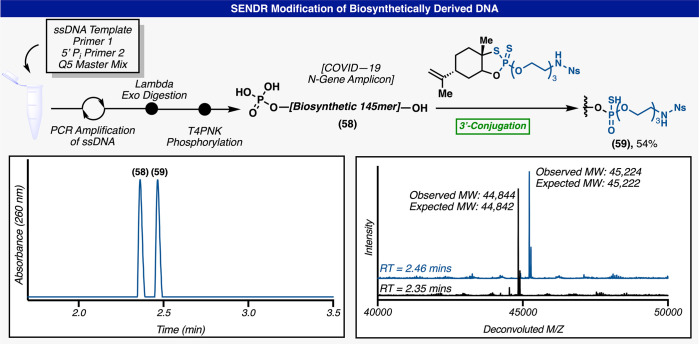
SENDR on biosynthetically derived DNA. Scheme representing the biosynthetic steps to produce the COVID-19 N gene amplicon (59). HPLC chromatogram of the SENDR reaction. Deconvoluted mass spectrum of the starting material peak and the product peak.
Figure 8
Figure 8
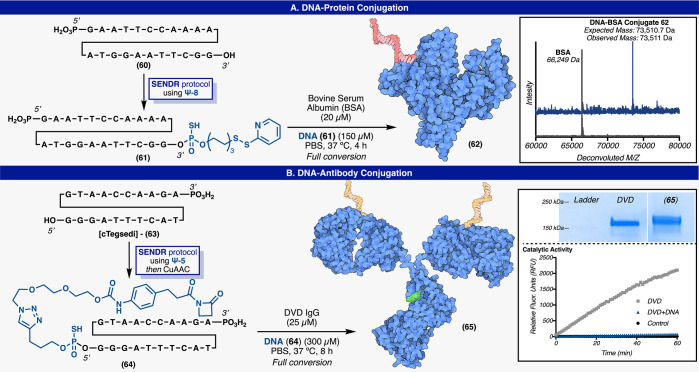
SENDR enabled DNA–protein conjugation. (A) DNA–BSA conjugation (ESI-TOF mass spectra of starting material and product). (B) cTegsedi–DVD conjugation (SDS PAGE and catalytic methodol fluorescence assay including control experiments). SENDR: DNA–protein conjugates.
Figure 9
Figure 9
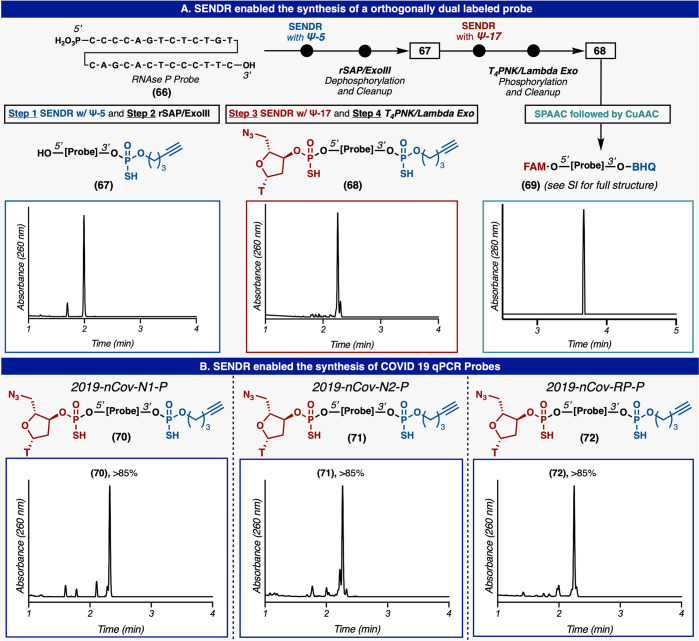
Creation of dual labeled DNA probes. (A) The synthesis of a TaqMan probe for RNaseP. (B) Synthesis of the COVID 19 qPCR panel of probes.

References

    1. Kolpashchikov D. M. Evolution of Hybridization Probes to DNA Machines and Robots. Acc. Chem. Res. 2019, 52 (7), 1949–1956. 10.1021/acs.accounts.9b00098. - DOI - PubMed
    1. Nieves D. J.; Gaus K.; Baker M. A. B. DNA-Based Super-Resolution Microscopy: DNA-PAINT. Genes 2018, 9 (12), 621.10.3390/genes9120621. - DOI - PMC - PubMed
    1. Jungmann R.; Avendano M. S.; Woehrstein J. B.; Dai M.; Shih W. M.; Yin P. Multiplexed 3D cellular super-resolution imaging with DNA-PAINT and Exchange-PAINT. Nat. Methods 2014, 11 (3), 313–318. 10.1038/nmeth.2835. - DOI - PMC - PubMed
    1. Jungmann R.; Steinhauer C.; Scheible M.; Kuzyk A.; Tinnefeld P.; Simmel F. C. Single-molecule kinetics and super-resolution microscopy by fluorescence imaging of transient binding on DNA origami. Nano Lett. 2010, 10 (11), 4756–4761. 10.1021/nl103427w. - DOI - PubMed
    1. Schnitzbauer J.; Strauss M. T.; Schlichthaerle T.; Schueder F.; Jungmann R. Super-resolution microscopy with DNA-PAINT. Nat. Protoc. 2017, 12 (6), 1198–1228. 10.1038/nprot.2017.024. - DOI - PubMed