


Deep learning from "passive feeding" to "selective eating" of real-world data
- PMID: 33145439
- PMCID: PMC7603327
- DOI: 10.1038/s41746-020-00350-y
Deep learning from "passive feeding" to "selective eating" of real-world data
Abstract
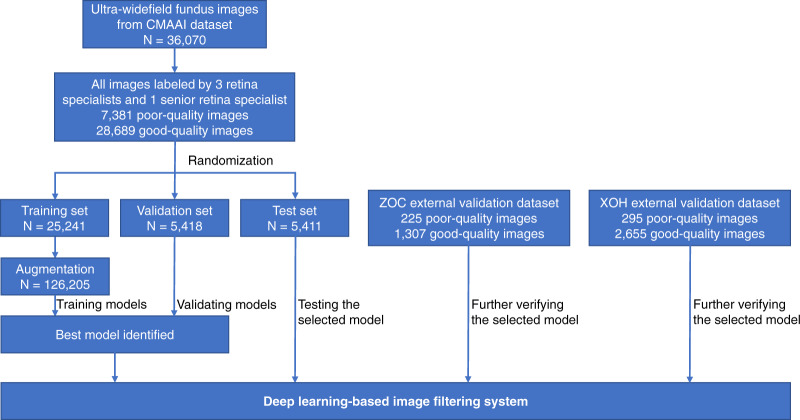
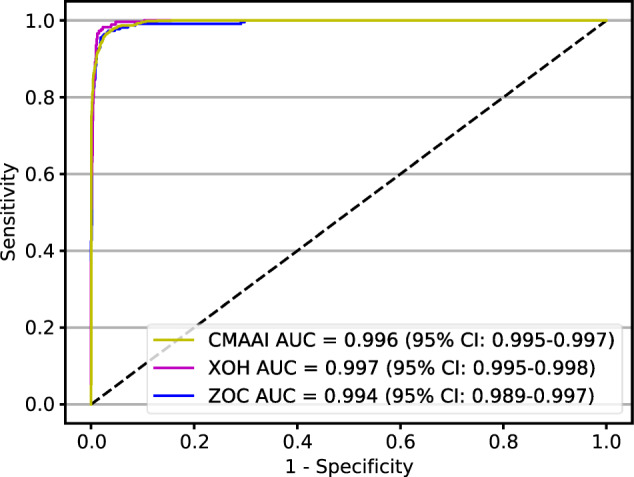
Artificial intelligence (AI) based on deep learning has shown excellent diagnostic performance in detecting various diseases with good-quality clinical images. Recently, AI diagnostic systems developed from ultra-widefield fundus (UWF) images have become popular standard-of-care tools in screening for ocular fundus diseases. However, in real-world settings, these systems must base their diagnoses on images with uncontrolled quality ("passive feeding"), leading to uncertainty about their performance. Here, using 40,562 UWF images, we develop a deep learning-based image filtering system (DLIFS) for detecting and filtering out poor-quality images in an automated fashion such that only good-quality images are transferred to the subsequent AI diagnostic system ("selective eating"). In three independent datasets from different clinical institutions, the DLIFS performed well with sensitivities of 96.9%, 95.6% and 96.6%, and specificities of 96.6%, 97.9% and 98.8%, respectively. Furthermore, we show that the application of our DLIFS significantly improves the performance of established AI diagnostic systems in real-world settings. Our work demonstrates that "selective eating" of real-world data is necessary and needs to be considered in the development of image-based AI systems.
Keywords: Medical imaging; Translational research.
© The Author(s) 2020.
Conflict of interest statement
Competing interestsThe authors declare no competing interests.
Figures


References
LinkOut - more resources
Full Text Sources
