


Generating Multibillion Chemical Space of Readily Accessible Screening Compounds
- PMID: 33145486
- PMCID: PMC7593547
- DOI: 10.1016/j.isci.2020.101681
Generating Multibillion Chemical Space of Readily Accessible Screening Compounds
Erratum in
-
Erratum: Generating Multibillion Chemical Space of Readily Accessible Screening Compounds.iScience. 2020 Dec 4;23(12):101873. doi: 10.1016/j.isci.2020.101873. eCollection 2020 Dec 18. iScience. 2020. PMID: 33313496 Free PMC article.
Abstract
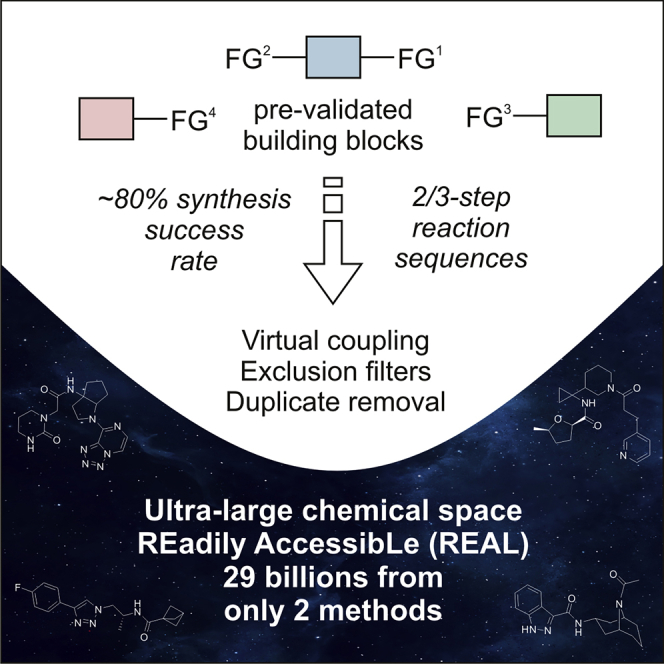
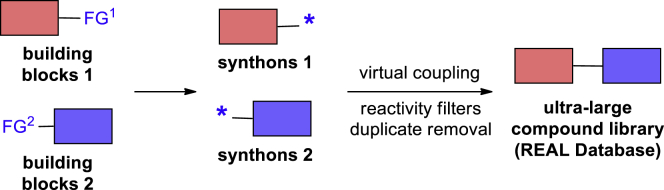
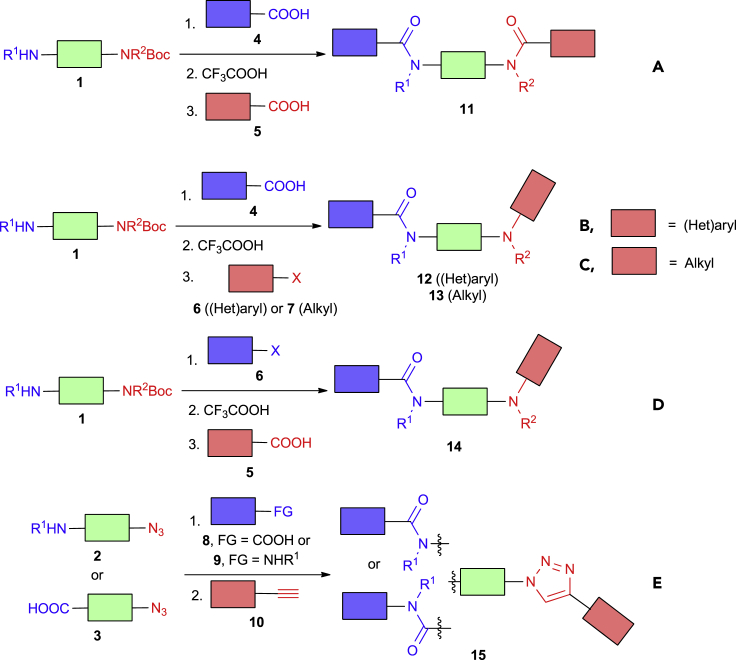
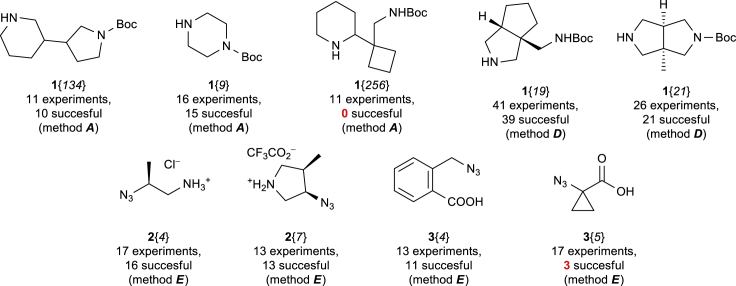
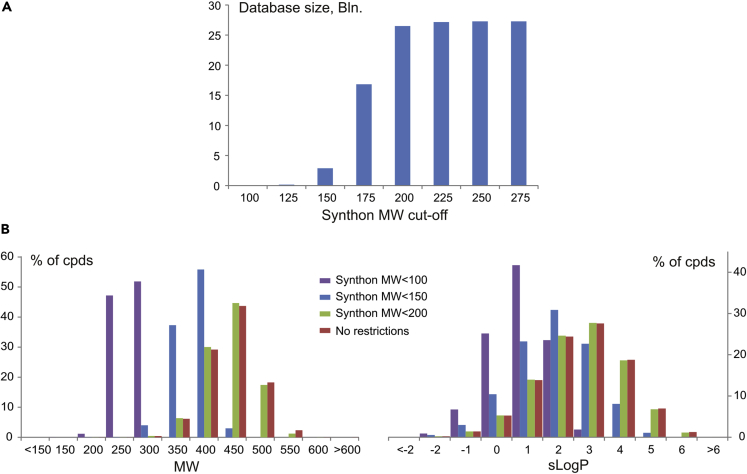
An approach to the generation of ultra-large chemical libraries of readily accessible ("REAL") compounds is described. The strategy is based on the use of two- or three-step three-component reaction sequences and available starting materials with pre-validated chemical reactivity. After the preliminary parallel experiments, the methods with at least ∼80% synthesis success rate (such as acylation - deprotection - acylation of monoprotected diamines or amide formation - click reaction with functionalized azides) can be selected and used to generate the target chemical space. It is shown that by using only on the two aforementioned reaction sequences, a nearly 29-billion compound library is easily obtained. According to the predicted physico-chemical descriptor values, the generated chemical space contains large fractions of both drug-like and "beyond rule-of-five" members, whereas the strictest lead-likeness criteria (the so-called Churcher's rules) are met by the lesser part, which still exceeds 22 million.
Keywords: Chemical Compound; Cheminformatics; Computational Chemistry by Subject.
© 2020 The Author(s).
Conflict of interest statement
The authors declare no competing interests.
Figures


References
-
- Boehm M., Wu T.Y., Haussen H., Lemmen C. Similarity searching and scaffold hopping in synthetically accessible combinatorial chemistry spaces. J. Med. Chem. 2008;51:2468–2480. - PubMed
-
- Brown N., Ertl P., Lewis R., Luksch T., Reker D., Schneider N. Artificial intelligence in chemistry and drug design. J. Comput. Aided. Mol. Des. 2020;34:709–715. - PubMed
-
- DeGoey D.A., Chen H.-J.J., Cox P.B., Wendt M.D. Beyond the rule of 5: lessons learned from AbbVie’s drugs and compound collection. J. Med. Chem. 2018;61:2636–2651. - PubMed
-
- Dobson C.M. Chemical space and biology. Nature. 2004;432:824–828. - PubMed
-
- Enamine REAL compounds (2020). Available at: https://enamine.net/library-synthesis/real-compounds.
Grants and funding
LinkOut - more resources
Full Text Sources
Other Literature Sources
Miscellaneous
