


Estimating the Year Each State in the United States Will Achieve the World Health Organization's Elimination Targets for Hepatitis C
- PMID: 33145648
- PMCID: PMC7609357
- DOI: 10.1007/s12325-020-01535-3
Estimating the Year Each State in the United States Will Achieve the World Health Organization's Elimination Targets for Hepatitis C
Abstract
Introduction: Although hepatitis C virus (HCV) infection remains a major clinical, economic, and societal burden, the development of curative antiviral therapy may accelerate the path toward elimination. This analysis assessed the progress of United States (US) states towards achieving the World Health Organization's (WHO) 2030 HCV elimination targets for incidence, mortality, diagnosis, and treatment.
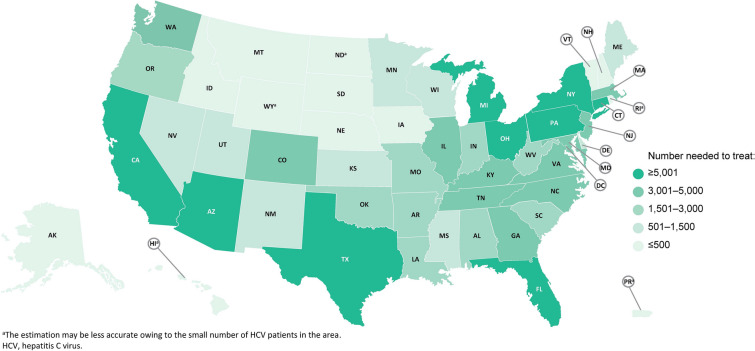
Methods: A previously published Markov model was used to simulate HCV progression over time to estimate the path to HCV elimination in each state based on prevalence, annual treatment, and diagnosis inputs from two large US laboratory datasets from January 2013 to December 2017. State-specific fibrosis stage restrictions on treatment in 2017 were included. The model estimated the year individual states would meet the WHO targets for diagnosing 90% of the HCV-infected population, treating 80% of the eligible population, reducing new HCV infections by 80%, and reducing HCV-related deaths by 65%. The minimum number of annual treatments needed between 2020 and 2030 to achieve the WHO treatment target was also calculated.
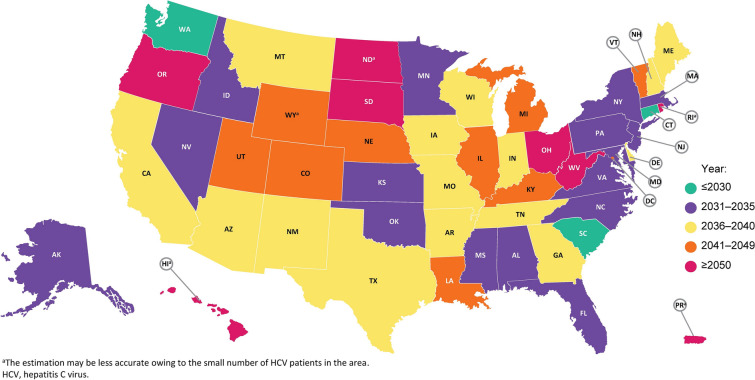
Results: Overall, the USA is projected to achieve HCV elimination by 2037, with individual targets related to mortality, diagnosis, treatment, and incidence being achieved by 2020, 2027, 2033, and 2037, respectively. Three states (Connecticut, South Carolina, and Washington) are on track to meet all four elimination targets by 2030, and 18 states are not expected to meet these targets before 2040. The estimated annual number of treatments required during 2020-2030 nationally to reach the WHO treatment target is 173,514.
Conclusion: With the exception of three states, the USA is not on target to meet the WHO 2030 elimination targets and 35% are off track by 10 years or more. Strategies must be implemented to reduce overall prevalence by preventing new infections, increasing rates of screening, improving linkage to care, and implementing unfettered access to curative therapy.
Keywords: Elimination; Epidemiology; Hepatitis C; Infectious disease; Prevalence.
Figures
References
-
- CDC. Viral hepatitis surveillance; 2019. https://www.cdc.gov/hepatitis/statistics/2017surveillance/index.htm. Accessed March 14, 2020.
-
- AASLD-IDSA. Management of acute HCV infection. Key populations: identification and management of HCV in people who inject drugs; https://www.hcvguidelines.org/unique-populations/pwid. Accessed June 1, 2020.
Publication types
MeSH terms
Substances
LinkOut - more resources
Full Text Sources
Medical
