


Increasing Access to Medications for Opioid Use Disorder and Complementary and Integrative Health Services in Primary Care
- PMID: 33145686
- PMCID: PMC7728925
- DOI: 10.1007/s11606-020-06255-6
Increasing Access to Medications for Opioid Use Disorder and Complementary and Integrative Health Services in Primary Care
Abstract
Objectives: Evidence-based therapies for opioid use disorder (OUD) and chronic pain, such as medications for OUD (MOUD) and complementary and integrative health (CIH; e.g., acupuncture and meditation) therapies, exist. However, their adoption has been slow, particularly in primary care, due to numerous implementation challenges. We sought to expand the use of MOUD and CIH within primary care by using an evidence-based quality improvement (EBQI) implementation strategy.
Methods: We used EBQI to engage two facilities in the Veterans Health Administration (VHA) from June 2018 to September 2019. EBQI included multilevel stakeholder engagement, with external facilitators providing technical support, practice facilitation, and routine data feedback. We established a quality improvement (QI) team at each facility with diverse stakeholders (e.g., primary care, addiction, pain, nursing, pharmacy). We met monthly with regional stakeholders to address implementation barriers. We also convened an advisory board to ensure alignment with national priorities.
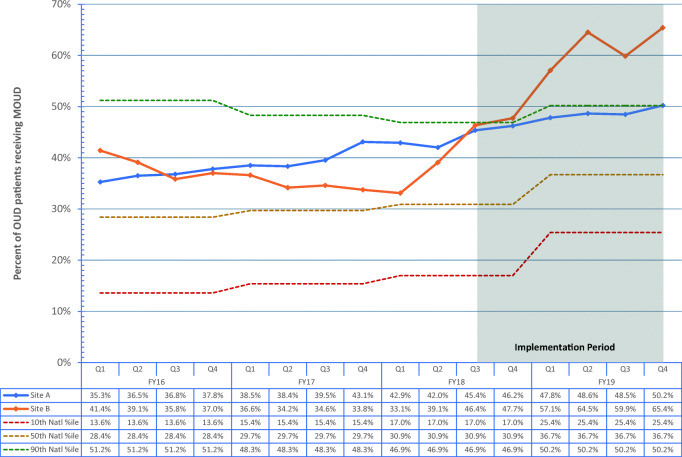
Results: Pre-implementation interviews indicated facility-level and provider-level barriers to prescribing buprenorphine, including strong primary care provider resistance. Both facilities developed action plans. They both conducted educational meetings (e.g., Grand Rounds, MOUD waiver trainings). Facility A also offered clinical preceptorships for newly trained primary care prescribers. Facility B used mass media and mailings to educate patients about MOUD and CIH options and dashboards to identify potential candidates for MOUD. After 15 months, both facilities increased their OUD treatment rates to the ≥ 90th percentile of VHA medical centers nationally. Exit interviews indicated an attitudinal shift in MOUD delivery in primary care. Stakeholders valued the EBQI process, particularly cross-site collaboration.
Implications: Despite initial implementation barriers, we effectively engaged stakeholders using EBQI strategies. Local QI teams used an assortment of QI interventions and developed tools to catapult their facilities to among the highest performers in VHA OUD treatment.
Impacts: EBQI is an effective strategy to partner with stakeholders to implement MOUD and CIH therapies.
Keywords: X-waiver; buprenorphine; complementary and integrative health; medications for opioid use disorder; opioid use disorder.
Conflict of interest statement
The authors declare that they do not have a conflict of interest.
Figures
References
-
- Hedegaard H, Warner M, Miniño A. Drug overdose deaths in the United States, 1999–2016. NCHS Data Brief, no 294. In. Hyattsville, MD: National Center for Health Statistics; 2017.
-
- Hempel S, Taylor SL, Marshall NJ, et al. VA Evidence-based Synthesis Program Reports. In: Evidence Map of Mindfulness. Washington (DC): Department of Veterans Affairs (US); 2014.
-
- Hempel S, Taylor SL, Solloway MR, et al. VA Evidence-based Synthesis Program Reports. In: Evidence Map of Acupuncture. Washington (DC): Department of Veterans Affairs (US); 2014.
-
- Hempel S, Taylor SL, Solloway MR, et al. VA Evidence-based Synthesis Program Reports. In: Evidence Map of Tai Chi. Washington (DC): Department of Veterans Affairs (US); 2014. - PubMed
Publication types
MeSH terms
Substances
LinkOut - more resources
Full Text Sources
Medical
Miscellaneous
