


FDA Approval Summary: Rucaparib for the Treatment of Patients with Deleterious BRCA-Mutated Metastatic Castrate-Resistant Prostate Cancer
- PMID: 33145877
- PMCID: PMC7873319
- DOI: 10.1002/onco.13585
FDA Approval Summary: Rucaparib for the Treatment of Patients with Deleterious BRCA-Mutated Metastatic Castrate-Resistant Prostate Cancer
Abstract
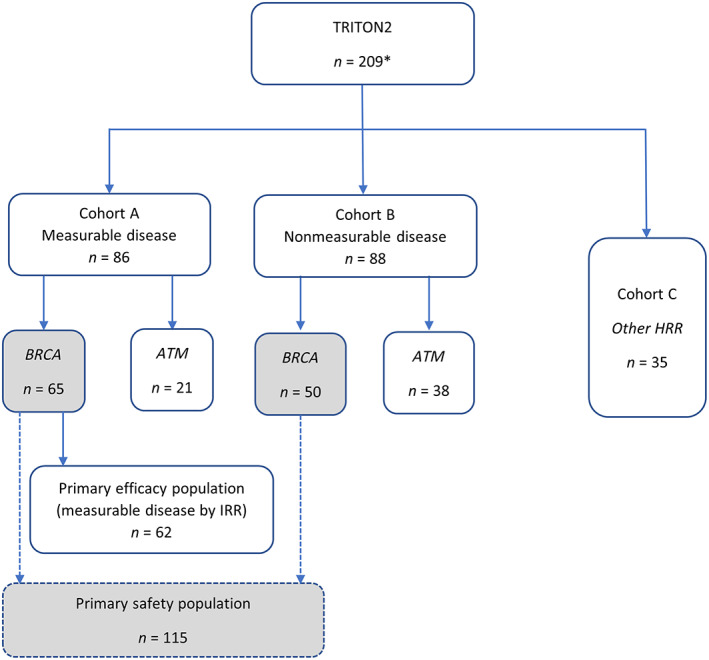
The U.S. Food and Drug Administration (FDA) granted accelerated approval to rucaparib in May 2020 for the treatment of adult patients with deleterious BRCA mutation (germline and/or somatic)-associated metastatic castrate-resistant prostate cancer (mCRPC) who have been treated with androgen receptor-directed therapy and a taxane. This approval was based on data from the ongoing multicenter, open-label single-arm trial TRITON2. The primary endpoint, confirmed objective response rate, in the 62 patients who met the above criteria, was 44% (95% confidence interval [CI]: 31%-57%). The median duration of response was not estimable (95% CI: 6.4 to not estimable). Fifty-six percent of patients had a response duration of >6 months and 15% >12 months. The safety profile of rucaparib was generally consistent with that of the class of poly-(ADP-ribose) polymerase enzyme inhibitors and other trials of rucaparib in the treatment of ovarian cancer. Deaths due to adverse events (AEs) occurred in 1.7% of patients, and 8% discontinued rucaparib because of an AE. Grade 3-4 AEs occurred in 59% of patients. No patients with prostate cancer developed myelodysplastic syndrome or acute myeloid leukemia. The trial TRITON3 in patients with mCRPC is ongoing and is planned to verify the clinical benefit of rucaparib in mCRPC. This article summarizes the FDA thought process and data supporting this accelerated approval. IMPLICATIONS FOR PRACTICE: The accelerated approval of rucaparib for the treatment of adult patients with deleterious BRCA mutation (germline and/or somatic)-associated metastatic castrate-resistant prostate cancer who have been treated with androgen receptor-directed therapy and a taxane represents the first approved therapy for this selected patient population. This approval was based on a single-arm trial demonstrating a confirmed objective response rate greater than that of available therapy with a favorable duration of response and an acceptable toxicity profile. The ongoing trial TRITON3 is verifying the clinical benefit of this drug.
Keywords: BRCA mutations; Metastatic castrate-resistant prostate cancer; Poly-(ADP-ribose) polymerase inhibitors; Rucaparib.
Published 2020. This article is a U.S. Government work and is in the public domain in the USA.
Conflict of interest statement
Figures
References
-
- Siegel RL, Miller KD, Jemal A. Cancer statistics, 2019. CA Cancer J Clin 2019;69:7–34. - PubMed
-
- Fizazi K, Scher HI, Molina A et al. Abiraterone acetate for treatment of metastatic castration‐resistant prostate cancer: Final overall survival analysis of the COU‐AA‐301 randomised, double‐blind, placebo‐controlled phase 3 study. Lancet Oncol 2012;13:983–992. - PubMed
-
- Scher HI, Fizazi K, Saad F et al. Increased survival with enzalutamide in prostate cancer after chemotherapy. N Engl J Med 2012;367:1187–1197. - PubMed
-
- Ryan CJ, Smith MR, Fizazi K et al. Abiraterone acetate plus prednisone versus placebo plus prednisone in chemotherapy‐naive men with metastatic castration‐resistant prostate cancer (COU‐AA‐302): Final overall survival analysis of a randomised, double‐blind, placebo‐controlled phase 3 study. Lancet Oncol 2015;16:152–160. - PubMed
Publication types
MeSH terms
Substances
LinkOut - more resources
Full Text Sources
Medical
Miscellaneous
