Randomized Controlled Trial
. 2021 Dec 6;73(11):e4278-e4287.
doi: 10.1093/cid/ciaa1673.

Induction of Cross-Reactive Hemagglutination Inhibiting Antibody and Polyfunctional CD4+ T-Cell Responses by a Recombinant Matrix-M-Adjuvanted Hemagglutinin Nanoparticle Influenza Vaccine

Affiliations
Randomized Controlled Trial

Induction of Cross-Reactive Hemagglutination Inhibiting Antibody and Polyfunctional CD4+ T-Cell Responses by a Recombinant Matrix-M-Adjuvanted Hemagglutinin Nanoparticle Influenza Vaccine

Vivek Shinde et al. Clin Infect Dis. .

Abstract

Background: Recurrent reports of suboptimal influenza vaccine effectiveness have renewed calls to develop improved, broadly cross-protective influenza vaccines. Here, we evaluated the safety and immunogenicity of a novel, saponin (Matrix-M)-adjuvanted, recombinant hemagglutinin (HA) quadrivalent nanoparticle influenza vaccine (qNIV).

Methods: We conducted a randomized, observer-blind, comparator-controlled (trivalent high-dose inactivated influenza vaccine [IIV3-HD] or quadrivalent recombinant influenza vaccine [RIV4]), safety and immunogenicity trial of qNIV (5 doses/formulations) in healthy adults ≥65 years. Vaccine immunogenicity was measured by hemagglutination-inhibition assays using reagents that express wild-type hemagglutination inhibition (wt-HAI) sequences and cell-mediated immune responses.

Results: A total of 1375 participants were randomized, immunized, and followed for safety and immunogenicity. Matrix-M-adjuvanted qNIV induced superior wt-HAI antibody responses against 5 of 6 homologous or drifted strains compared with unadjuvanted qNIV. Adjuvanted qNIV induced post-vaccination wt-HAI antibody responses at day 28 that were statistically higher than IIV3-HD against a panel of homologous or drifted A/H3N2 strains, similar to IIV3-HD against homologous A/H1N1 and B (Victoria) strains and similar to RIV4 against all homologous and drifted strains evaluated. The qNIV formulation with 75 µg Matrix-M adjuvant induced substantially higher post-vaccination geometric mean fold increases of influenza HA-specific polyfunctional CD4+ T cells compared with IIV3-HD or RIV4. Overall, similar frequencies of solicited and unsolicited adverse events were reported in all treatment groups.

Conclusions: qNIV with 75 µg Matrix-M adjuvant was well tolerated and induced robust antibody and cellular responses, notably against both homologous and drifted A/H3N2 viruses. Further investigation in a pivotal phase 3 trial is underway.

Clinical trials registration: NCT03658629.

Keywords: cell-mediated immunity; hemagglutination inhibition; influenza; vaccination.


Figures

Figure 1.
Figure 1.
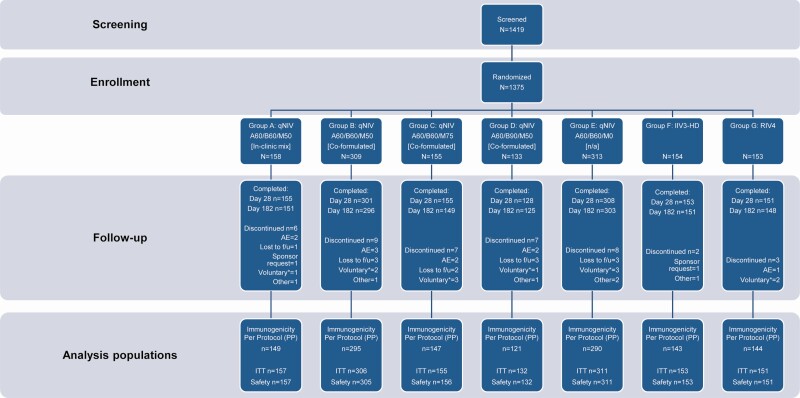
Flow diagram on screening, enrollment, and disposition of participants through the study. Safety population is defined as all participants who provided consent, were randomized, and received any investigational treatment; used for all descriptive safety analyses. Immunogenicity per protocol population is defined as all participants in the safety population who received the assigned investigational treatment according to the protocol, had wild-type hemagglutination inhibition (HAI) serology results for day 0 and day 28, and had no major protocol deviations that affected the primary immunogenicity outcomes as determined by the sponsor prior to database lock and unblinding; used for all immunogenicity analyses. The ITT population is defined as all participants in the safety population who provided any HAI serology data. Abbreviations: A, influenza A strain hemagglutinin (HA) antigen content in micrograms for each of A/H1N1 and A/H3N2 strains; AE, adverse event; B, influenza B strain HA antigen content in micrograms for each of B/Victoria and B/Yamagata lineage strains; f/u, follow-up; IIV3-HD, trivalent high-dose inactivated influenza vaccine (Fluzone High-Dose); ITT, intent-to-treat population; M, Matrix-M adjuvant content in micrograms; qNIV, quadrivalent recombinant nanoparticle influenza vaccine; RIV4, quadrivalent recombinant influenza vaccine (Flublok Quadrivalent); voluntary*, voluntary withdrawal unrelated to an adverse event.
Figure 2.
Figure 2.
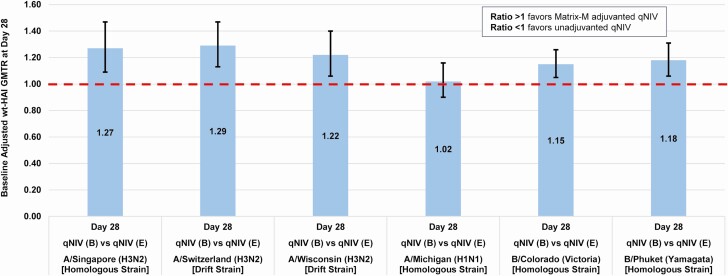
Demonstration of adjuvant effect–baseline adjusted ratio of day 28 wt-HAI geometric mean titers (GMTs; GMTR) (Matrix-M–adjuvanted qNIV [group B]/unadjuvanted qNIV [group E]). Full strain names: A/Singapore/INFIMH-16–0019/2016 (H3N2); A/Switzerland/9715293/2013 (H3N2); A/Wisconsin/19/2017 (H3N2); A/Michigan/45/2015 (H1N1); B/Colorado/06/2017 (Victoria lineage); B/Phuket/3073/2013 (Yamagata lineage). The primary immunogenicity objective of demonstrating an adjuvant effect required establishing immunogenic superiority of group B (qNIV 60 µg hemagglutinin [HA] × 4 strains with 50 µg Matrix-M1 adjuvant) relative to group E (qNIV 60 µg HA × 4 strains without adjuvant) by excluding values ≤1.0 at the lower 95% confidence bound for the baseline-adjusted ratio of day 28 post-vaccination wt-HAI GMTs (ie, GMT of group B [adjuvant]/GMT of group E [no adjuvant] at day 28) for not less than 2 of 6 influenza strains (ie, any 2 of 4 vaccine-homologous strains and/or 2 antigenically drifted influenza strains), while no other strain(s) demonstrated GMTRs that were significantly <1.0. Abbreviations: qNIV, quadrivalent recombinant nanoparticle influenza vaccine; wt-HAI, wild-type sequenced hemagglutinin inhibition antibody.
Figure 3.
Figure 3.
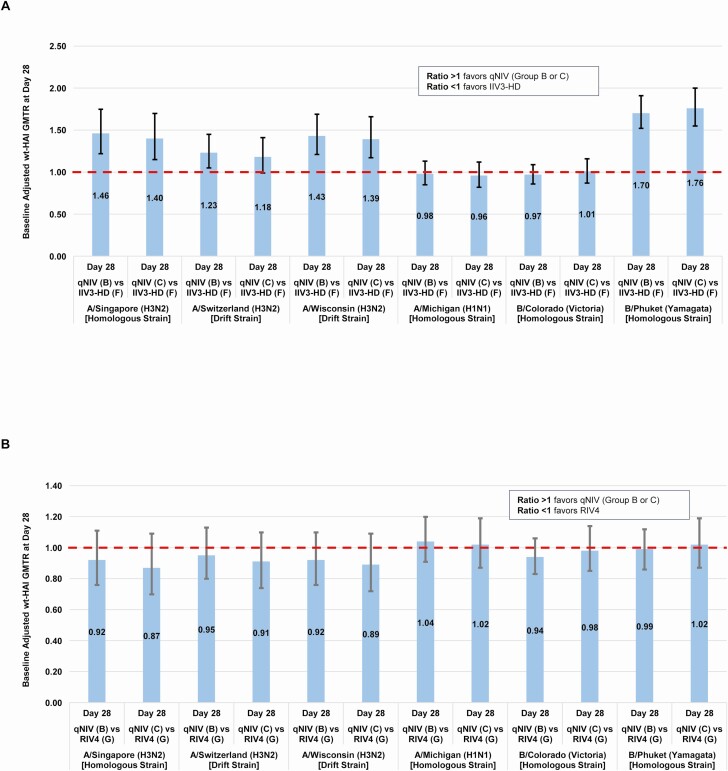
A, qNIV (group B or C) compared with IIV3-HD–baseline adjusted ratio of day 28 wt-HAI geometric mean titers (GMTs; GMTR) (qNIV [group B or C]/IIV3-HD [group F]). Full strain names: A/Singapore/INFIMH-16–0019/2016 (H3N2); A/Switzerland/9715293/2013 (H3N2); A/Wisconsin/19/2017 (H3N2); A/Michigan/45/2015 (H1N1); B/Colorado/06/2017 (Victoria lineage); B/Phuket/3073/2013 (Yamagata lineage). B, qNIV (group B or C) compared with RIV4–baseline adjusted ratio of day 28 wt-HAI GMTs (GMTR) (qNIV [group B or C]/RIV4 [group G]). Since day 56 samples were tested separately from day 0 and day 28 samples, day 56 titers were adjusted for the long-term assay variability. The adjustment was based on retesting of a randomly selected subset, 50 participants, of day 0 samples concurrently with day 56 samples. Abbreviations: B, group B; C, group C; F, group F; IIV3-HD, trivalent high-dose inactivated influenza vaccine; qNIV, quadrivalent recombinant nanoparticle influenza vaccine; wt-HAI, wild-type sequenced hemagglutinin inhibition antibody.
Figure 4.
Figure 4.
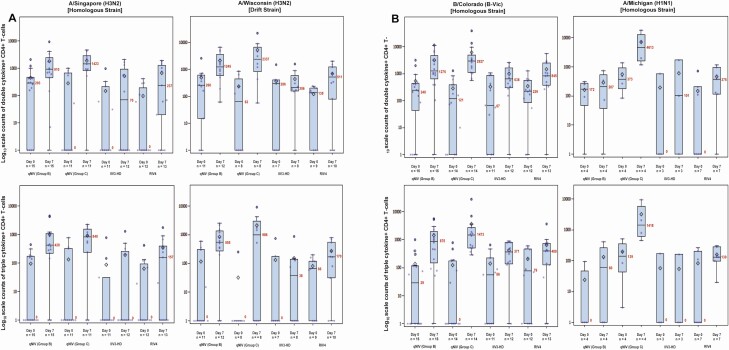
Log10 scale counts of double- or triple-cytokine producing strain-specific CD4+ T cells by treatment group, time point, and strain. Cell-mediated immune (CMI) responses were measured by intracellular cytokine staining. Counts of peripheral blood CD4+ T cells producing interleukin-2 (IL-2), interferon gamma (IFN-γ), and/or tumor necrosis factor alpha (TNF-α) cytokines were measured following in vitro restimulation with vaccine-homologous (A/Singapore/FIMH-16–0019/2016 [H3N2]; A/Michigan/45/2015 [H1N1]; /Colorado/06/2017 [Victoria]), or drifted (A/Wisconsin/19/2017 [H3N2]) strain-specific recombinant wild-type sequence hemagglutinins (HAs). A, CMI responses against A/Singapore and A/Wisconsin. B, CMI responses against B/Colorado and A/Michigan. Box plots are shown for counts of double-cytokine producing (any 2 of IFN-γ, TNF-α, or IL-2) or triple-cytokine producing (all 3 of IFN-γ, TNF-α, and IL-2) strain-specific CD4+ T-cell responses across the 4 strains evaluated using peripheral blood mononuclear cells obtained from a subgroup of participants on day 0 (pre-vaccination) and day 7 (post-vaccination). The box plots represent the interquartile range (±3 standard deviations), the solid horizontal black line represents the median, the number in red indicates the median count of double- or triple-cytokine producing CD4+ T cells, respectively, and the open diamond represents the mean. Group B is qNIV 60 µg HA × 4 strains with 50 µg Matrix-M1 adjuvant; group C is qNIV 60 µg HA × 4 strains with 75 µg Matrix-M1 adjuvant; group F is IIV3-HD; and group G is RIV4. Note that the number of strains tested for a given participant’s sample was dependent on the number of cells available; thus, not all samples could be tested across all 4 strains. Abbreviations: IIV3-HD, trivalent high-dose inactivated influenza vaccine; qNIV, quadrivalent recombinant nanoparticle influenza vaccine; RIV4, quadrivalent recombinant influenza vaccine.

References

    1. Grohskopf LA, Alyanak E, Broder KR, Walter EB, Fry AM, Jernigan DB. Prevention and control of seasonal influenza with vaccines: recommendations of the Advisory Committee on Immunization Practices—United States, 2019–20 influenza season. MMWR Recomm Rep 2019; 68:1–20. - PMC - PubMed
    1. Paget J, Spreeuwenberg P, Charu V, et al. ; Global Seasonal Influenza-associated Mortality Collaborator Network and GLaMOR Collaborating Teams . Global mortality associated with seasonal influenza epidemics: new burden estimates and predictors from the GLaMOR Project. J Glob Health 2019; 9:020421. - PMC - PubMed
    1. Centers for Disease Control and Prevention. Past weekly surveillance reports. Available at: https://www.cdc.gov/flu/weekly/pastreports.htm. Accessed 7 February 2020.
    1. Kissling E, Pozo F, Buda S, et al. Low 2018/19 vaccine effectiveness against influenza A(H3N2) among 15–64-year-olds in Europe: exploration by birth cohort. Euro Surveill 2019; 24:1900604. - PMC - PubMed
    1. Kissling E, Pozo F, Buda S, et al. ; I-MOVE/I-MOVE+ Study Team . Effectiveness of influenza vaccine against influenza A in Europe in seasons of different A(H1N1)pdm09 and the same A(H3N2) vaccine components (2016–17 and 2017–18). Vaccine X 2019; 3:100042. - PMC - PubMed

Publication types

Associated data

Grants and funding