


Can platelet-rich plasma coating improve polypropylene mesh integration? An immunohistochemical analysis in rabbits
- PMID: 33146979
- PMCID: PMC7857777
- DOI: 10.1590/S1677-5538.IBJU.2020.0017
Can platelet-rich plasma coating improve polypropylene mesh integration? An immunohistochemical analysis in rabbits
Abstract
Purpose: Despite high success rates in the treatment of urinary incontinence, complications related to the use of polypropylene (PP) meshes are still a concern, especially in vaginal prolapses surgeries. The objective of this study was to assess the effect of autologous platelet-rich plasma (PRP) coating on the integration of PP meshes implanted in the vaginal submucosa of rabbits.
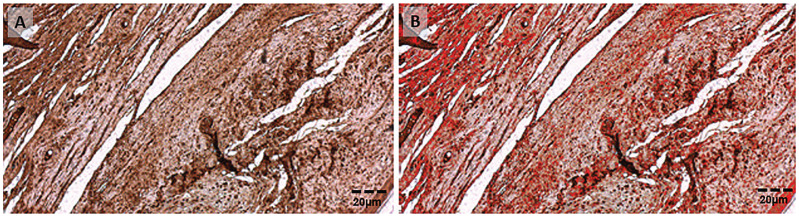
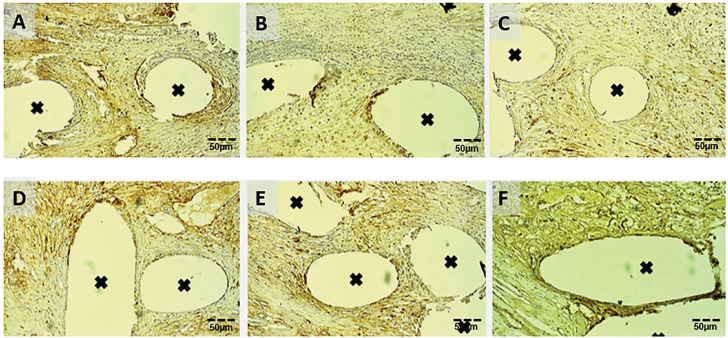
Materials and methods: Thirty adult New Zealand rabbits were randomly divided into two groups (n=15): PP, implanted with conventional PP meshes; and PRP, implanted with autologous PRP coated PP meshes. Animals in both groups (n=5) were euthanized at 7, 30 and 90 days postoperatively, the vaginas extracted and sent to immunohistochemical analysis for the assessment of the pro-inflammatory agent TNF-α, anti-inflammatory agents TGF-β and IL-13, collagen metabolism marker MMP-2, and angiogenesis marker CD-31. AxioVision™ image analysis was used for the calculation of the immunoreactive area and density. Statistical analysis was performed with ANOVA followed by Tukey test (p <0.05).
Results: Animals in the PRP group showed significantly increased expression of the angiogenesis agent CD-31 at all experimental times when compared to the PP group (p <0.0001). However, no differences concerning the expression of the other markers were observed between the groups.
Conclusion: The addition of autologous PRP gel to PP meshes can be simply and safely achieved and seems to have a positive effect on implantation site angiogenesis. Further investigations are required to ascertain PPR coated meshes clinical efficacy in prolapses and stress urinary incontinence surgeries.
Keywords: Suburethral Slings; Tissue Engineering; Urinary Incontinence; Female.
Copyright® by the International Brazilian Journal of Urology.
Conflict of interest statement
None declared.
Figures
References
-
- 1. Maher C, Baessler K, Barber M, Cheon C, Deitz V, DeTayrac R, et al.: Surgical management of pelvic organ prolapse. In: Abrams C, Khoury W (ed). 5th International Consultation on Incontinence. Paris, Health Publication Ltd. 2013; pp. 1379-430.
-
- 2. Castellani D, Valloni A, Piccirilli A, Paradiso Galatioto G, Vicentini C. An innovative approach to treating vaginal mesh exposure after abdominal sacral colpopexy: endoscopic resection of mesh and platelet-rich plasma; initial experience in three women. Int Urogynecol J. 2017;28:325-7. - PubMed
-
- 3. Gomelsky A, Dmochowski RR. Biocompatibility assessment of synthetic sling materials for female stress urinary incontinence. J Urol. 2007;178(4 Pt 1):1171-81. - PubMed
-
- 4. Burger JW, Halm JA, Wijsmuller AR, ten Raa S, Jeekel J. Evaluation of new prosthetic meshes for ventral hernia repair. Surg Endosc. 2006;20:1320-5. - PubMed
MeSH terms
Substances
LinkOut - more resources
Full Text Sources
Other Literature Sources
Research Materials
Miscellaneous
