


Decorated bodies for eternal life: A multidisciplinary study of late Roman Period stucco-shrouded portrait mummies from Saqqara (Egypt)
- PMID: 33147238
- PMCID: PMC7641350
- DOI: 10.1371/journal.pone.0240900
Decorated bodies for eternal life: A multidisciplinary study of late Roman Period stucco-shrouded portrait mummies from Saqqara (Egypt)
Abstract
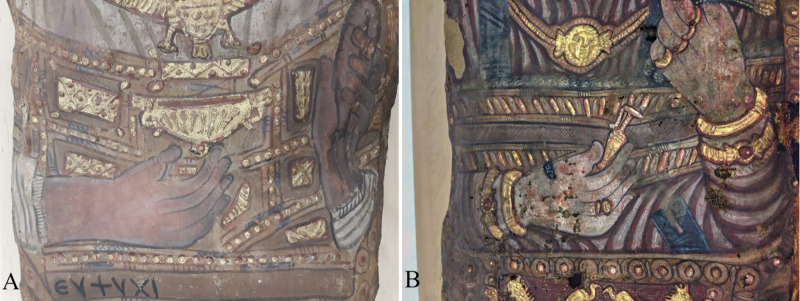
This study focuses on the multidisciplinary investigation of three stucco-shrouded mummies with mummy portrait from Egypt dating from the late 3rd to the middle of the 4th century AD, corresponding to the late Roman Period. These three mummies were excavated in the early 17th and late 19th centuries in the Saqqara necropolis near the ancient Egyptian capital of Memphis. Two of them experienced an interesting collection history, when they became part of the collection of the Elector of Saxony and King of Poland August II in Dresden, Germany, in 1728. The investigation includes information about the mummies' discovery, collection history and shroud decoration obtained through Egyptological expertise. In addition, information on the state of preservation, technique of artificial mummification, age at death, sex, body height and health of the deceased was achieved through computed tomography (CT) analysis. Research yielded an adult male, a middle-aged female and a young female. Due to the rather poorly preserved bodies of the male and middle-aged female, a specific technique of artificial mummification could not be ascertained. Brain and several internal organs of the well-preserved young female were identified. Wooden boards, beads of necklaces, a hairpin, and metal dense items, such as lead seals, nails and two coins or medallions were discovered. Paleopathological findings included carious lesions, Schmorl's nodes, evidence of arthritis and a vertebral hemangioma. The study revealed insights on the decoration and burial preparation of individuals of upper socioeconomic status living in the late Roman Period, as well as comprehensive bioanthropological information of the deceased.
Conflict of interest statement
One of the authors (WR) is affiliated to the Curt-Engelhorn-Center Archaeometry gGmbH. gGmbH is a non-profit company. There are no other relevant declarations relating to employment, consultancy, patents, products in development, or marketed products, etc. This does not alter our adherence to PLOS ONE policies on sharing data and materials.
Figures




References
-
- Dannenfeldt KH. Egyptian Mumia: The Sixteenth Century Experience and Debate. Sixt Century J, 1985; 16(2): 163–180. https://www.jstor.org/stable/2540910 - PubMed
-
- Ikram S, Dodson A. The Mummy in Ancient Egypt: Equipping the Dead for Eternity. London: Thames and Hudson; 1998.
-
- Aufderheide AC. The Scientific Study of Mummies. Cambridge: Cambridge University Press; 2003.
-
- Rühli FJ, Chhem RK, Böni T. Diagnostic paleoradiology of mummified tissue: interpretation and pitfalls. Can Assoc Radiol J. 2004; 55(4): 218–227. - PubMed
-
- Hawass Z, Gad YZ, Ismail S, Khairat R, Fathalla D, Hasan N, et al. Ancestry and Pathology in King Tutankhamun’s Family. JAMA. 2010; 303(7): 638–647. http://jama.ama-assn.org/cgi/content/full/303/7/638 10.1001/jama.2010.121 - DOI - PubMed
Publication types
MeSH terms
LinkOut - more resources
Full Text Sources
