


Neurodevelopmental performance among pre-schoolers treated for severe anaemia at Lira Regional Referral Hospital, Uganda
- PMID: 33147287
- PMCID: PMC7641407
- DOI: 10.1371/journal.pone.0240694
Neurodevelopmental performance among pre-schoolers treated for severe anaemia at Lira Regional Referral Hospital, Uganda
Erratum in
-
Correction: Neurodevelopmental performance among pre-schoolers treated for severe anaemia at Lira Regional Referral Hospital, Uganda.PLoS One. 2021 Jan 5;16(1):e0244913. doi: 10.1371/journal.pone.0244913. eCollection 2021. PLoS One. 2021. PMID: 33400720 Free PMC article.
Abstract
Background: Severe anaemia is a common clinical problem among young children in sub-Saharan Africa. However, the effect of severe anaemia on neurodevelopment of these children is not well described. Therefore, we assessed the neurodevelopmental performance of preschool children diagnosed with severe anaemia in Northern Uganda.
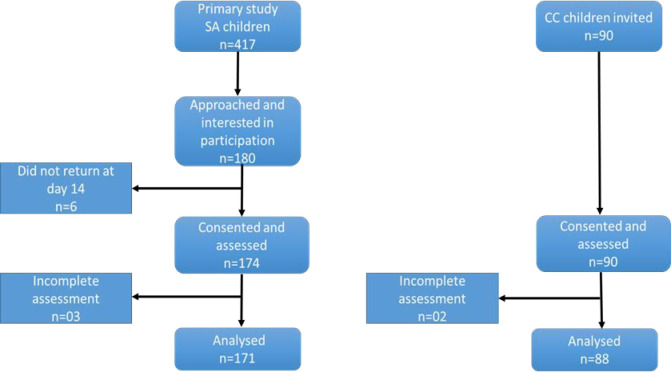
Methods: We conducted a prospective cohort study among children < 5 years of age 14 days post discharge after an episode of severe anaemia (Hb < 5.0 g/dl; n = 171; mean Hb = 3.9g/dl) at Lira Regional Referral Hospital, Uganda. Neurodevelopmental outcomes (cognitive, language and motor) were assessed using Bayley Scales of Infant and Toddler Development, 3rd edition (Bayley-III). Age-adjusted z-scores for each domain were calculated using scores from healthy community control children (n = 88) recruited from the same environment for each age category. Multiple linear regression was used to compare z-scores in the cognitive, language and motor scales between the two groups after adjusting for weight-for-age z-score, socioeconomic status, mother's education, and father's employment on all the scales.
Results: The prevalence of neurodevelopmental impairment was 2.3% (95% CI: 0.8-6.1) for cognition, 1.7% (95%: 0.6-5.3) for language and 3.5% (95% CI: 1.6-7.6) for motor scales and 4.6% (95% CI: 2.3-9.1) for deficits in ≥1 area of neurodevelopment. Significant differences were observed between the two groups with the SA group performing worse on cognition [adjusted mean score, (Standard error, SE), P-value] [-0.20, (0.01) vs. 0.00, (0.01), P = 0.02]; language [-0.25, (0.01) vs. 0.00, (0.01), P< 0.001]; and motor [-0.17, (0.01) vs. 0.00, (0.01), P = 0.05] scales.
Conclusion: In children < 5 years of age, severe anaemia was associated with neurocognitive (cognition, language and motor) deficits in the immediate period post treatment. Further research is needed to identify risk factors and determine the long-term effects of poor neurodevelopment in young children with severe anaemia.
Conflict of interest statement
The authors have declared that no competing interests exist.
Figures
References
-
- Stevens GA, Finucane MM, De-Regil LM, Paciorek CJ, Flaxman SR, Branca F, et al. Global, regional, and national trends in haemoglobin concentration and prevalence of total and severe anaemia in children and pregnant and non-pregnant women for 1995–2011: a systematic analysis of population-representative data. The Lancet Global Health. 2013;1(1):e16–e25. 10.1016/S2214-109X(13)70001-9 - DOI - PMC - PubMed
Publication types
MeSH terms
Grants and funding
LinkOut - more resources
Full Text Sources
Medical
