


Normative values of muscle strength across ages in a 'real world' population: results from the longevity check-up 7+ project
- PMID: 33147374
- PMCID: PMC7749608
- DOI: 10.1002/jcsm.12610
Normative values of muscle strength across ages in a 'real world' population: results from the longevity check-up 7+ project
Abstract
Background: Low muscle strength is a powerful predictor of negative health-related events and a key component of sarcopenia. The lack of normative values for muscle strength across ages hampers the practical appraisal of this parameter. The aim of the present study was to produce normative values for upper and lower extremity muscle strength across a wide spectrum of ages, in a large sample of community-dwellers recruited in the Longevity check-up (Lookup) 7+ project.
Methods: Lookup 7+ is an ongoing project that started in June 2015 and conducted in unconventional settings (i.e. exhibitions, malls, and health promotion campaigns) across Italy with the aim of fostering the adoption of healthy lifestyles in the general population. Candidate participants are eligible for enrolment if they are 18+ years and provide written informed consent. Upper and lower extremity muscle strength is assessed by handgrip strength and five-repetition chair-stand [5 × sit-to-stand (STS)] tests, respectively. Cross-sectional centile and normative values for handgrip strength and 5 × STS tests from age 18 to 80+ years were generated for the two genders. Smoothed normative curves for the two tests were constructed for men and women using the lambda-mu-sigma method.
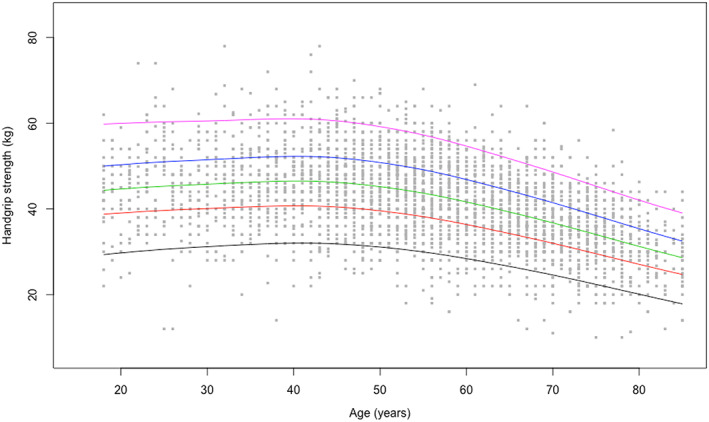
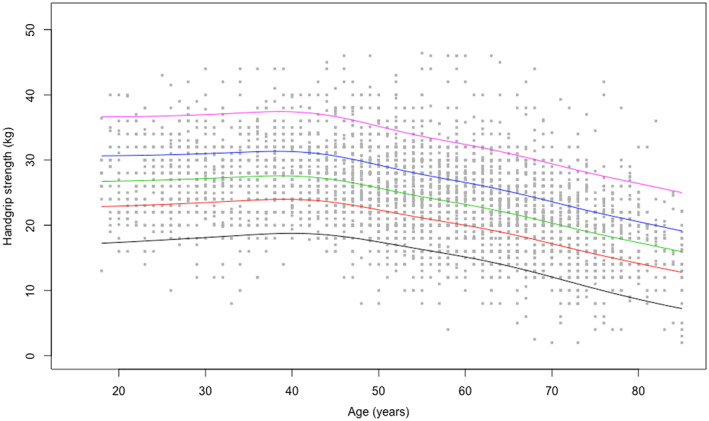
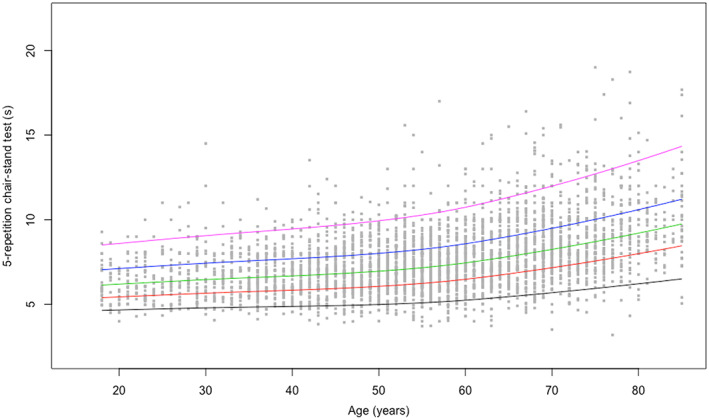
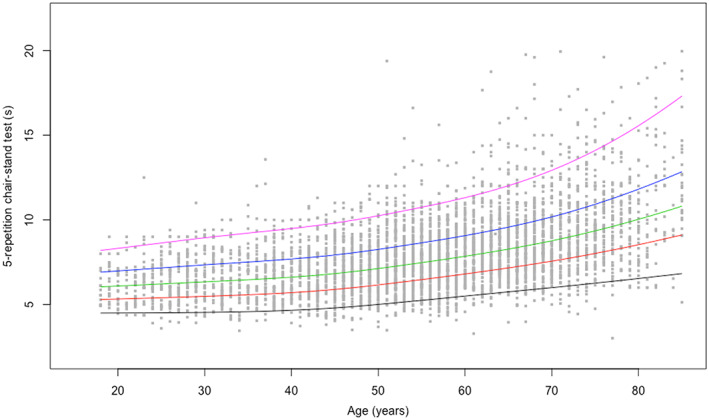
Results: From 1 June 2015 to 30 May 2019, 11 448 participants were enrolled. The mean age of participants was 55.6 years (standard deviation: 11.5 years; range: 18-98 years), and 6382 (56%) were women. Normative values for handgrip strength and the 5 × STS test, both absolute and normalized by body mass index, were obtained for men and women, stratified by age groups. Values of upper and lower extremity muscle strength across ages identified three periods in life: an increase to peak in young age and early adulthood (18-24 years), preservation through midlife (25-44 years), and a decline from midlife onwards (45+ years).
Conclusions: Our study established age-specific and gender-specific percentile reference values for handgrip strength and the 5 × STS test. The normative curves generated can be used to interpret the assessment of muscle strength in everyday practice for the early detection of individuals with or at risk of sarcopenia.
Keywords: Chair-stand test; EWGSOP2; Early diagnosis; Handgrip strength; Sarcopenia; Screening.
© 2020 The Authors. Journal of Cachexia, Sarcopenia and Muscle published by John Wiley & Sons Ltd on behalf of the Society on Sarcopenia, Cachexia and Wasting Disorders.
Conflict of interest statement
None to disclose.
Figures
References
-
- Landi F, Calvani R, Tosato M, Martone AM, Fusco D, Sisto A, et al. Age‐related variations of muscle mass, strength, and physical performance in community‐dwellers: results from the Milan EXPO survey. J Am Med Dir Assoc 2017;18:88.e17–e24. - PubMed
-
- Marzetti E, Hwang AC, Tosato M, Peng LN, Calvani R, Picca A, et al. Age‐related changes of skeletal muscle mass and strength among Italian and Taiwanese older people: results from the Milan EXPO 2015 survey and the I‐Lan Longitudinal Aging Study. Exp Gerontol 2018;102:76–80. - PubMed
Publication types
MeSH terms
LinkOut - more resources
Full Text Sources
Medical
Research Materials
