


Analysis of Adverse Events Related to Impella Usage (from the Manufacturer and User Facility Device Experience and National Inpatient Sample Databases)
- PMID: 33147430
- PMCID: PMC7796940
- DOI: 10.1016/j.amjcard.2020.10.056
Analysis of Adverse Events Related to Impella Usage (from the Manufacturer and User Facility Device Experience and National Inpatient Sample Databases)
Abstract
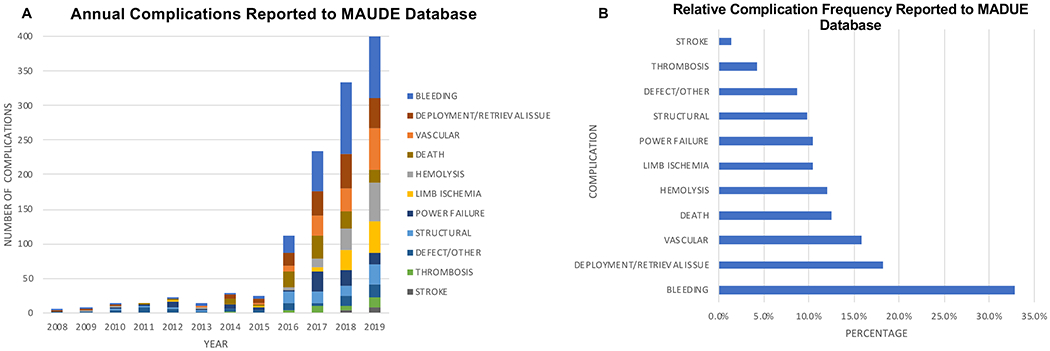
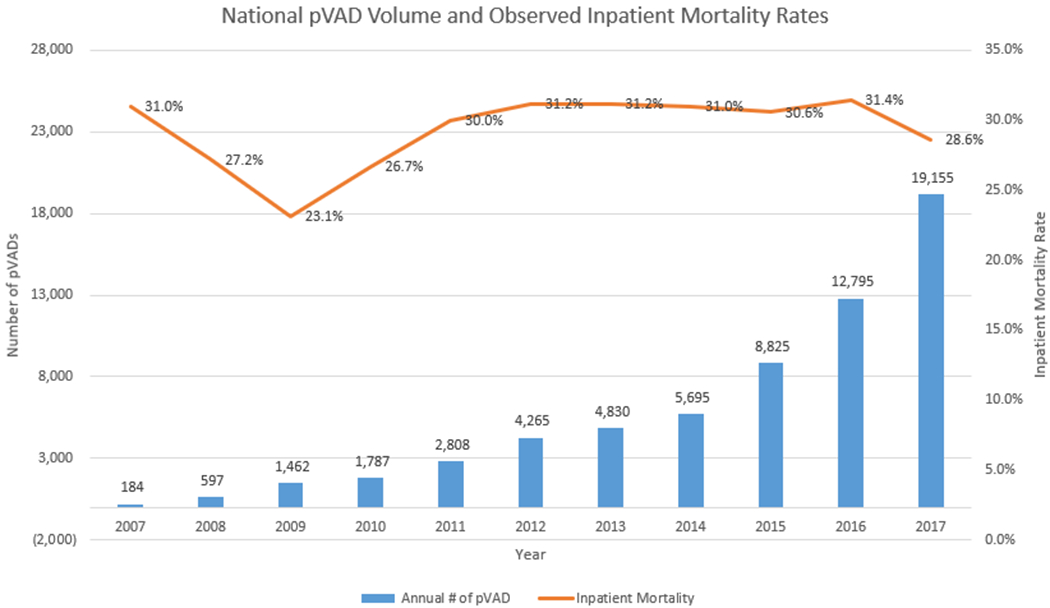
Impella devices are increasingly utilized for hemodynamic support in high-risk percutaneous coronary intervention or cardiogenic shock despite a lack of randomized clinical trial data showing clinical benefit and newer observational data suggesting harm. In this retrospective analysis, our aim was to determine the most common adverse events associated with Impella usage reported annually to the Food and Drug Administration Manufacturer and User Facility Device Experience (MAUDE) database and to estimate via the National Inpatient Sample (NIS) database the number of percutaneous ventricular assist devices utilized and associated with inpatient mortality since introduction of the Impella. Among the 885 complete reports submitted to the MAUDE database from 2008 to 2019 related to Impella usage, there were 1,206 complications coded; 88.2% of reports occurred from 2016 to 2019. Among patients with adverse events reported, bleeding (32.8%), device deployment or retrieval issues (18.2%), vascular complications (15.8%), and death (12.4%) were the most common, and 7.9% of all complications were attributable to operator decision-making or technique. From 2007 to 2017 there was a >100-fold increase in percutaneous ventricular assist devices use with an increase and plateau in in-hospital mortality to 31% from 2012 to 2016 based on NIS data. In conclusion, Impella use has increased substantially over the last decade but remains associated with high inpatient mortality and serious complications based on data from the NIS and MAUDE databases. These findings emphasize the need for high quality randomized controlled trials to determine the clinical utility of Impella in high-risk percutaneous coronary intervention and cardiogenic shock.
Copyright © 2020 Elsevier Inc. All rights reserved.
Conflict of interest statement
Declaration of interests
The authors declare that they have no known competing financial interests or personal relationships that could have appeared to influence the work reported in this paper.
Figures
References
-
- Thiele H, Zeymer U, Neumann FJ, Ferenc M, Olbrich HG, Hausleiter J, Richardt G, Hennersdorf M, Empen K, Fuernau G, Desch S, Eitel I, Hambrecht R, Fuhrmann J, Bohm M, Ebelt H, Schneider S, Schuler G, Werdan K. Intraaortic balloon support for myocardial infarction with cardiogenic shock. N Engl J Med 2012;367:1287–1296. - PubMed
-
- O’Neill WW, Kleiman NS, Moses J, Henriques JPS, Dixon S, Massaro J, Palacios I, Maini B, Mulukutla S, Džavík V, Popma J, Douglas PS, Ohman M. A prospective, randomized clinical trial of hemodynamic support with impella 2.5 versus intra-aortic balloon pump in patients undergoing high-risk percutaneous coronary intervention: The PROTECT II study. Circulation 2012;126:1717–1727. - PubMed
-
- Schrage B, Ibrahim K, Loehn T, Werner N, Sinning JM, Pappalardo F, Pieri M, Skurk C, Lauten A, Landmesser U, Westenfeld R, Horn P, Pauschinger M, Eckner D, Twerenbold R, Nordbeck P, Salinger T, Abel P, Empen K, Busch MC, Felix SB, Sieweke JT, Møller JE, Pareek N, Hill J, MacCarthy P, Bergmann MW, Henriques JPS, Möbius-Winkler S, Schulze PC, Ouarrak T, Zeymer U, Schneider S, Blankenberg S, Thiele H, Schafer A, Westermann D. Impella support for acute myocardial infarction complicated by cardiogenic shock: Matched-pair iabp-shock II trial 30-day mortality analysis. Circulation 2019;139:1249–1258. - PubMed
MeSH terms
Grants and funding
LinkOut - more resources
Full Text Sources
Other Literature Sources
Medical
