


Cellular Phone Use and Risk of Tumors: Systematic Review and Meta-Analysis
- PMID: 33147845
- PMCID: PMC7663653
- DOI: 10.3390/ijerph17218079
Cellular Phone Use and Risk of Tumors: Systematic Review and Meta-Analysis
Abstract
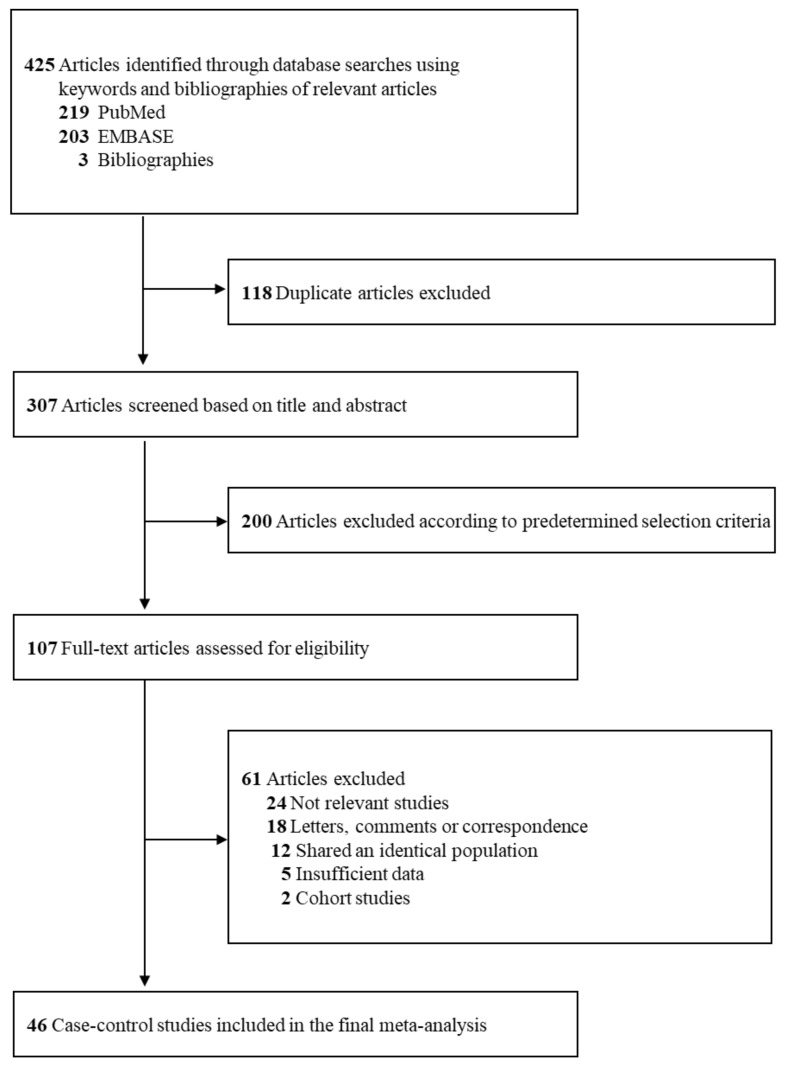
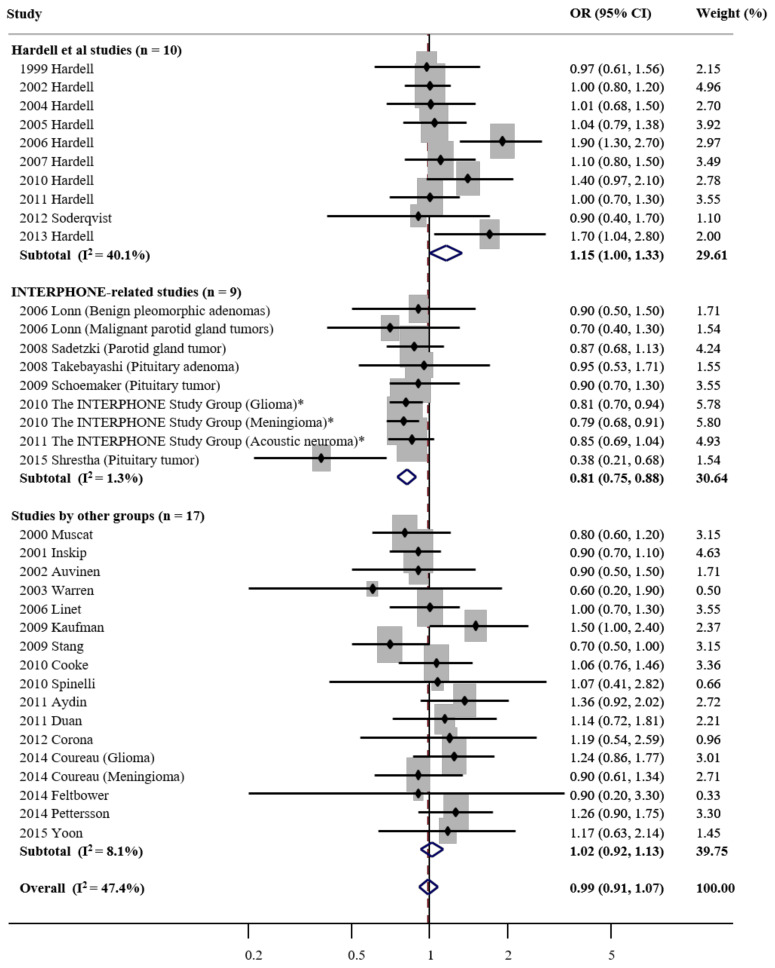
We investigated whether cellular phone use was associated with increased risk of tumors using a meta-analysis of case-control studies. PubMed and EMBASE were searched from inception to July 2018. The primary outcome was the risk of tumors by cellular phone use, which was measured by pooling each odds ratio (OR) and its 95% confidence interval (CI). In a meta-analysis of 46 case-control studies, compared with never or rarely having used a cellular phone, regular use was not associated with tumor risk in the random-effects meta-analysis. However, in the subgroup meta-analysis by research group, there was a statistically significant positive association (harmful effect) in the Hardell et al. studies (OR, 1.15-95% CI, 1.00 to 1.33- n = 10), a statistically significant negative association (beneficial effect) in the INTERPHONE-related studies (case-control studies from 13 countries coordinated by the International Agency for Research on Cancer (IARC); (OR, 0.81-95% CI, 0.75 to 0.89-n = 9), and no statistically significant association in other research groups' studies. Further, cellular phone use with cumulative call time more than 1000 h statistically significantly increased the risk of tumors. This comprehensive meta-analysis of case-control studies found evidence that linked cellular phone use to increased tumor risk.
Keywords: case-control study; cellular phone; electromagnetic field; meta-analysis; tumor.
Conflict of interest statement
The authors declare no conflict of interest.
Figures
Comment in
-
Comment on Choi, Y.-J., et al. Cellular Phone Use and Risk of Tumors: Systematic Review and Meta-Analysis. Int. J. Environ. Res. Public Health 2020, 17, 8079.Int J Environ Res Public Health. 2021 Mar 18;18(6):3125. doi: 10.3390/ijerph18063125. Int J Environ Res Public Health. 2021. PMID: 33803580 Free PMC article.
-
Reply to Comment on Choi, Y.-J., et al. Cellular Phone Use and Risk of Tumors: Systematic Review and Meta-Analysis. Int. J. Environ. Res. Public Health 2020, 17, 8079.Int J Environ Res Public Health. 2021 Mar 23;18(6):3326. doi: 10.3390/ijerph18063326. Int J Environ Res Public Health. 2021. PMID: 33807080 Free PMC article.
-
Comment on Choi et al. Cellular Phone Use and Risk of Tumors: Systematic Review and Meta-Analysis. Int. J. Environ. Res. Public Health 2020, 17, 8079.Int J Environ Res Public Health. 2021 May 20;18(10):5459. doi: 10.3390/ijerph18105459. Int J Environ Res Public Health. 2021. PMID: 34065238 Free PMC article.
-
Reply to Brzozek et al. Comment on "Choi et al. Cellular Phone Use and Risk of Tumors: Systematic Review and Meta-Analysis. Int. J. Environ. Res. Public Health 2020, 17, 8079".Int J Environ Res Public Health. 2021 May 24;18(11):5581. doi: 10.3390/ijerph18115581. Int J Environ Res Public Health. 2021. PMID: 34073653 Free PMC article.
References
-
- International Telecommunication Union ICT Statistics. [(accessed on 22 January 2020)]; Available online: https://www.itu.int/en/ITU-D/Statistics/Pages/stat/default.aspx.
Publication types
MeSH terms
LinkOut - more resources
Full Text Sources
Medical
Miscellaneous
