


Association between physiological responses after exercise at low altitude and acute mountain sickness upon ascent is sex-dependent
- PMID: 33148321
- PMCID: PMC7643355
- DOI: 10.1186/s40779-020-00283-3
Association between physiological responses after exercise at low altitude and acute mountain sickness upon ascent is sex-dependent
Abstract
Background: Acute mountain sickness (AMS) is the mildest form of acute altitude illnesses, and consists of non-specific symptoms when unacclimatized persons ascend to elevation of ≥2500 m. Risk factors of AMS include: the altitude, individual susceptibility, ascending rate and degree of pre-acclimatization. In the current study, we examined whether physiological response at low altitude could predict the development of AMS.
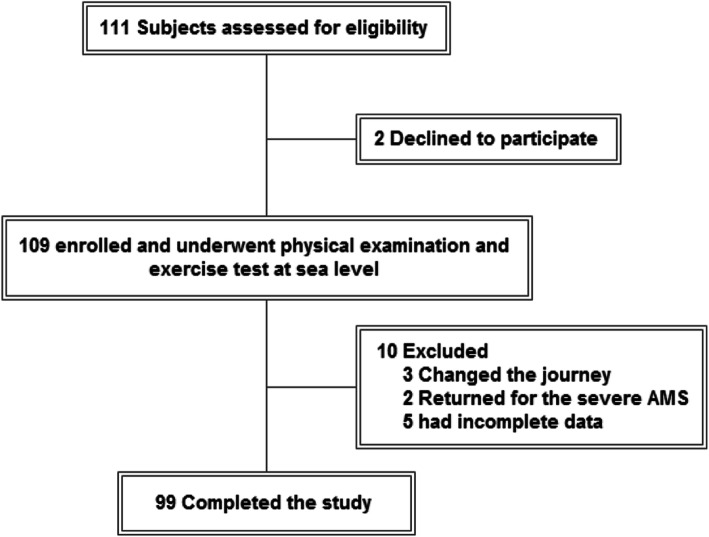
Methods: A total of 111 healthy adult healthy volunteers participated in this trial; and 99 (67 men and 32 women) completed the entire study protocol. Subjects were asked to complete a 9-min exercise program using a mechanically braked bicycle ergometer at low altitude (500 m). Heart rate, blood pressure (BP) and pulse oxygen saturation (SpO2) were recorded prior to and during the last minute of exercise. The ascent from 500 m to 4100 m was completed in 2 days. AMS was defined as ≥3 points in a 4-item Lake Louise Score, with at least one point from headache wat 6-8 h after the ascent.
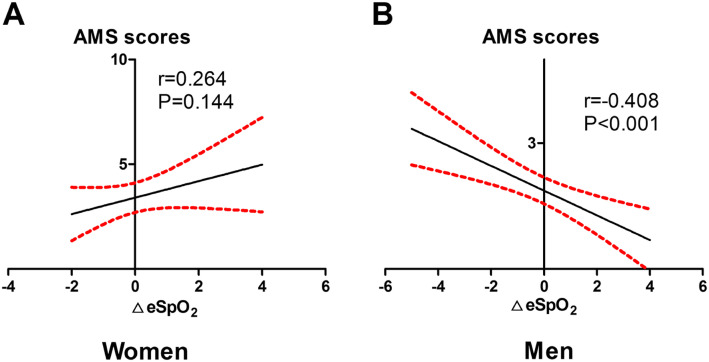
Results: Among the 99 assessable subjects, 47 (23 men and 24 women) developed AMS at 4100 m. In comparison to the subjects without AMS, those who developed AMS had lower proportion of men (48.9% vs. 84.6%, P < 0.001), height (168.4 ± 5.9 vs. 171.3 ± 6.1 cm, P = 0.019), weight (62.0 ± 10.0 vs. 66.7 ± 8.6 kg, P = 0.014) and proportion of smokers (23.4% vs. 51.9%, P = 0.004). Multivariate regression analysis revealed the following independent risks for AMS: female sex (odds ratio (OR) =6.32, P < 0.001), SpO2 change upon exercise at low altitude (OR = 0.63, P = 0.002) and systolic BP change after the ascent (OR = 0.96, P = 0.029). Women had larger reduction in SpO2 after the ascent, higher AMS percentage and absolute AMS score. Larger reduction of SpO2 after exercise was associated with both AMS incidence (P = 0.001) and AMS score (P < 0.001) in men but not in women.
Conclusions: Larger SpO2 reduction after exercise at low altitude was an independent risk for AMS upon ascent. Such an association was more robust in men than in women.
Trial registration: Chinese Clinical Trial Registration, ChiCTR1900025728 . Registered 6 September 2019.
Keywords: Acute mountain sickness; Exercise testing; High altitude; Individual susceptibility; Sex differences.
Conflict of interest statement
The authors declare that they have no competing interests.
Figures
References
-
- Basnyat B. Acute high-altitude illnesses. N Engl J Med. 2013;369(17):1666. - PubMed
Publication types
MeSH terms
Associated data
LinkOut - more resources
Full Text Sources
Medical
