


Family history of non-communicable diseases and associations with weight and movement behaviours in Australian school-aged children: a prospective study
- PMID: 33148740
- PMCID: PMC7640516
- DOI: 10.1136/bmjopen-2020-038789
Family history of non-communicable diseases and associations with weight and movement behaviours in Australian school-aged children: a prospective study
Abstract
Objective: To assess differences in weight status and movement behaviour guideline compliance among children aged 5-12 years with and without a family history of non-communicable diseases (NCDs).
Design: Prospective.
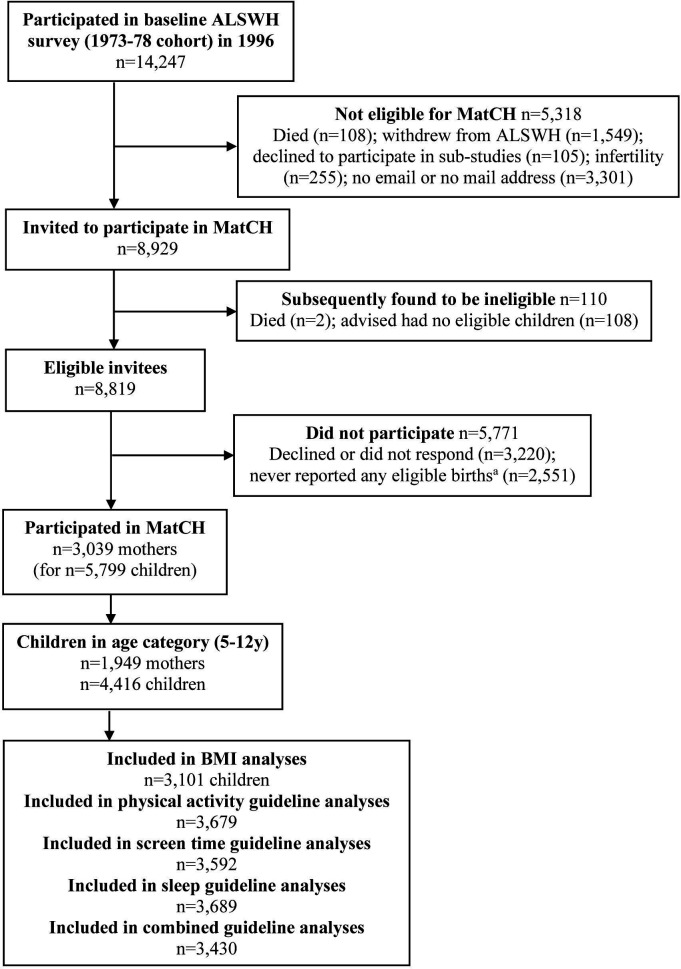
Setting and participants: Women born between 1973 and 1978 were recruited to the Australian Longitudinal Study on Women's Health (ALSWH) via the database of the Health Insurance Commission (now Medicare; Australia's universal health insurance scheme). In 2016-2017, women in that cohort were invited to participate in the Mothers and their Children's Health Study and reported on their three youngest children (aged <13 years). Data from children aged 5-12 years (n=4416) were analysed.
Measures: Mothers reported their children's height and weight, used to calculate body mass index (kg/m2), physical activity, screen time and sleep. In the 2015 ALSWH Survey, women reported diagnoses and family history of type 2 diabetes, heart disease and hypertension. Logistic regression models determined differences between outcomes for children with and without a family history of NCDs.
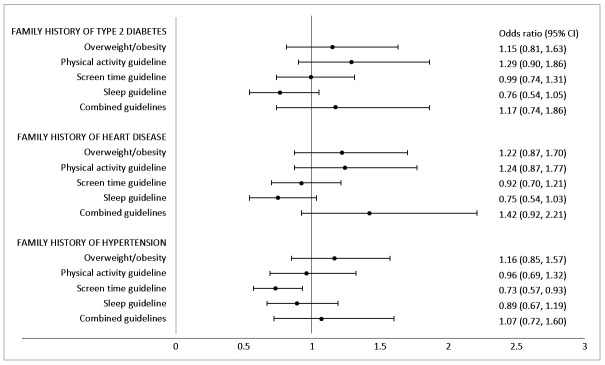
Results: Boys with a family history of type 2 diabetes had 30% (95% CI: 0.51%-0.97%) and 43% lower odds (95% CI: 0.37%-0.88%) of meeting the sleep and combined guidelines, respectively, and 40% higher odds (95% CI: 1.01%- 1.95%) of being overweight/obese. Girls with a family history of hypertension had 27% lower odds (95% CI: 0.57%-0.93%) of meeting the screen time guidelines. No associations were observed for family history of heart disease.
Conclusions: Children who have a family history of type 2 diabetes and hypertension may be at risk of poorer health behaviours from a young age. Mothers with a diagnosis or a family history of these NCDs may need additional support to help their children develop healthy movement behaviours and maintain healthy weight.
Keywords: community child health; epidemiology; public health.
© Author(s) (or their employer(s)) 2020. Re-use permitted under CC BY-NC. No commercial re-use. See rights and permissions. Published by BMJ.
Conflict of interest statement
Competing interests: None declared.
Figures

References
Publication types
MeSH terms
LinkOut - more resources
Full Text Sources
Medical
