


Effects of social distancing and isolation on epidemic spreading modeled via dynamical density functional theory
- PMID: 33149128
- PMCID: PMC7643184
- DOI: 10.1038/s41467-020-19024-0
Effects of social distancing and isolation on epidemic spreading modeled via dynamical density functional theory
Abstract
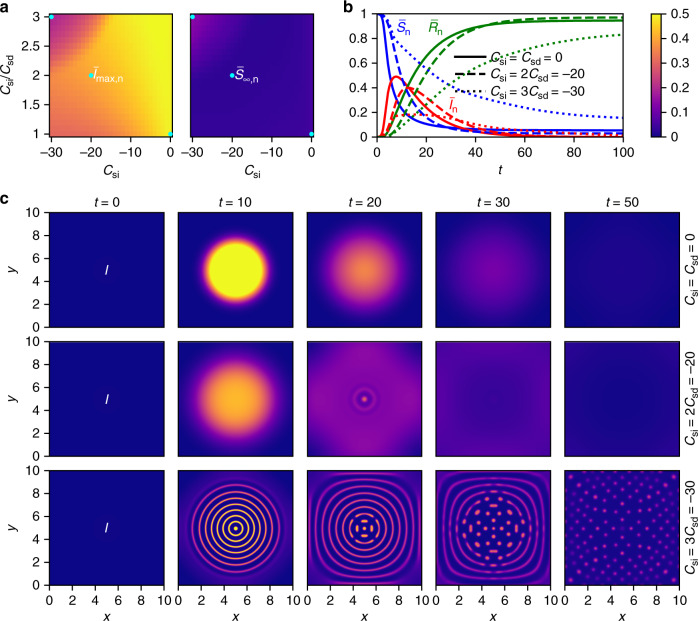
For preventing the spread of epidemics such as the coronavirus disease COVID-19, social distancing and the isolation of infected persons are crucial. However, existing reaction-diffusion equations for epidemic spreading are incapable of describing these effects. In this work, we present an extended model for disease spread based on combining a susceptible-infected-recovered model with a dynamical density functional theory where social distancing and isolation of infected persons are explicitly taken into account. We show that the model exhibits interesting transient phase separation associated with a reduction of the number of infections, and allows for new insights into the control of pandemics.
Conflict of interest statement
The authors declare no competing interests.
Figures
References
-
- Poland, J. D. & Dennis, D. T. Plague. In Evans, A. S. & Brachman, P. S. (eds.) Bacterial Infections of Humans, 545–558 (Springer, Boston, 1998).
-
- Cliff A, Smallman-Raynor M. Oxford textbook of infectious disease control: a geographical analysis from medieval quarantine to global eradication. Oxford: Oxford University Press; 2013.
Publication types
MeSH terms
LinkOut - more resources
Full Text Sources
