


doi: 10.1038/s41375-020-01066-4.
Epub 2020 Nov 4.
Targeting RNA-binding proteins in acute and chronic leukemia
Affiliations
- PMID: 33149266
- PMCID: PMC7868134
- DOI: 10.1038/s41375-020-01066-4
Item in Clipboard
Targeting RNA-binding proteins in acute and chronic leukemia
Leukemia.
2021 Feb.
Abstract
RNA-binding proteins (RBPs) play a crucial role in cellular physiology by regulating RNA processing, translation, and turnover. In neoplasms, RBP support of cancer-relevant expression of alternatively spliced, modified, and stabilized mRNA transcripts is essential to self-renewal, proliferation, and adaptation to stress. In this review, we assess the impact of key families of RBPs in leukemogenesis, review progress in targeting those proteins with small molecules, and discuss how multilevel composition of posttranscriptional regulation of gene expression could be used for potential therapies in acute and chronic leukemia.
Conflict of interest statement
Conflict of interest
The authors declare no conflicts of interest.
Figures
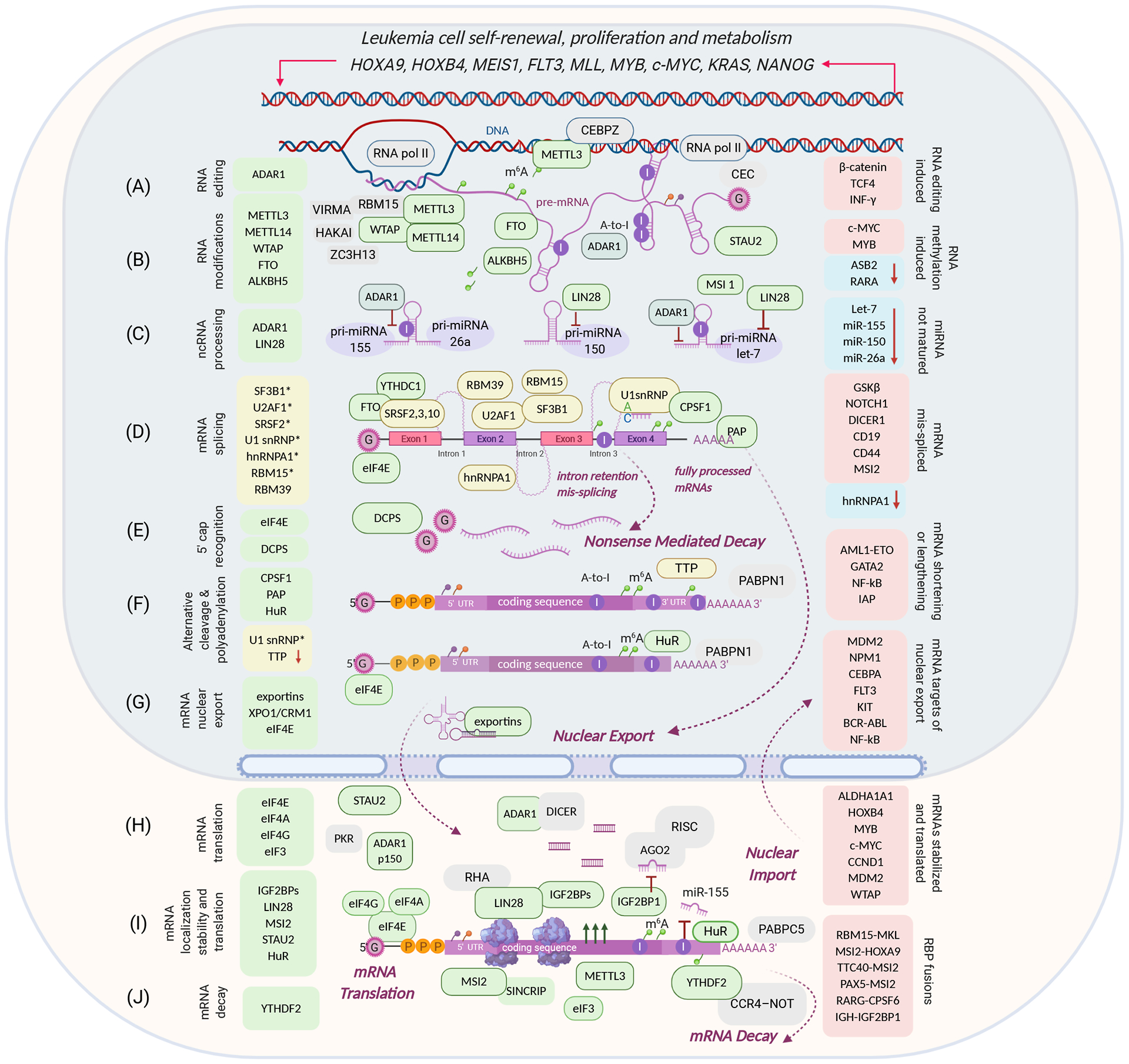
RNA-binding proteins are listed on the left side of the diagram: upregulation, gain-of-function (green), loss- or change-of-function (yellow, arrow down, *mutation). Target genes are listed on the right side of the diagram: upregulated oncogenes (red boxes), tumor suppressor gene inactivation (blue boxes, arrow down). (A) ADAR1 regulates miRNA biogenesis in an A-to-I editing-dependent manner (C), A-to-I editing affects mRNA stability (I); (B) RNA modifying enzymes facilitate m6A methylation (METTL3/14), demethylation (FTO, ALKBH5), substrate recognition (WTAP, RBM15); METTL3 can co-localize with DNA in the nucleus and enhance mRNA translation in the cytoplasm; (C) noncoding RNA processing: ADAR1 and LIN28 suppress maturation of miRNA let-7, miR-155, miR-150, and miR-26a; (D) RNA splicing factors are often mutated in chronic leukemia and/or mis-spliced in acute leukemia producing more mis-spliced pro-oncogenic mRNA isoforms; (E) 5’ cap recognizing enzymes that either promote mRNA nuclear export and translation (eIF4E) or destabilize mRNA (DCPS); (F) alternative cleavage and polyadenylation, occurring during splicing (D), is characterized by mRNA 3’UTRs shortening or lengthening; shorter 3’UTRs increase stability and expression of oncogenic transcripts; downregulation or deactivation of 3’UTR-binding protein TTP increases mRNA abundance; (G) high expression levels of nuclear export regulators (exportins, XPO1/CRM1, eIF4E) increase transport and translation of oncogenic factors; (H) high levels of eIF4E promote nuclear export and translation of selective proto-oncogenic targets; (I) increased mRNA stability and translation of oncogenic transcripts through multiple post-transcriptional events, including reactivation of oncofetal proteins LIN28 and IGF2BPs; (J) m6A reader YTHDF2 targets mRNAs for CCR4-NOT-dependent deadenylation and degradation.
References
-
- Hentze MW, Castello A, Schwarzl T, Preiss T. A brave new world of RNA-binding proteins. Nat Rev Mol Cell Biol 2018. May; 19(5): 327–341. - PubMed
-
- Wang Q, Khillan J, Gadue P, Nishikura K. Requirement of the RNA editing deaminase ADAR1 gene for embryonic erythropoiesis. Science 2000. December 1; 290(5497): 1765–1768. - PubMed
Publication types
MeSH terms
Substances
Grants and funding
LinkOut - more resources
Full Text Sources
Medical
