


Teleneuropsychology for Monolingual and Bilingual Spanish-Speaking Adults in the Time of COVID-19: Rationale, Professional Considerations, and Resources
- PMID: 33150414
- PMCID: PMC7665473
- DOI: 10.1093/arclin/acaa100
Teleneuropsychology for Monolingual and Bilingual Spanish-Speaking Adults in the Time of COVID-19: Rationale, Professional Considerations, and Resources
Abstract
Objective: Neuropsychological assessments with monolingual Spanish and bilingual Spanish/English-speaking adults present unique challenges. Barriers include, but are not limited to, the paucity of test norms, uncertainty about the equivalence of translated neuropsychological tests, and limited proficiency in the provision of culturally competent services. Similar issues generalize to telephone- and video-based administration of neuropsychological tests or teleneuropsychology (TeleNP) with Hispanics/Latinos (as), and few studies have examined its feasibility and validity in this group. The sudden onset of the COVID-19 pandemic prompted neuropsychologists to identify alternative ways to provide equitable care. Clinicians providing TeleNP to this population during (and after) the pandemic must consider safety, professional factors, and systemic barriers to accessing and benefitting from virtual modalities.
Method: This clinical process manuscript describes how cross-cultural neuropsychologists across five U.S. academic institutions serving Hispanics/Latinos (as) developed TeleNP models of care during the pandemic.
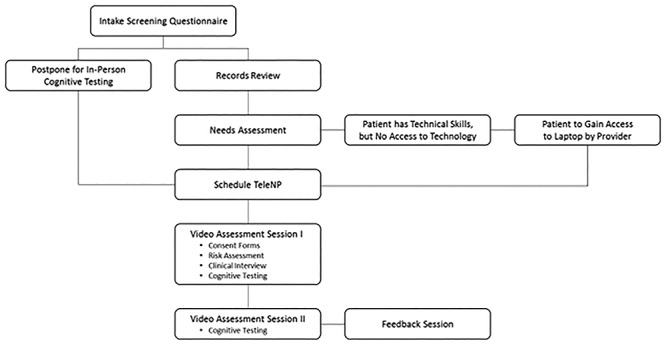
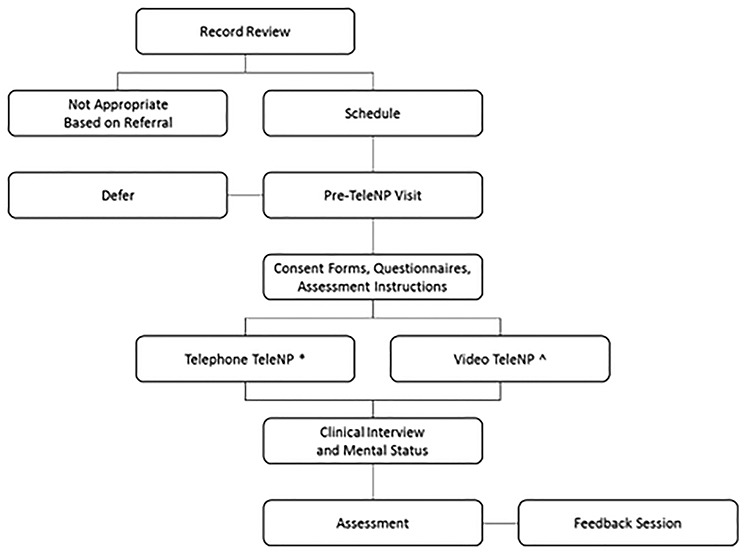
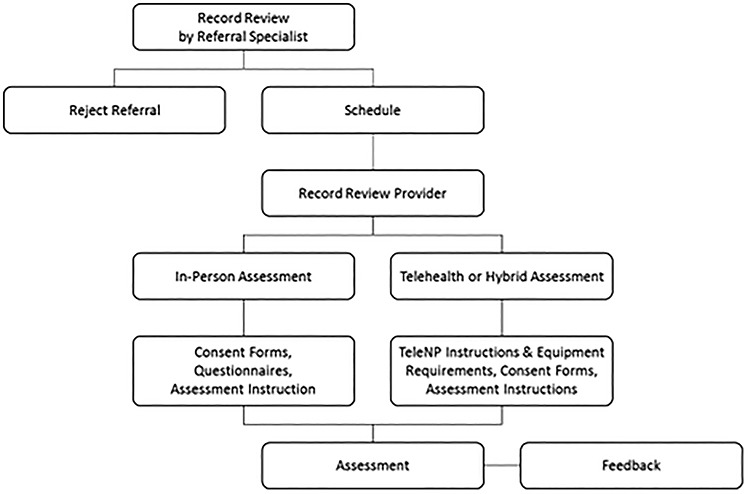
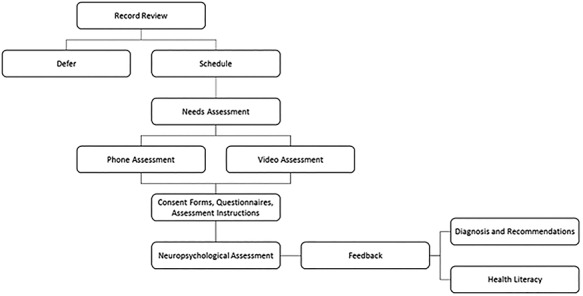
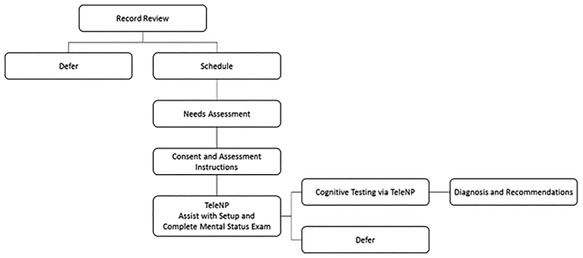
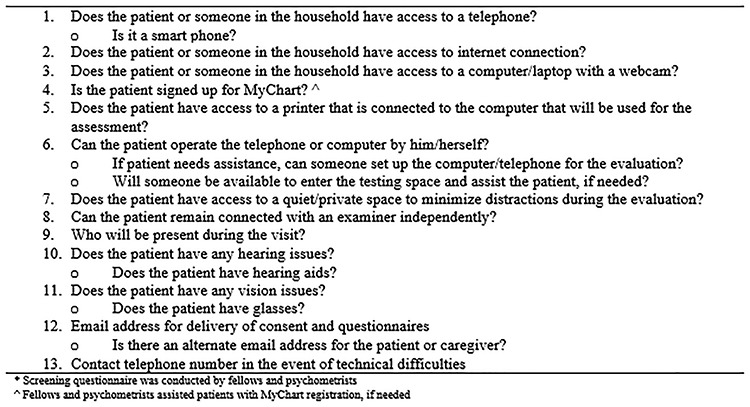
Results: Workflows, test batteries, and resources for TeleNP assessment with monolingual and bilingual Spanish-speaking patients are included. Factors guiding model development and informing decisions to incorporate virtual administration of neuropsychological tests into their practice are also discussed.
Conclusions: Provision of TeleNP is a promising modality. Additional research in this area is warranted with focus on cultural and contextual factors that support or limit the use of TeleNP with this community.
Keywords: COVID-19; Cross-cultural Minority; Spanish-speaking Patients; Teleneuropsychology.
© The Author(s) 2020. Published by Oxford University Press. All rights reserved. For permissions, please e-mail: journals.permissions@oup.com.
Figures
References
-
- American Psychological Association (2002). Ethical principles of psychologists and code of conduct. American Psychologist, 57(12), 1060–1073. - PubMed
-
- American Psychological Association (2013). Guidelines for the practice of telepsychology. American Psychologist, 68(9), 791–800. - PubMed
-
- American Psychological Association (2016). Revision of ethical standard 3.04 of the “ethical principles of psychologists and code of conduct” (2002, as amended 2010). American Psychologist, 71(9), 900. - PubMed
-
- Arango-Lasprilla J. C., Rivera D., Garza M. T., Saracho C. P., Rodríguez W., Rodríguez-Agudelo Y. et al. (2015). Hopkins verbal learning test-revised: Normative data for the Latin American Spanish-speaking adult population. Neurorehabilitation, 37(4), 699–718. - PubMed
-
- Ardila A. (2003). Culture in our brains: Cross-cultural differences in the brain-behavior relationships In Toomela A. (Ed.), Cultural guidance in the development of the human mind (, pp. 63–86). Westport, CT: Ablex Publishing.
MeSH terms
Grants and funding
LinkOut - more resources
Full Text Sources
Medical
