


Identification of gene targets of developmental neurotoxicity focusing on DNA hypermethylation involved in irreversible disruption of hippocampal neurogenesis in rats
- PMID: 33150595
- PMCID: PMC8247304
- DOI: 10.1002/jat.4089
Identification of gene targets of developmental neurotoxicity focusing on DNA hypermethylation involved in irreversible disruption of hippocampal neurogenesis in rats
Abstract
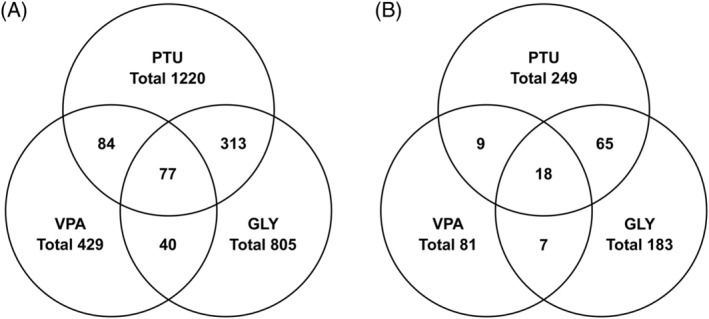
We have previously found that maternal exposure to 6-propyl-2-thiouracil (PTU), valproic acid (VPA), or glycidol (GLY) has a sustained or late effect on hippocampal neurogenesis at the adult stage in rat offspring. Herein, we searched for genes with hypermethylated promoter region and downregulated transcript level to reveal irreversible markers of developmental neurotoxicity. The hippocampal dentate gyrus of male rat offspring exposed maternally to PTU, VPA, or GLY was subjected to Methyl-Seq and RNA-Seq analyses on postnatal day (PND) 21. Among the genes identified, 170 were selected for further validation analysis of gene expression on PND 21 and PND 77 by real-time reverse transcription-PCR. PTU and GLY downregulated many genes on PND 21, reflecting diverse effects on neurogenesis. Furthermore, genes showing sustained downregulation were found after PTU or VPA exposure, reflecting a sustained or late effect on neurogenesis by these compounds. In contrast, such genes were not observed with GLY, probably because of the reversible nature of the effects. Among the genes showing sustained downregulation, Creb, Arc, and Hes5 were concurrently downregulated by PTU, suggesting an association with neuronal mismigration, suppressed synaptic plasticity, and reduction in neural stem and progenitor cells. Epha7 and Pvalb were also concurrently downregulated by PTU, suggesting an association with the reduction in late-stage progenitor cells. VPA induced sustained downregulation of Vgf and Dpysl4, which may be related to the aberrations in synaptic plasticity. The genes showing sustained downregulation may be irreversible markers of developmental neurotoxicity.
Keywords: 6-propyl-2-thiouracil (PTU); developmental neurotoxicity (DNT); gene expression; glycidol (GLY); hippocampal neurogenesis; methylation; rat; valproic acid (VPA).
© 2020 The Authors. Journal of Applied Toxicology published by John Wiley & Sons Ltd.
Conflict of interest statement
All authors declare that there are no conflicts of interest that influenced the outcome of the present study.
Figures
References
-
- Akane, H. , Saito, F. , Shiraki, A. , Takeyoshi, M. , Imatanaka, N. , Itahashi, M. , … Shibutani, M. (2014). Downregulation of immediate‐early genes linking to suppression of neuronal plasticity in rats after 28‐day exposure to glycidol. Toxicology and Applied Pharmacology, 279(2), 150–162. 10.1016/j.taap.2014.05.017 - DOI - PubMed
-
- Akane, H. , Saito, F. , Yamanaka, H. , Shiraki, A. , Imatanaka, N. , Akahori, Y. , … Shibutani, M. (2013). Methacarn as a whole brain fixative for gene and protein expression analyses of specific brain regions in rats. Journal of Toxicological Sciences, 38(3), 431–443. 10.2131/jts.38.431 - DOI - PubMed
-
- Akane, H. , Shiraki, A. , Imatanaka, N. , Akahori, Y. , Itahashi, M. , Ohishi, T. , … Shibutani, M. (2013). Glycidol induces axonopathy by adult‐stage exposure and aberration of hippocampal neurogenesis affecting late‐stage differentiation by developmental exposure in rats. Toxicological Sciences, 134(1), 140–154. 10.1093/toxsci/kft092 - DOI - PubMed
Publication types
MeSH terms
Substances
LinkOut - more resources
Full Text Sources
Miscellaneous
