Long-Term Efficacy of Prophylactic Cavotricuspid Isthmus Ablation during Atrial Fibrillation Ablation in Patients Without Typical Atrial Flutter: a Prospective, Multicentre, Randomized Trial
- PMID: 33150753
- PMCID: PMC7779821
- DOI: 10.4070/kcj.2020.0174
Long-Term Efficacy of Prophylactic Cavotricuspid Isthmus Ablation during Atrial Fibrillation Ablation in Patients Without Typical Atrial Flutter: a Prospective, Multicentre, Randomized Trial
Abstract
Background and objectives: Cavotricuspid isthmus (CTI) block is easily achieved, and prophylactic ablation can be performed during atrial fibrillation (AF) ablation. However, the previous study was too small and short-term to clarify the efficacy of this block.
Methods: Patients who underwent catheter ablation for paroxysmal AF were enrolled, and patients who had previous or induced atrial flutter (AFL) were excluded. We randomly assigned 366 patients to pulmonary vein isolation (PVI) only and prophylactic CTI ablation (PVI vs. PVI+CTI).
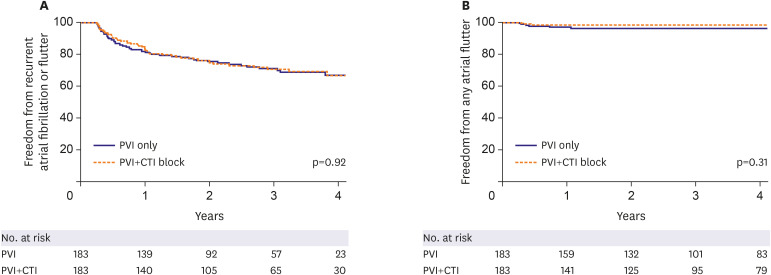
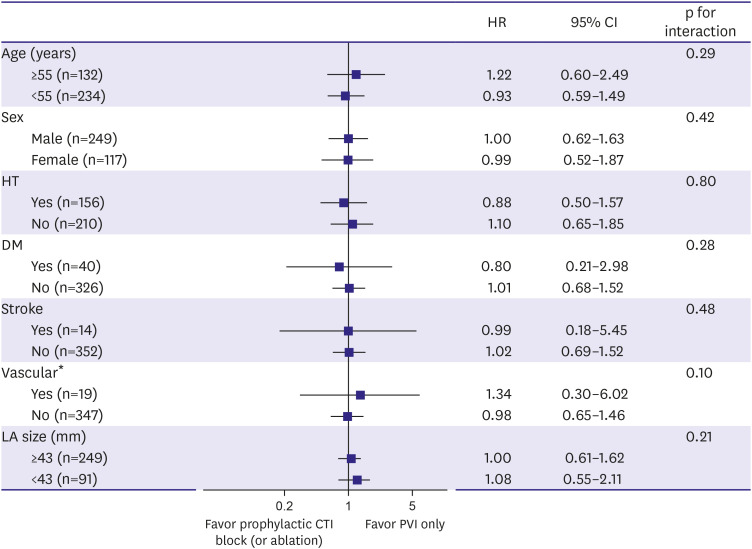
Results: There was no significant difference in procedure time between the two groups because most CTI blocks were performed during the waiting time after the PVI (176.8±72.6 minutes in PVI vs. 174.2±76.5 minutes in PVI+CTI, p=0.75). All patients were followed up for at least 18 months, and the median follow-up was 3.4 years. The recurrence rate of AF or AFL was not different in the 2 groups (25.7% in PVI vs. 25.7% in PVI+CTI, p=0.92). The recurrence rate of any AFL was not significantly different in the 2 groups (3.3% in PVI vs. 1.6% in PVI+CTI, p=0.31). The recurrence rate of typical AFL also was not different (0.5% in PVI vs. 0.5% in PVI+CTI, p=0.99).
Conclusions: In this large and long-term follow-up study, prophylactic CTI ablation had no benefit in patients with paroxysmal AF without typical AFL.
Trial registration: ClinicalTrials.gov Identifier: NCT02031705.
Keywords: Atrial fibrillation; Atrial flutter; Catheter ablation.
Copyright © 2021. The Korean Society of Cardiology.
Conflict of interest statement
The authors have no financial conflicts of interest.
Figures
References
-
- Feld G, Wharton M, Plumb V, et al. Radiofrequency catheter ablation of type 1 atrial flutter using large-tip 8- or 10-mm electrode catheters and a high-output radiofrequency energy generator: results of a multicenter safety and efficacy study. J Am Coll Cardiol. 2004;43:1466–1472. - PubMed
-
- Calkins H, Canby R, Weiss R, et al. Results of catheter ablation of typical atrial flutter. Am J Cardiol. 2004;94:437–442. - PubMed
-
- Hsieh MH, Tai CT, Chiang CE, et al. Recurrent atrial flutter and atrial fibrillation after catheter ablation of the cavotricuspid isthmus: a very long-term follow-up of 333 patients. J Interv Card Electrophysiol. 2002;7:225–231. - PubMed
-
- Scharf C, Veerareddy S, Ozaydin M, et al. Clinical significance of inducible atrial flutter during pulmonary vein isolation in patients with atrial fibrillation. J Am Coll Cardiol. 2004;43:2057–2062. - PubMed
-
- Roithinger FX, Karch MR, Steiner PR, SippensGroenewegen A, Lesh MD. Relationship between atrial fibrillation and typical atrial flutter in humans: activation sequence changes during spontaneous conversion. Circulation. 1997;96:3484–3491. - PubMed
Associated data
LinkOut - more resources
Full Text Sources
Other Literature Sources
Medical