Review
. 2020 Dec;94(1):e106.
doi: 10.1002/cpns.106.

Recombinant Antibodies in Basic Neuroscience Research

Affiliations
Review

Recombinant Antibodies in Basic Neuroscience Research

James S Trimmer. Curr Protoc Neurosci. 2020 Dec.

Abstract

Basic neuroscience research employs antibodies as key reagents to label, capture, and modulate the function of proteins of interest. Antibodies are immunoglobulin proteins. Recombinant antibodies are immunoglobulin proteins whose nucleic acid coding regions, or fragments thereof, have been cloned into expression plasmids that allow for unlimited production. Recombinant antibodies offer many advantages over conventional antibodies including their unambiguous identification and digital archiving via DNA sequencing, reliable expression, ease and reliable distribution as DNA sequences and as plasmids, and the opportunity for numerous forms of engineering to enhance their utility. Recombinant antibodies exist in many different forms, each of which offers potential advantages and disadvantages for neuroscience research applications. I provide an overview of recombinant antibodies and their development. Examples of their emerging use as valuable reagents in basic neuroscience research are also discussed. Many of these examples employ recombinant antibodies in innovative experimental approaches that cannot be pursued with conventional antibodies. © 2020 Wiley Periodicals LLC.

Keywords: brain; immunocytochemistry; immunohistochemistry; intrabody; neuron.


Conflict of interest statement

Conflict of Interest

The author has no conflict of interest to declare.

Figures

Fig. 1.
Fig. 1.
Comparison of typical mammalian IgG and camelid heavy-chain only IgG and their derivatives. Left. A typical mammalian IgG molecule is a heterotetramer comprising two heavy and two light chains. Light chains comprise one variable (VL, light orange) and one constant domain (CL, light green). Heavy chains comprise one variable domain (VH, dark orange) and three constant domains (CH1–3, dark green). The primary region of covalent disulfide bond linkage of the two identical H + L chain heterodimers is shown by a purple bar. The functional antigen binding unit is formed by noncovalent association of the VL and VH domains. Typical mammalian H + L chain IgGs can be miniaturized to various forms including Fabs and ScFvs. The schematic of the VH domain shows the arrangement and typical sizes of the constituent FR and CDR segments. Approximate sizes of FR and CDR segments were derived from the IMTG database http://www.imgt.org/. Right. Camelid H chain-only IgGs lack light chains and exist as a homodimer of two identical H chains. The primary region of covalent disulfide bond linkage of the two identical H chain monomers is shown by a purple bar. The functional antigen binding unit is formed by a single VHH domain. This VHH domain can function autonomously as a nAb. The schematic of the VHH domain shows the arrangement and typical sizes of the constitutive FR and CDR segments, note elongated CDR3 relative to typical mammalian VH domain. Approximate sizes of FR and CDR segments were derived from Mitchell and Colwell, 2018.
Fig. 2.
Fig. 2.
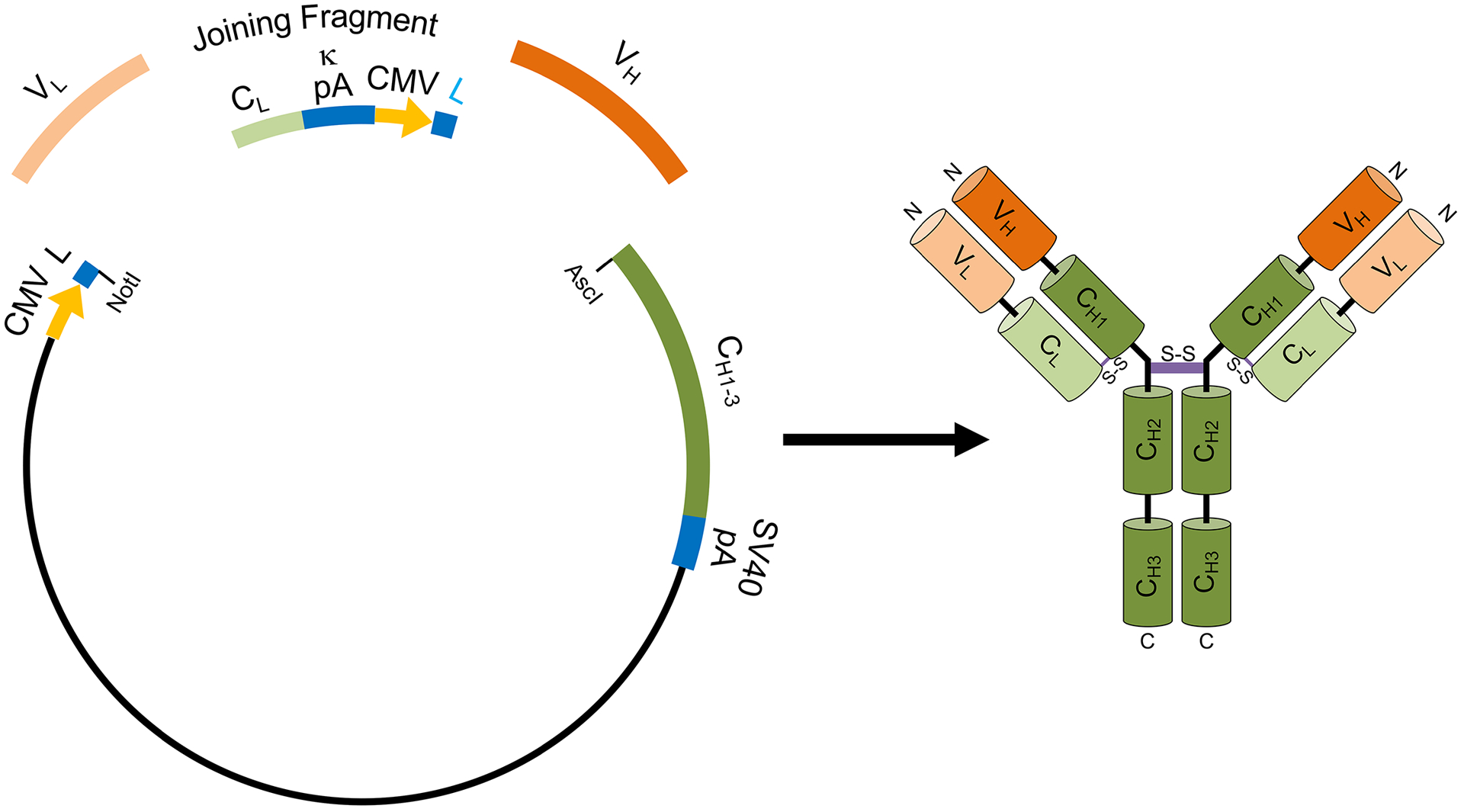
Example of an R-mAb expression plasmid. Schematic to the left shows the elements of the R-mAb expression plasmid as developed by Gavin Wright and colleagues (Crosnier et al., 2010) that we have used for our R-mAb expression (Andrews et al., 2019). This plasmid allows for coexpression of H + L chains as driven by two CMV promoters (yellow). In transfected mammalian cells the H + L chains coassemble to generate an intact IgG (right). Hybridoma-derived VL (light orange) and VH (dark orange) region PCR products or synthetic gene fragments are fused to a joining fragment comprising a κ light chain constant domain (CL) and the κ light chain polyA tail sequences (κ pA), a CMV promoter for heavy chain expression, and an ER signal/leader sequence (L) for translocation of the heavy chain across the ER membrane. PCR-mediated fusion of these three elements is followed by their insertion into the p1316 plasmid that contains an upstream CMV promoter for light chain expression, and an ER signal/leader sequence (L) for translocation of the light chain across the ER membrane. Downstream of the insert are the heavy chain constant regions (CH1–3) that are either γ1 or γ2a depending on the plasmid variant used, followed by the SV40 polyA tail (SV40 pA). Such plasmids can also be generated using Gibson assembly of the four elements (VL, joining fragment, VH and plasmid backbone).
Fig. 3.
Fig. 3.
Examples of generic forms of recombinant antibody engineering. Cartoon of various ways that recombinant antibodies (IgG, ScFVs, nAbs) can be engineered to enhance their utility. The top box shows a cartoon of various approaches to impact detection of recombinant antibodies. These include alternate heavy chain constant regions (CH1–3, in pink) to confer selective recognition by species- and or IgG subclass-specific secondary antibodies on R-mAbs, epitope and/or site-specific labeling tags (light blue) on R-mAbs, ScFVs and nAbs, and GFP (bright green) or other fluorescent proteins on ScFV and nAbs (primarily on those used as intrabodies). The middle box shows a cartoon of an ScFV and a nAb (primarily on those used as intrabodies) fused to a protein (dark blue) that confers functionality (protein degradation, enzymatic activity, etc.) to influence target protein, subcellular compartment and/or cellular function. The bottom box shows a cartoon demonstrating mutations (red dots) generated within the VH and VL regions of R-mAbs or ScFVs, or within the VHH region of nAbs. As these regions comprise the antigen (target) binding domains, such mutations can impact the efficacy and specificity of antigen (target) binding.
Fig. 4.
Fig. 4.
Flow chart of generic pipelines for developing R-mAbs and ScFVs from existing mAbs. Top two rows show a schematic overview of the major steps involved in generation of R-mAbs from mAb-producing hybridomas. The top row shows a PCR-based cloning based approach whereby VH and VL region fragments are amplified using degenerate primer sets, cloned into an expression plasmid such as that shown in Fig. 2, the R-mAbs expressed and functionally characterized relative to the corresponding conventional mAb. Positive clones are then sequenced and archived. The middle row shows a high-throughput sequencing approach based approach whereby VH and VL region fragments are amplified using degenerate primer sets including bar codes and the amplicons from many different hybridomas pooled and sequenced. The primary VH and VL region fragments are synthesized and cloned into an expression plasmid such as that shown in Fig. 2, the R-mAbs expressed and functionally characterized relative to the corresponding conventional mAb. The bottom row shows a schematic of typical approach used to develop ScFVs from existing R-mAbs. One of the approaches above is used to obtain R-mAb VH and VL region sequences. These are used to design a synthetic gene fragment that has these sequences fused with an intervening flexible linker sequence. This gene fragment is then cloned into a mammalian or bacterial expression plasmid with suitable promoter and leader sequences and used for expression of secreted ScFVs, or expression plasmids without a leader sequence for expression as intrabodies.
Fig. 5.
Fig. 5.
Flow chart of generic pipelines for de novo ScFV, R-mAb and nAb development. The top row shows a PCR-based cloning based approach to develop ScFVs. The VH and VL region fragments are amplified from mammalian (non-camelid) B cells using degenerate primer sets, and are used to generate a high complexity cDNA library of ScFVs by fusing the VH and VL region fragments with an intervening flexible linker, which are cloned into an expression plasmid, and expressed ScFVs that bind to the target protein isolated by phage display or another appropriate selection method. Selected ScFVs are further characterized and sequenced. The middle row shows a schematic of one approach used to develop R-mAbs from ScFVs obtained from such a de novo approach. Selected ScFV-derived VH and VL region fragments are cloned into an expression plasmid such as that shown in Fig. 2, and the encoded R-mAbs expressed and functionally characterized. The bottom row shows a PCR-based cloning based approach to develop nAbs. VHH region fragments are amplified from camelid B cells using degenerate primer sets, and are used to generate a high complexity cDNA library of nAbs which are cloned into an expression plasmid, and expressed nAbs that bind to the target protein isolated by phage display or another appropriate selection method. Selected nAbs are further characterized and sequenced.

References

    1. Almagro JC, Pedraza-Escalona M, Arrieta HI, & Perez-Tapia SM (2019). Phage display libraries for antibody therapeutic discovery and development. Antibodies (Basel), 8(3). doi: 10.3390/antib8030044 - DOI - PMC - PubMed
    1. Andrews NP, Boeckman JX, Manning CF, Nguyen JT, Bechtold H, Dumitras C, … Trimmer JS (2019). A toolbox of IgG subclass-switched recombinant monoclonal antibodies for enhanced multiplex immunolabeling of brain. eLife, 8, e43322. doi: 10.7554/eLife.43322 - DOI - PMC - PubMed
    1. Anliker B, Abel T, Kneissl S, Hlavaty J, Caputi A, Brynza J, … Buchholz CJ (2010). Specific gene transfer to neurons, endothelial cells and hematopoietic progenitors with lentiviral vectors. Nat Methods, 7(11), 929–935. doi: 10.1038/nmeth.1514 - DOI - PubMed
    1. Bates A, & Power CA (2019). David vs. Goliath: the structure, function, and clinical prospects of antibody fragments. Antibodies (Basel), 8(2). doi: 10.3390/antib8020028 - DOI - PMC - PubMed
    1. Bekele-Arcuri Z, Matos MF, Manganas L, Strassle BW, Monaghan MM, Rhodes KJ, & Trimmer JS (1996). Generation and characterization of subtype-specific monoclonal antibodies to K+ channel alpha- and beta-subunit polypeptides. Neuropharmacology, 35(7), 851–865. - PubMed

Publication types