Cochlear Implantation in Children With Single-Sided Deafness: A Systematic Review and Meta-analysis
- PMID: 33151295
- PMCID: PMC7645748
- DOI: 10.1001/jamaoto.2020.3852
Cochlear Implantation in Children With Single-Sided Deafness: A Systematic Review and Meta-analysis
Abstract
Importance: In 2019, the US Food and Drug Administration approved cochlear implantation for children with single-sided deafness (SSD). The absence of robust clinical data specific to pediatric patients to guide shared decision-making and to identify potential advantages is a challenge in family counseling.
Objective: To evaluate the audiological and patient-reported outcomes in children who underwent cochlear implantation for SSD and to assess the association between time of implantation, subjective outcomes, and cochlear implant device use rates.
Data source: MEDLINE, Embase, Scopus, Cochrane, and PubMed were searched for English-language articles that were published in a peer-reviewed journal from database inception to February 18, 2020.
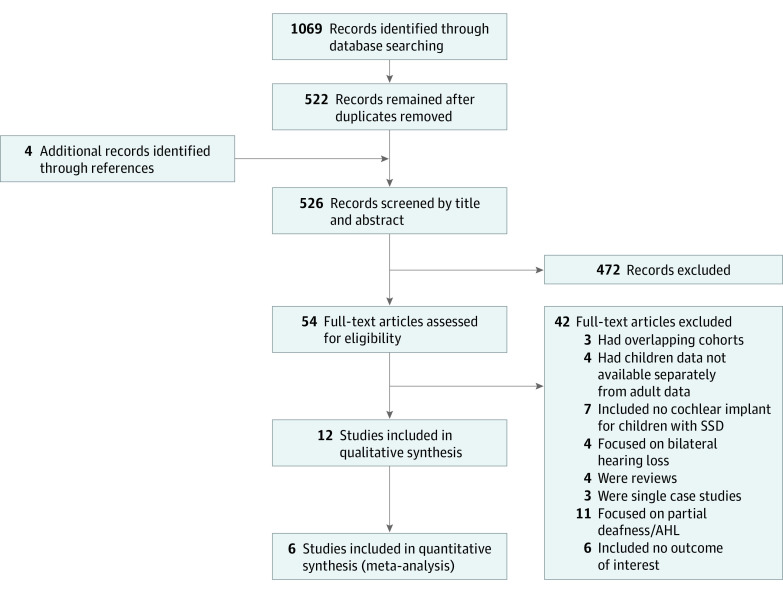
Study selection: Inclusion criteria were designed to capture studies that evaluated pediatric patients (1) younger than 18 years, (2) with a diagnosis of SSD for which they underwent a cochlear implantation, and (3) with at least 1 outcome of interest measured numerically: speech perception, sound localization, device use, and patient-reported outcomes. Of the 526 articles reviewed, 12 (2.3%) met the selection criteria.
Data extraction and synthesis: The Meta-analyses Of Observational Studies in Epidemiology (MOOSE) reporting guidelines were followed. Data were pooled using fixed-effect and random-effect models. The following information was obtained from each article: study characteristics, patient characteristics, hearing loss and intervention characteristics, and outcomes.
Main outcomes and measures: Outcomes were (1) postoperative changes in speech perception (in quiet was measured as a proportion of correct responses, and in noise was measured as decibel signal to noise ratio for speech reception threshold) and sound localization (measured in degree of localization error), (2) patient-reported audiological outcomes (measured by the speech, spatial, and qualities of hearing scale), and (3) device use rates among children who received cochlear implantation for SSD.
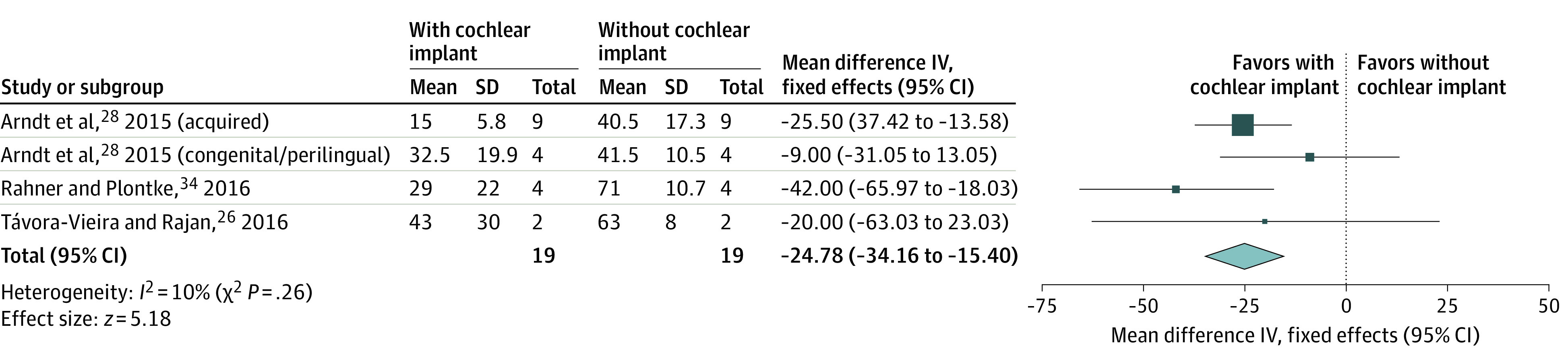
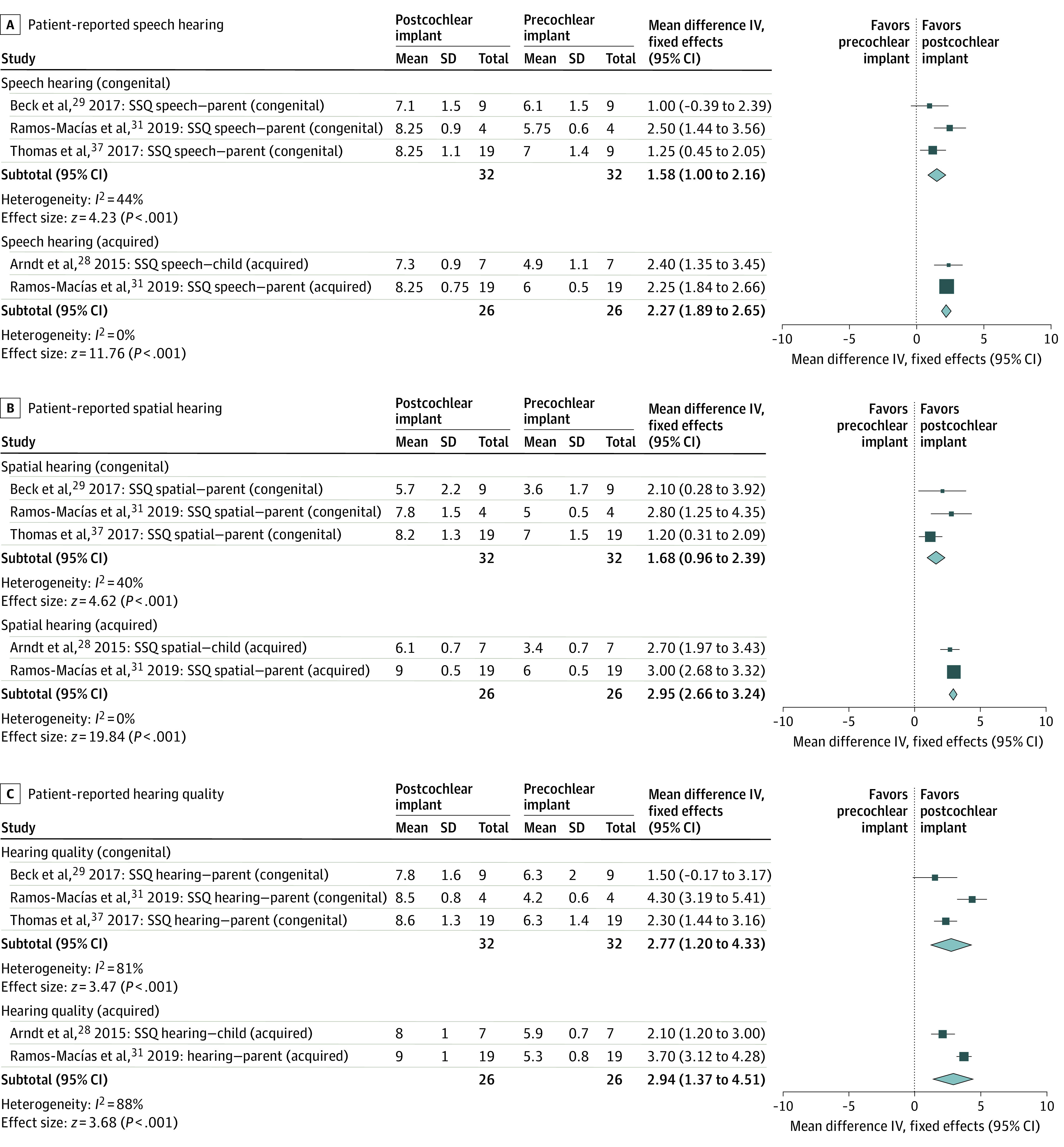
Results: Twelve observational studies that evaluated 119 children (mean [SD] age, 6.6 [4.0] years) with SSD who received a cochlear implant were included. Most children showed clinically meaningful improvement in speech perception in noise (39 of 49 children [79.6%]) and in quiet (34 of 42 children [81.0%]). Long duration of deafness (>4 years in congenital SSD and >7 years in perilingual SSD) was the most commonly proposed reason for lack of improvement. Sound localization as measured by degrees of error from true location (mean difference [MD], -24.78°; 95% CI, -34.16° to -15.40°; I2 = 10%) improved statistically significantly after cochlear implantation. Patients with acquired SSD and shorter duration of deafness compared with those with congenital SSD reported greater improvements in speech (MD, 2.27; 95% CI, 1.89-2.65 vs 1.58; 95% CI, 1.00-2.16) and spatial (MD, 2.95; 95% CI, 2.66-3.24 vs 1.68; 95% CI, 0.96-2.39) hearing qualities. The duration of deafness among device nonusers was statistically significantly longer than the duration of deafness among regular device users (median difference, 6.84; 95% CI, 4.02-9.58).
Conclusions and relevance: This systematic review and meta-analysis found that cochlear implantation for children with SSD was associated with clinically meaningful improvements in audiological and patient-reported outcomes; shorter duration of deafness may lead to better outcomes. These findings can guide future research efforts, refine cochlear implantation candidacy criteria, and aid in family counseling and shared decision-making.
Conflict of interest statement
Figures
References
Publication types
MeSH terms
Grants and funding
LinkOut - more resources
Full Text Sources
Other Literature Sources
Medical
Miscellaneous