Multicenter Study
. 2020 Dec;46(6):1227-1237.
doi: 10.1007/s00068-020-01537-4. Epub 2020 Nov 5.

Bone metabolism is a key factor for clinical outcome of tibial plateau fractures

Affiliations
Multicenter Study

Bone metabolism is a key factor for clinical outcome of tibial plateau fractures

Matthias Krause et al. Eur J Trauma Emerg Surg. 2020 Dec.

Abstract

Purpose: Given that tibial plateau fractures (TPF) are rare, they may pose a challenge to the treating surgeon due to their variety of complex fracture patterns. Numerous studies have identified potential fracture-specific, surgery-related, and patient-related risk factors for impaired patient outcomes. However, reports on the influence of bone metabolism on functional outcomes are missing.

Methods: In a retrospective multicenter cohort study, 122 TPF of 121 patients were analyzed with respect to radiological and clinical outcomes (Rasmussen) with a mean follow-up of 35.7 ± 24.9 months. The risk factor assessment included bone metabolism-affecting comorbidities and medication.

Results: The findings showed that 95.9% of the patients reported a good-to-excellent clinical outcome, and 97.4% reported a good-to-excellent radiological outcome. Logistic regression revealed that potentially impaired bone metabolism (IBM) was an independent risk factor for the clinical (p = 0.016) but not the radiological outcome (Table 4). Patients with 41-type B fractures and a potential IBM had a seven times higher risk to present a fair-to-poor clinical outcome [OR 7.45, 95 CI (4.30, 12.92)]. The most common objective impairment was a limited range of motion in 16.4% of the patients, especially in 41-type C fractures (p = 0.06). The individual failure analysis additionally identified surgery-related options for improvement.

Conclusion: This study demonstrated that potential IBM was an independent risk factor for a poor-to-fair clinical outcome.

Keywords: Bone metabolism; Failure analysis; Follow-up; Ten-segment classification; Tibial plateau fracture.


Conflict of interest statement

All authors declare that they have no conflict of interest.

Figures

Fig. 1
Fig. 1
A 50-year-old male with a bicondylar TPF [AO 41-type C3, medial split, lateral comminution involving the tibial spine and the most severe depression in the postero-latero-central (PLC) segment, pre-OP] after a motorcycle accident. A 1-month follow-up (FU) after lateral unilateral plating and antero-posterior screw fixation of the medial plateau showed anatomic articular reconstruction medially and laterally via an anterolateral and posteromedial approach, including an osteotomy of the medial femoral epicondyle for improved visualization (1-month FU). At the 16-month FU, lateral and medial loss of reduction (red arrows in anterior–posterior (ap) view and red line in sagittal view) with a substantial subchondral bone defect (red dotted line in ap view) accompanied with a medial bony union (yellow dotted line) could be observed. Primarily, the postero-latero-lateral and the PLC segments were affected (red dotted line in axial view). The patient presented with bone metabolism-affecting comorbidities, including human immunodeficiency virus with anti-retroviral therapy and a long-term proton-pump inhibitor prescription
Fig. 2
Fig. 2
A 50-year-old male with a bicondylar TPF (AO 41-type C3, medial split, lateral comminution involving the tibial spine and the most severe depression in the postero-latero-central segment, pre-OP) after a fall due to alcohol intoxication. A postoperative X-ray of the lateral and posterolateral reduction with individual plate fixation in addition to anatomic reduction and medial plate fixation of the medial tibial plateau (yellow head line). Medially, an additional jail screw supported subchondral fixation (post-OP). The 4-month follow-up (FU) showed secondary loss of reduction (red arrow in the anterior–posterior view) with a substantial subchondral bone defect (red dotted line), secondary intraarticular screw location, and an osteopenic bone stock (4-mo FU). The sagittal and axial views revealed an unfortunate screw placement into the fracture gap without providing sufficient stabilization. While the antero-posterior jail screw might not have had enough osteosynthetic subchondral bone support, there was no posteromedial buttress. Comorbidities included chronic hypocalcemia, chronic alcohol abuse, and long-term smoking
Fig. 3
Fig. 3
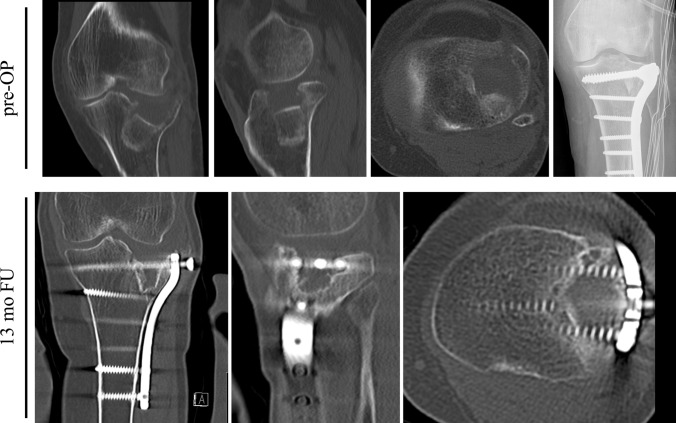
A 78-year-old female with a lateral depression fracture (AO 41-type B2, involving antero-latero-lateral, antero-latero-central segments, pre-OP) after a trip and fall. Surgical treatment included an anatomic reduction, transplantation with an autogenic cortico-cancellous iliac crest graft, and fixation with an anterolateral plate. A computed tomography scan at the 13-month follow-up revealed a severe osteochondral defect with a complete dissolution of the autogenic graft. The patient demonstrated a severe vitamin D deficiency of 3.4 ng/mL and persistent hypocalcemia

References

    1. Krause M, Preiss A, Muller G, Madert J, Fehske K, Neumann MV, et al. Intra-articular tibial plateau fracture characteristics according to the "Ten segment classification". Injury. 2016;47(11):2551–2557. doi: 10.1016/j.injury.2016.09.014. - DOI - PubMed
    1. Hoekstra H, Kempenaers K, Nijs S. A revised 3-column classification approach for the surgical planning of extended lateral tibial plateau fractures. Eur J Trauma EmergSurg. 2017;43(5):637–643. doi: 10.1007/s00068-016-0696-z. - DOI - PubMed
    1. Patzold R, Friederichs J, von Ruden C, Panzer S, Buhren V, Augat P. The pivotal role of the coronal fracture line for a new three-dimensional CT-based fracture classification of bicondylar proximal tibial fractures. Injury. 2017;48(10):2214–2220. doi: 10.1016/j.injury.2017.06.019. - DOI - PubMed
    1. Wang Y, Luo C, Zhu Y, Zhai Q, Zhan Y, Qiu W, et al. Updated three-column concept in surgical treatment for tibial plateau fractures: a prospective cohort study of 287 patients. Injury. 2016;47(7):1488–1496. doi: 10.1016/j.injury.2016.04.026. - DOI - PubMed
    1. Frosch KH, Korthaus A, Thiesen D, Frings J, Krause M. The concept of direct approach to lateral tibial plateau fractures and stepwise extension as needed. Eur J Trauma EmergSurg. 2020 doi: 10.1007/s00068-020-01422-0. - DOI - PMC - PubMed

Publication types