Professional and Psychological Impacts of the COVID-19 Pandemic on Oncology Residents: A National Survey
- PMID: 33151771
- PMCID: PMC7713519
- DOI: 10.1200/GO.20.00376
Professional and Psychological Impacts of the COVID-19 Pandemic on Oncology Residents: A National Survey
Abstract
Purpose: The COVID-19 pandemic has severely affected clinical practice in oncology, leading to organizational, ethical, and medical issues. In particular, it has raised challenges in the context of competing care priorities between COVID-19 and cancer treatment. Residents on the front line face difficulties related to increasing care needs and urgent reorganization of health care systems while managing psychological stress and uncertainty. We aimed to evaluate the impact of the COVID-19 pandemic on oncology residents.
Methods and materials: We conducted a national survey (39 questions) in France among oncology and radiation therapy residents to determine the psychological impact and professional difficulties (eg, reassignment, training/research time, supervision, teleworking, management of patients) associated with the first peak of the COVID-19 pandemic.
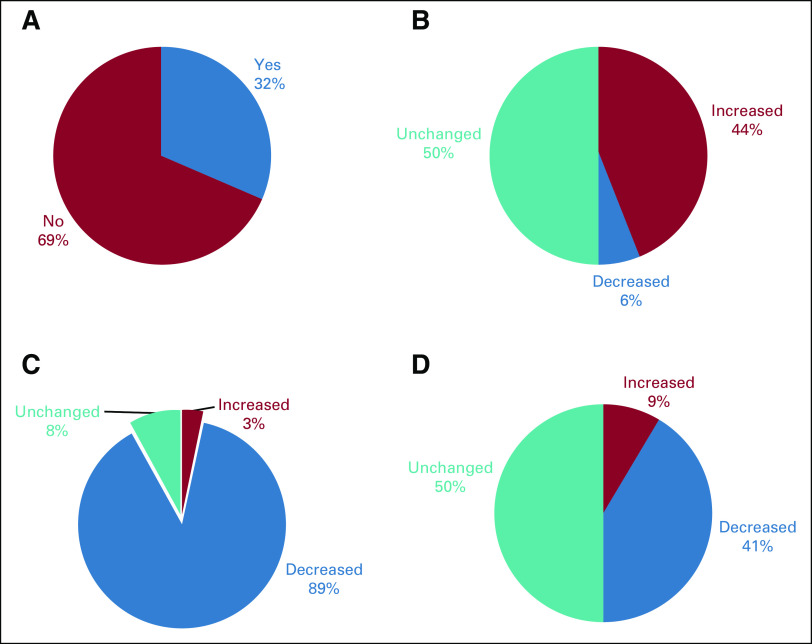
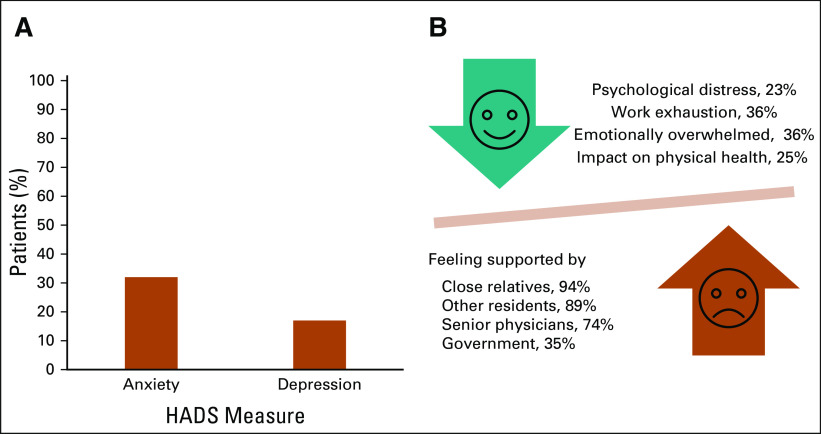
Results: Overall, 222 residents (medical oncologists, 61%; radiation therapists, 39%) participated in our survey, representing approximately one third of all residents and fellows in France. One third of respondents had been reassigned to a COVID-19 ward. Training and research activity decreased for 89% and 41% of respondents, respectively. Two thirds (70%) of respondents declared that they had faced ethical issues, 35% felt worried about their own health, and 23% experienced psychological distress. According to the Hospital Anxiety and Depression Scale, 32% were anxious and 17% depressed. Consumption of tobacco, psychostimulants, and alcohol increased in 31%, 24%, and 29% of respondents, respectively.
Conclusion: French oncology residents were highly affected by the first peak of the COVID-19 pandemic in terms of professional activity and psychological impact. This national survey can be used as a basis for improved management, medical reorganization, and training of residents during the ongoing COVID-19 pandemic.
Conflict of interest statement
Anthony Turpin
Cindy Neuzillet
No other potential conflicts of interest were reported.
Figures
Comment in
-
COVID-19 Effects on Medical Education: A Viral Transfer of Knowledge to Radiation Oncology.Int J Radiat Oncol Biol Phys. 2022 Jul 15;113(4):705-713. doi: 10.1016/j.ijrobp.2022.03.001. Int J Radiat Oncol Biol Phys. 2022. PMID: 35772437 Free PMC article. No abstract available.
References
-
- Worldometer: COVID-19 coronavirus pandemic. https://www.worldometers.info/coronavirus/
-
- Wong SH, Lui RN, Sung JJ. Covid-19 and the digestive system. J Gastroenterol Hepatol. 2020;35:744–748. - PubMed
-
- Emanuel EJ, Persad G, Upshur R, et al. Fair allocation of scarce medical resources in the time of Covid-19. N Engl J Med. 2020;382:2049–2055. - PubMed
Publication types
MeSH terms
LinkOut - more resources
Full Text Sources
Medical