


Concerns Expressed by Chinese Social Media Users During the COVID-19 Pandemic: Content Analysis of Sina Weibo Microblogging Data
- PMID: 33151894
- PMCID: PMC7695542
- DOI: 10.2196/22152
Concerns Expressed by Chinese Social Media Users During the COVID-19 Pandemic: Content Analysis of Sina Weibo Microblogging Data
Abstract
Background: The COVID-19 pandemic has created a global health crisis that is affecting economies and societies worldwide. During times of uncertainty and unexpected change, people have turned to social media platforms as communication tools and primary information sources. Platforms such as Twitter and Sina Weibo have allowed communities to share discussion and emotional support; they also play important roles for individuals, governments, and organizations in exchanging information and expressing opinions. However, research that studies the main concerns expressed by social media users during the pandemic is limited.
Objective: The aim of this study was to examine the main concerns raised and discussed by citizens on Sina Weibo, the largest social media platform in China, during the COVID-19 pandemic.
Methods: We used a web crawler tool and a set of predefined search terms (New Coronavirus Pneumonia, New Coronavirus, and COVID-19) to investigate concerns raised by Sina Weibo users. Textual information and metadata (number of likes, comments, retweets, publishing time, and publishing location) of microblog posts published between December 1, 2019, and July 32, 2020, were collected. After segmenting the words of the collected text, we used a topic modeling technique, latent Dirichlet allocation (LDA), to identify the most common topics posted by users. We analyzed the emotional tendencies of the topics, calculated the proportional distribution of the topics, performed user behavior analysis on the topics using data collected from the number of likes, comments, and retweets, and studied the changes in user concerns and differences in participation between citizens living in different regions of mainland China.
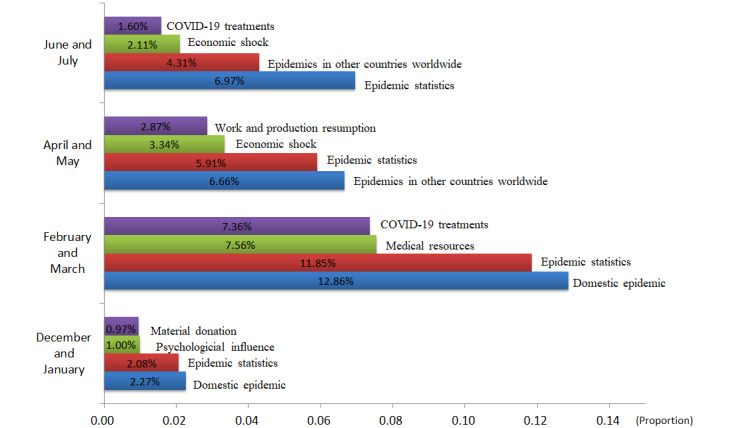
Results: Based on the 203,191 eligible microblog posts collected, we identified 17 topics and grouped them into 8 themes. These topics were pandemic statistics, domestic epidemic, epidemics in other countries worldwide, COVID-19 treatments, medical resources, economic shock, quarantine and investigation, patients' outcry for help, work and production resumption, psychological influence, joint prevention and control, material donation, epidemics in neighboring countries, vaccine development, fueling and saluting antiepidemic action, detection, and study resumption. The mean sentiment was positive for 11 topics and negative for 6 topics. The topic with the highest mean of retweets was domestic epidemic, while the topic with the highest mean of likes was quarantine and investigation.
Conclusions: Concerns expressed by social media users are highly correlated with the evolution of the global pandemic. During the COVID-19 pandemic, social media has provided a platform for Chinese government departments and organizations to better understand public concerns and demands. Similarly, social media has provided channels to disseminate information about epidemic prevention and has influenced public attitudes and behaviors. Government departments, especially those related to health, can create appropriate policies in a timely manner through monitoring social media platforms to guide public opinion and behavior during epidemics.
Keywords: COVID-19; Sina Weibo; citizen concerns; coronavirus; public health; public opinion; social media.
©Junze Wang, Ying Zhou, Wei Zhang, Richard Evans, Chengyan Zhu. Originally published in the Journal of Medical Internet Research (http://www.jmir.org), 26.11.2020.
Conflict of interest statement
Conflicts of Interest: None declared.
Figures
References
-
- WHO Director-General's opening remarks at the media briefing on COVID-19 - 29 June 2020. World Health Organization. 2020. Jun 29, [2020-11-23]. https://www.who.int/director-general/speeches/detail/who-director-genera....
-
- The latest news about the COVID-19 by the time of 3rd July. Public Health Office, National Health Commission of China. 2020. Jul 03, [2020-11-20]. http://www.nhc.gov.cn/xcs/yqtb/list_gzbd_13.shtml.
-
- Weekly Operational Update on COVID-19 21 August 2020. World Health Organization. 2020. Aug 21, [2020-11-23]. https://www.who.int/docs/default-source/coronaviruse/weekly-updates/wou-....
-
- Johnston KA, Taylor M, Ryan B. Emergency management communication: The paradox of the positive in public communication for preparedness. Public Relations Review. 2020 Jun;46(2):101903. doi: 10.1016/j.pubrev.2020.101903. - DOI
-
- Huang Y, DiStaso M. Responding to a Health Crisis on Facebook: The Effects of Response Timing and Message Appeal. Public Relat Rev. 2020 Sep;46(3):101909. doi: 10.1016/j.pubrev.2020.101909. - DOI
MeSH terms
LinkOut - more resources
Full Text Sources
Medical
