. 2021 Jan 20;109(2):273-284.e4.
doi: 10.1016/j.neuron.2020.10.014. Epub 2020 Nov 4.

A Non-covalent Ligand Reveals Biased Agonism of the TRPA1 Ion Channel

Affiliations

A Non-covalent Ligand Reveals Biased Agonism of the TRPA1 Ion Channel

Chang Liu et al. Neuron. .

Abstract

The TRPA1 ion channel is activated by electrophilic compounds through the covalent modification of intracellular cysteine residues. How non-covalent agonists activate the channel and whether covalent and non-covalent agonists elicit the same physiological responses are not understood. Here, we report the discovery of a non-covalent agonist, GNE551, and determine a cryo-EM structure of the TRPA1-GNE551 complex, revealing a distinct binding pocket and ligand-interaction mechanism. Unlike the covalent agonist allyl isothiocyanate, which elicits channel desensitization, tachyphylaxis, and transient pain, GNE551 activates TRPA1 into a distinct conducting state without desensitization and induces persistent pain. Furthermore, GNE551-evoked pain is relatively insensitive to antagonist treatment. Thus, we demonstrate the biased agonism of TRPA1, a finding that has important implications for the discovery of effective drugs tailored to different disease etiologies.

Keywords: TRPA1; biased agonism; covalent; cryo-EM; drug discovery; ion channel; non-covalent; pain.


Conflict of interest statement

Declaration of Interests All of the authors, except S.V. and J.Z., are current or former employees of Genentech, a member of the Roche group, and may hold Roche stock or stock options.

Figures
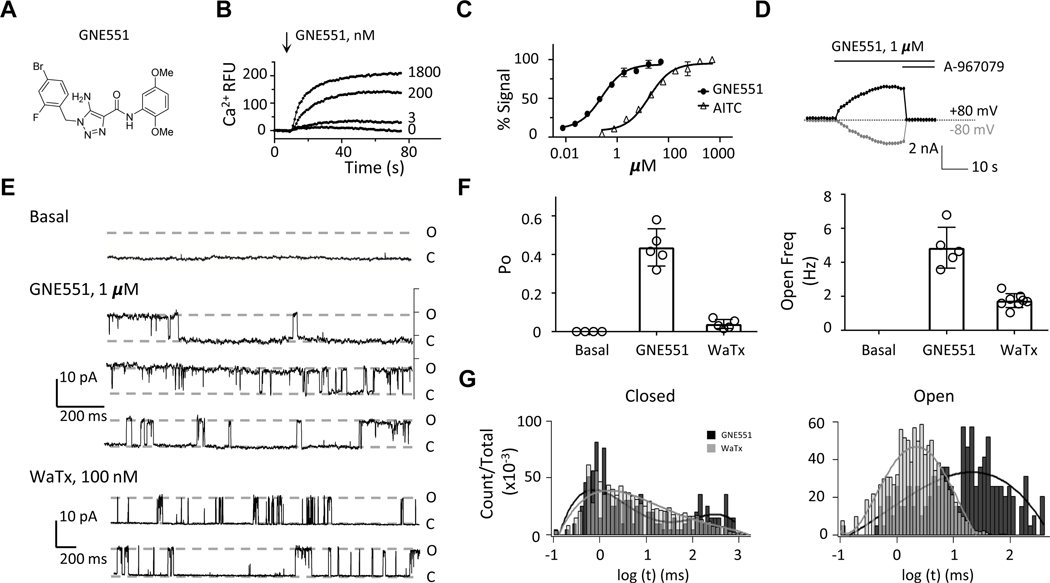
Figure 1.
Figure 1.. GNE551 Activates TRPA1 with Distinct Properties.
(A) Chemical structure of GNE551. (B) In a Ca2+ influx assay using HEK293-F cells expressing human TRPA1, GNE551 activated the channel in a concentration-dependent manner. Representative traces of Ca2+ fluorescence (indicated as Ca2+ RFU, or relative fluorescence unit) are shown. Arrow indicates GNE551 addition. (C) Concentration response of GNE551 and AITC in the Ca2+ influx assay. The EC50 was 254 nM for GNE551 (95% confidence interval, 207–312 nM, n = 4); in comparison, the EC50 for AITC was 17.5 μM (95% confidence interval, 13.7–22.5 μM, n = 4). (D) In whole-cell recordings, GNE551 (1 μM) evoked outward currents at +80 mV (black trace) and inward currents at −80 mV (gray trace), which were blocked by 1 μM A-967079. Dotted line indicates zero current. (E) Representative inside-out single channel current traces at the basal level and in the presence of GNE551 (1 μM) or WaTx (100 nM) recorded at +80 mV. O and C indicate open and closed state, respectively. (F) Open probability (left) and open frequency (right) of TRPA1 channel under basal condition (n = 3), 1 μM GNE551 (n = 5) and 100 nM WaTX (n = 8). (G) Closed and open dwell time histograms of a GNE551- or WaTx-activated channel. The open state dwell time was 20.9 milliseconds for GEN551 and 2.2 milliseconds for WaTx-activated channels, respectively.
Figure 2.
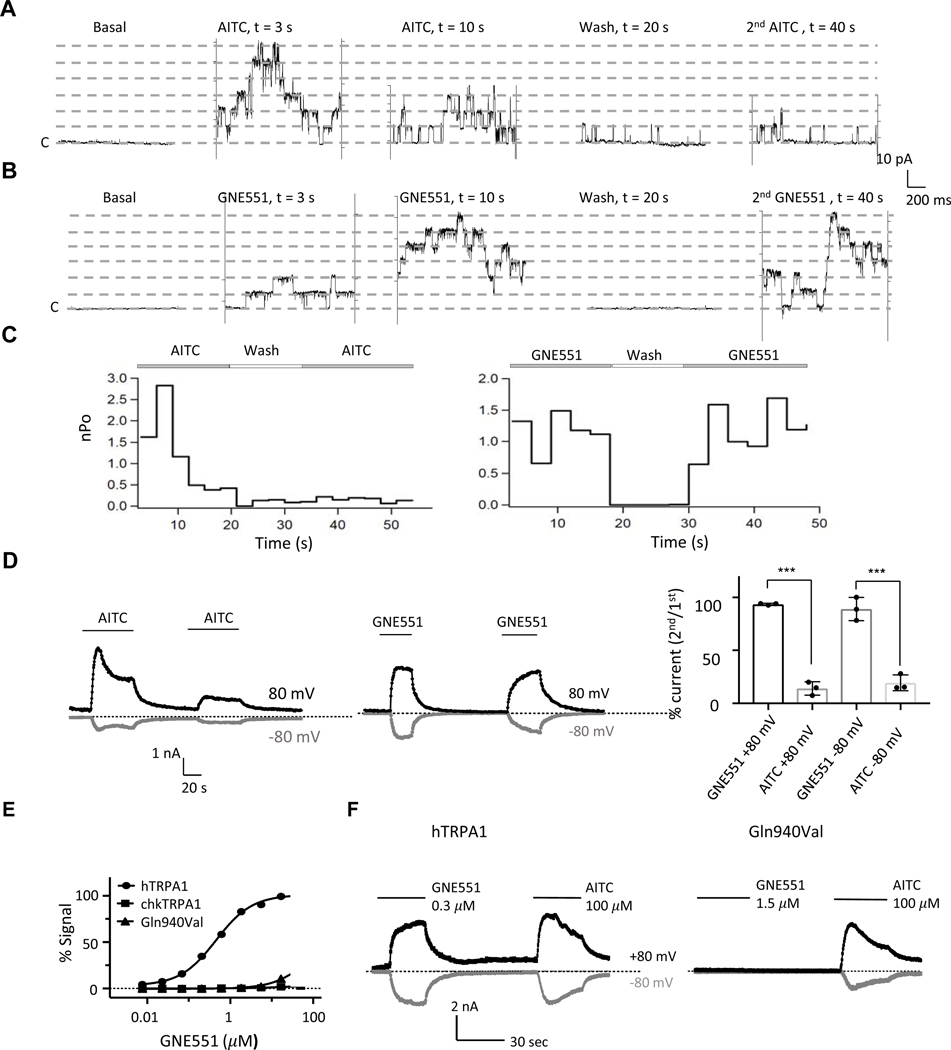
Figure 2.. GNE551 does not Induce Desensitization and a Single Residue is Critical for Activation.
(A-B) Time course of single channel TRPA1 currents (inside-out macropatches, +80 mV) in response to 10 μM AITC and 1 μM GNE551. (C) Plots of time course of nPo of TRPA1 channels activated by AITC (n = 4) and GNE551 (n = 3). (D)Whole-cell currents in response to repeated stimulations by AITC (Left) and GNE551 (Middle), and percentage of currents of second compared to the first application (Right). The current during second application was reduced for AITC and mostly retained for GNE551. ***p<0.005. (E) GNE551 concentration-response relationships in Ca2+ assay. GNE551 activated human channel (hTRPA1), but not chicken channel (chkTRPA1), or Gln940Val mutant human channel. n = 4. (F) In whole-cell patch clamp recordings, GNE551 (300 nM) activated hTRPA1, but GNE551 (1.5 μM) failed to activate Gln940Val TRPA1 (n = 4). AITC was used as a positive control. Dotted lines indicate zero current.
Figure 3.
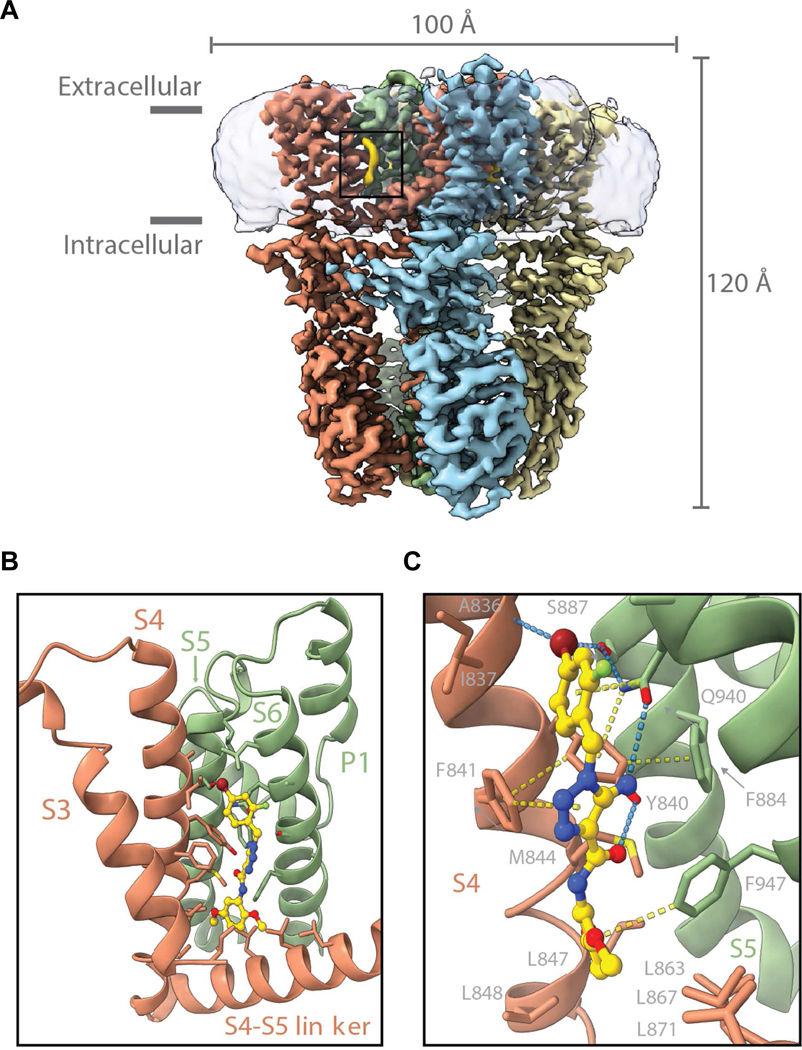
Figure 3.. Structure of TRPA1 in Complex with GNE551 and Key Binding Pocket Interactions.
(A) Isosurface rendering of the cryo-EM map of human TRPA1 in complex with GNE551. TRPA1 protomers are colored in red, green, yellow, and blue; GNE551 in yellow and micelle density is shown in transparent. (B)Close-up view of GNE551 binding site. GNE551 (shown in stick with carbon atoms colored in yellow, oxygen in red, and nitrogen in blue) binds in a pocket located at the interface between the S4 helix of one subunit (red) and pore module of an adjacent subunit (green). P1 = pore helix 1. Side chains for residues in close proximity of GNE551 are shown in stick. (C)Molecular interactions between GNE551 and TRPA1. Hydrogen bonds are shown in blue. Favorable contacts involving aromatic side chains are in yellow. View is rotated 45 degrees relative to panel B.
Figure 4.
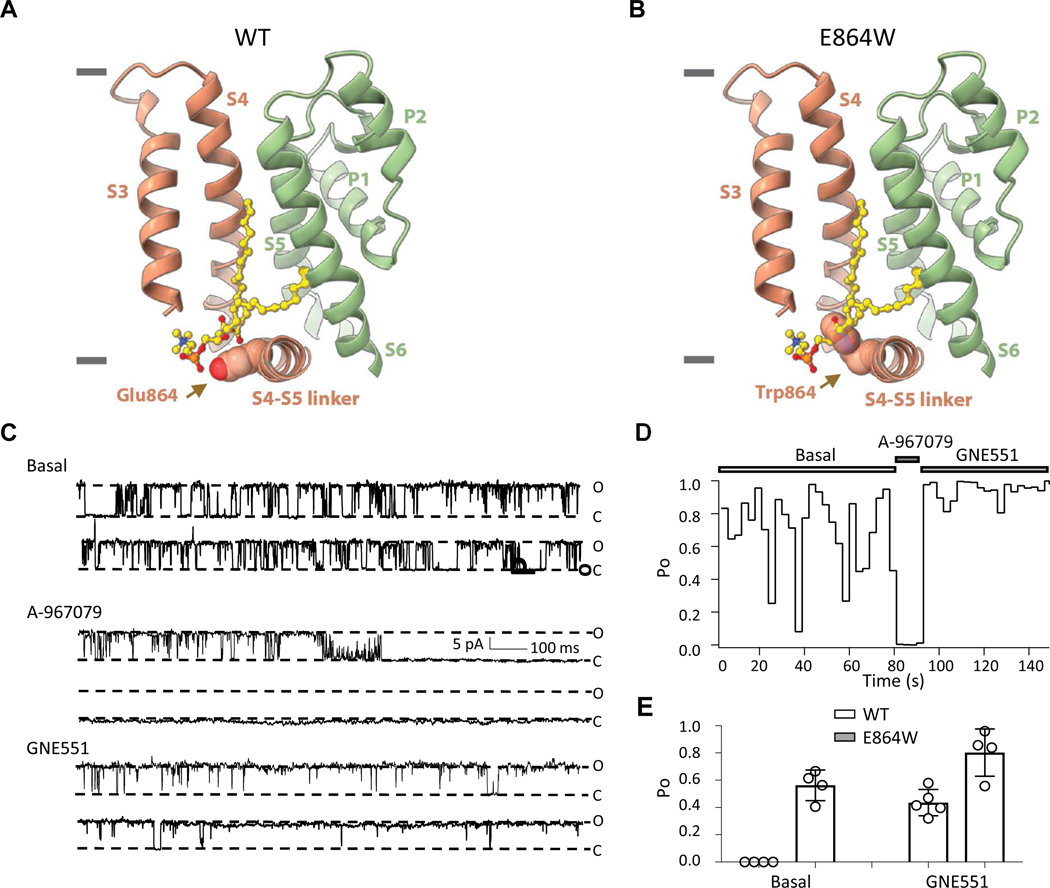
Figure 4.. The Glu864Trp Mutation Renders TRPA1 Channel Constitutively Open.
(A) The structure of unliganded human TRPA1 (PDB: 6PQQ) revealed well-ordered lipid 5 (yellow), with its acyl chains occupying the GNE551-binding pocket, and its head group located in close proximity of Glu864 from the S4-S5 linker. TRPA1 is depicted in ribbon representation using the same colors as in Figure 3. The side chain of Glu864 is shown using a space-filling sphere representation. Gray bars indicate extracellular or intracellular boundaries. (B) In the Glu864Trp mutant channel, the large hydrophobic side chain of the Trp would sterically clash with the lipid 5. (C) Representative single-channel currents of Glu864Trp channel recorded at +80 mV under basal condition or in response to A-967079 (1 μM) or GNE551 (1 μM). (D)Open probability (Po) over time of Glu864Trp at the basal level and in response to compounds. (E) Glu864Trp increased the open probability at the basal level, and in response to GNE551.
Figure 5.
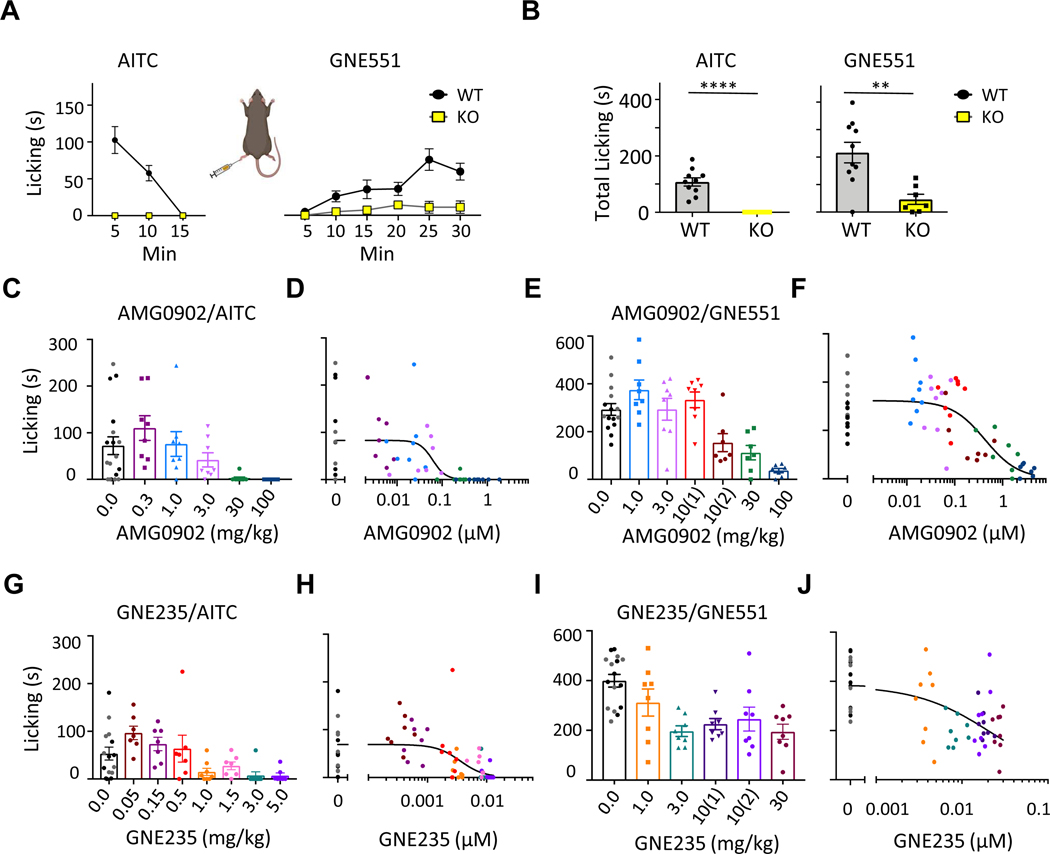
Figure 5.. GNE551 and AITC Elicit Pain with Distinct Kinetics and Sensitivity to Antagonists.
(A) Time course for time spent licking the ipsilateral paws after intraplantar injection of AITC (0.1%) or GNE551 (10 mM) in TRPA1 wild type rats (WT) and knockout rats (KO). n = 7 – 10. (B) Quantification of total time licking in response to AITC (during the first 5 min) and GNE551 (during the first 30 min). ** p=0.0027, ****p<0.0001 (T-test). n = 7 – 10. (C-F) Dose-dependent inhibition of AITC- or GNE551-evoked nocifensive behavior by TRPA1 inhibitor AMG0902 (C, E) and corresponding PK/PD plots (D, F). AMG0902 blocked the nocifensive responses evoked by AITC and GNE551 with EC50, (unbound free AMG0902 concentration at 50% efficacy) of 62 ± 26 nM (D) and 431 ± 145 nM (F), respectively. Data in E was collected over two sessions. First session: arms vehicle (black symbols), 1 mg/kg, 3 mg/kg, and 10 mg/kg (1); second session: arms vehicle (gray symbols), 10 mg/kg (2), 30 mg/kg, and 100 mg/kg. n = 7 – 14. (G-J) Dose-dependent inhibition of AITC- or GNE551-evoked nocifensive responses by TRPA1 inhibitor GNE235 (G, I) and corresponding PK/PD plots (H, J). GNE235 blocked AITC- or GNE551-evoked responses with EC50 of 3.4 ± 1.1 nM (H) and 22 ± 6 nM (J), respectively. Data in I was collected over two sessions. First session: arms vehicle (black symbols), 1 mg/kg, 3 mg/kg, and 10 mg/kg (1); second session: arms vehicle (gray symbols), 10 mg/kg (2), and 30 mg/kg. n = 7 – 15. p<0.001 for 5C, 5E, 5G; and p=0.006 for 5I (Kruskall-Wallis non-parametric analysis).
Figure 6.
Figure 6.. Covalent and Non-covalent Agonists Exert Biased Agonism at the TRPA1 Channel.
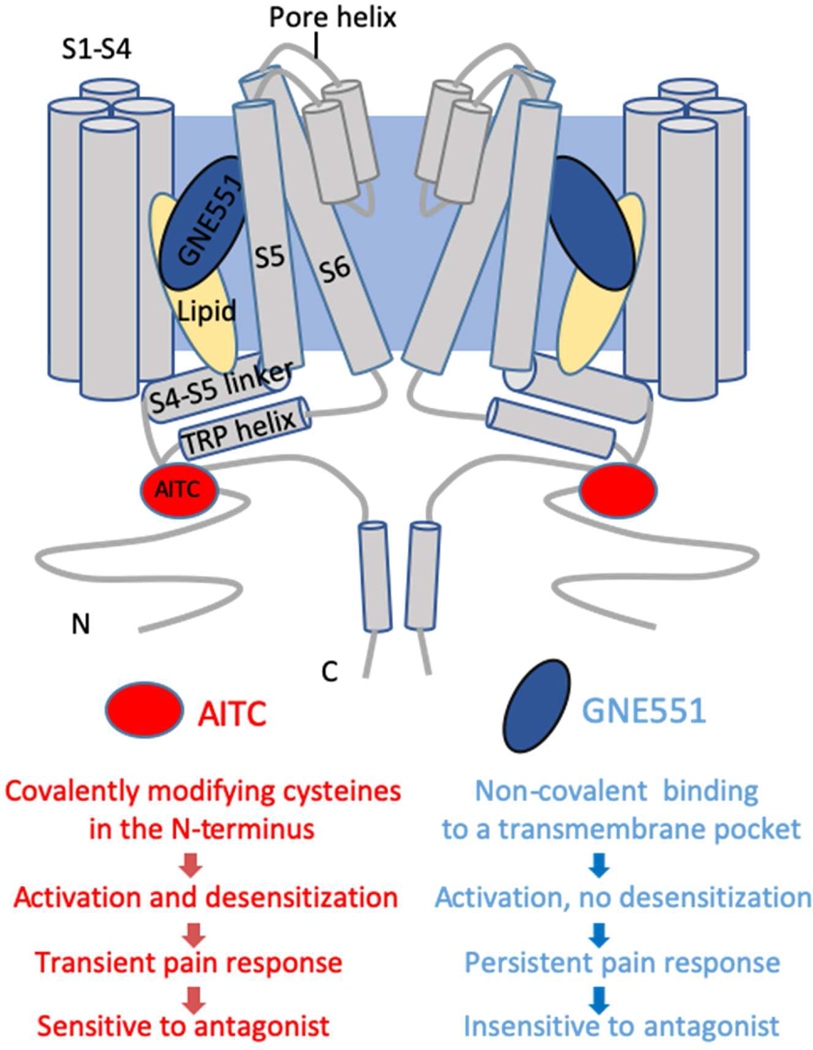
AITC covalently modifies intracellular cysteines; GNE551 binds to a transmembrane pocket. AITC activates and desensitizes TRPA1; GNE551 activates the channel without desensitization. AITC induces transient pain; GNE551 induces persistent pain. AITC-evoked pain is sensitive to antagonist treatment; GNE551-evoked pain is relatively insensitive to antagonist treatment.

Comment in

References

    1. Afonine PV, Poon BK, Read RJ, Sobolev OV, Terwilliger TC, Urzhumtsev A, and Adams PD (2018). Real-space refinement in PHENIX for cryo-EM and crystallography. Acta Crystallogr D Struct Biol 74, 531–544. - PMC - PubMed
    1. Andersen HH, Lo Vecchio S, Gazerani P, and Arendt-Nielsen L. (2017). Dose-response study of topical allyl isothiocyanate (mustard oil) as a human surrogate model of pain, hyperalgesia, and neurogenic inflammation. Pain 158, 1723–1732. - PubMed
    1. Bandell M, Story GM, Hwang SW, Viswanath V, Eid SR, Petrus MJ, Earley TJ, and Patapoutian A. (2004). Noxious cold ion channel TRPA1 is activated by pungent compounds and bradykinin. Neuron 41, 849–857. - PubMed
    1. Bautista DM, Jordt SE, Nikai T, Tsuruda PR, Read AJ, Poblete J, Yamoah EN, Basbaum AI, and Julius D. (2006). TRPA1 Mediates the Inflammatory Actions of Environmental Irritants and Proalgesic Agents. Cell 124, 1269–1282. - PubMed
    1. Bautista DM, Pellegrino M, and Tsunozaki M. (2013). TRPA1: A gatekeeper for inflammation. Annu Rev Physiol 75, 181–200. - PMC - PubMed

Publication types