. 2021 Jan 15:1751:147190.
doi: 10.1016/j.brainres.2020.147190. Epub 2020 Nov 2.

Responses to chronic corticosterone on brain glucocorticoid receptors, adrenal gland, and gut microbiota in mice lacking neuronal serotonin

Affiliations

Responses to chronic corticosterone on brain glucocorticoid receptors, adrenal gland, and gut microbiota in mice lacking neuronal serotonin

Mariana Angoa-Pérez et al. Brain Res. .

Abstract

Dysregulation of the stress-induced activation of the hypothalamic-pituitary-adrenocortical axis can result in disease. Bidirectional communication exists between the brain and the gut, and alterations in these interactions appear to be involved in stress regulation and in the pathogenesis of neuropsychiatric diseases, such as depression. Serotonin (5HT) plays a crucial role in the functions of these two major organs but its direct influence under stress conditions remains unclear. To investigate the role of neuronal 5HT on chronic stress responses and its influence on the gut microbiome, mice lacking the gene for tryptophan hydroxylase-2 were treated with the stress hormone corticosterone (CORT) for 21 days. The intake of fluid and food, as well as body weights were recorded daily. CORT levels, expression of glucocorticoid receptors (GR) in the brain and the size of the adrenal gland were evaluated. Caecum was used for 16S rRNA gene characterization of the gut microbiota. Results show that 5HT depletion produced an increase in food intake and a paradoxical reduction in body weight that were enhanced by CORT. Neuronal 5HT depletion impaired the feedback regulation of CORT levels but had no putative effect on the CORT-induced decrease in hippocampal GR expression and the reduction of the adrenal cortex size. Finally, the composition and structure of the gut microbiota were significantly impacted by the absence of neuronal 5HT, and these alterations were enhanced by chronic CORT treatment. Therefore, we conclude that neuronal 5HT influences the stress-related responses at different levels involving CORT levels regulation and the gut microbiome.

Keywords: 16S rRNA; Adrenal gland; Glucocorticoid receptor; Gut microbiota; Serotonin; Tryptophan hydroxylase-2.


Conflict of interest statement

Declaration of Competing Interest

The authors declare that they have no known competing financial interests or personal relationships that could have appeared to influence the work reported in this paper.

Figures

Fig. 1.
Fig. 1.
Fluids intake (A), food intake (B) and body weight (C) in WT (n = 8–10) and TPH2−/− (n = 6–9) mice treated with corticosterone (CORT) or vehicle over 21 days. Intakes are shown in g of consumed fluids or food/g of body weight/24 h. Mean ± SEM.
Fig. 2.
Fig. 2.
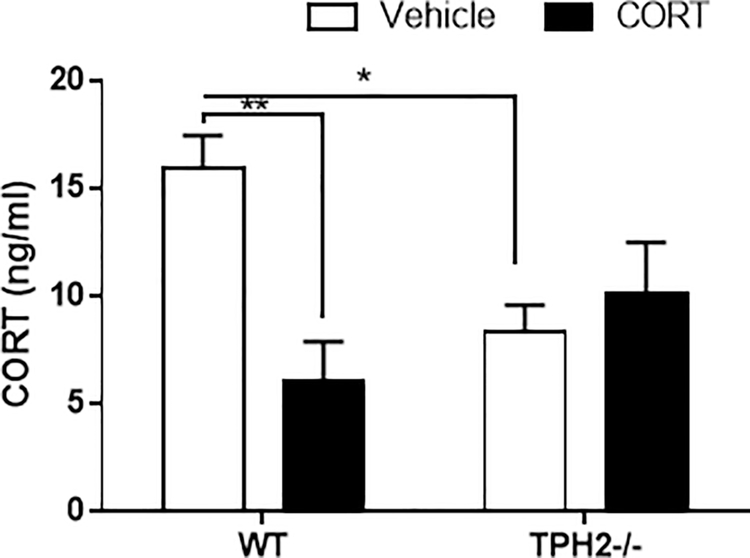
Corticosterone (CORT) levels in serum of WT (n = 5–8) and TPH2−/− (n = 5–7) mice. Values are mean ± SEM. *p < 0.05, **p < 0.01.
Fig. 3.
Fig. 3.
Photomicrographs of glucocorticoid receptors (GR) immunoreactivity in the hippocampus dentate gyrus (A), hippocampal CA1 area (B) and hypothalamus (C) of WT (n = 6–7) and TPH2−/− (n = 7–8) mice treated with corticosterone (CORT) or vehicle over 21 days. Expression of GR in the dentate gyrus (D), CA1 area (E) and hypothalamus (F) the subjects mentioned above. Scale bars represent 500 μm. Values are mean ± SEM. **p < 0.01, ***p < 0.001.
Fig. 4.
Fig. 4.
Time that WT (n = 9–10) and TPH2−/− (n = 9–10) mice treated with corticosterone (CORT) or vehicle spent grooming in the splash test. Mean ± SEM values. ***p < 0.001.
Fig. 5.
Fig. 5.
Whole adrenal gland size (A), adrenal cortex size (B) and hematoxylin-eosin staining of adrenal glands (C) in WT (n = 7–8) and TPH2−/− (n = 6–7) mice treated with corticosterone (CORT) or vehicle over 21 days. Scale bars represent 250 μm. Values are mean ± SEM. *p < 0.05, **p < 0.01, ***p < 0.001.
Fig. 6.
Fig. 6.
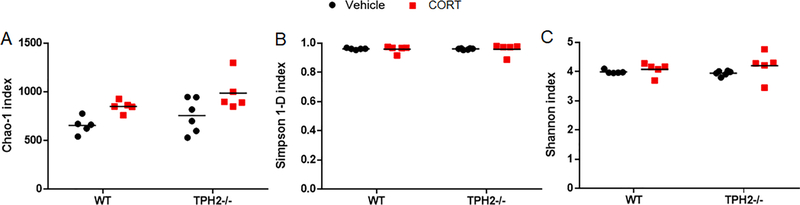
Scatter plots of the indices of microbial α-diversity Chao-1 (A), reverse Simpson (B), and Shannon (C) in WT (n = 5–7) and TPH2−/− (n = 6–7) mice treated with corticosterone (CORT) or vehicle over 21 days. Values are mean ± SEM.
Fig. 7.
Fig. 7.
Principal coordinate analyses of the microbial β-diversity indices Jaccard (A) and Bray-Curtis (B) in WT (n = 5) and TPH2−/− (n = 5–6) mice treated with corticosterone (CORT) or vehicle (Veh) over 21 days.
Fig. 8.
Fig. 8.
Relative abundance (%) of the most prominent bacterial phyla in WT (n = 5) and TPH2−/− (n = 5–6) mice treated with corticosterone (CORT) or vehicle (Veh) over 21 days.
Fig. 9.
Fig. 9.
Heat map illustrating patterns in the top 25 operational taxonomic units with relative abundance greater than 4% in WT (n = 5) and TPH2−/− (n = 5–6) mice treated with corticosterone (CORT) or vehicle over 21 days. All subjects in each group are arrayed in columns and bacterial taxonomies are indicated in rows. Clustering along the y-axis was done using the Ward algorithm.
Fig. 10.
Fig. 10.
Bacterial taxa that were differentially abundant across the WT and TPH2−/− genotypes treated with corticosterone (CORT) or vehicle (Veh). LEfSe was carried out using the Galaxy Project and the results are displayed as bars, the lengths of which are indicative of the linear discriminant analysis score for each operational taxonomic unit (OTU). The taxonomic identity of each OTU is indicated to the left of each bar. All groups are statistically significant compared to each other (LDA > 3.6).

References

    1. Afgan E, Baker D, Batut B, van den Beek M, Bouvier D, Cech M, Chilton J, Clements D, Coraor N, Gruning BA, Guerler A, Hillman-Jackson J, Hiltemann S, Jalili V, Rasche H, Soranzo N, Goecks J, Taylor J, Nekrutenko A, Blankenberg D, 2018. The Galaxy platform for accessible, reproducible and collaborative biomedical analyses: 2018 update. Nucleic Acids Res. 46, W537–W544. 10.1093/nar/gky379. - DOI - PMC - PubMed
    1. Angoa-Perez M, Kane MJ, Briggs DI, Herrera-Mundo N, Sykes CE, Francescutti DM, Kuhn DM, 2014. Mice genetically depleted of brain serotonin do not display a depression-like behavioral phenotype. ACS Chem. Neurosci. 5, 908–919. 10.1021/cn500096g. - DOI - PMC - PubMed
    1. Angoa-Perez M, Zagorac B, Winters AD, Greenberg JM, Ahmad M, Theis KR, Kuhn DM, 2020. Differential effects of synthetic psychoactive cathinones and amphetamine stimulants on the gut microbiome in mice. PLoS ONE 15, e0227774. 10.1371/journal.pone.0227774. - DOI - PMC - PubMed
    1. Anneken JH, Angoa-Perez M, Sati GC, Crich D, Kuhn DM, 2019. Dissociation between hypothermia and neurotoxicity caused by mephedrone and methcathinone in TPH2 knockout mice. Psychopharmacology 236, 1097–1106. 10.1007/s00213-018-4991-8. - DOI - PubMed
    1. Banskota S, Ghia JE, Khan WI, 2019. Serotonin in the gut: blessing or a curse. Biochimie 161, 56–64. 10.1016/j.biochi.2018.06.008. - DOI - PubMed

Publication types

MeSH terms

LinkOut - more resources