Review
. 2020 Nov 3;12(11):1051.
doi: 10.3390/pharmaceutics12111051.

Large-Scale Production of Lentiviral Vectors: Current Perspectives and Challenges

Affiliations
Review

Large-Scale Production of Lentiviral Vectors: Current Perspectives and Challenges

Eduardo Martínez-Molina et al. Pharmaceutics. .

Abstract

Lentiviral vectors (LVs) have gained value over recent years as gene carriers in gene therapy. These viral vectors are safer than what was previously being used for gene transfer and are capable of infecting both dividing and nondividing cells with a long-term expression. This characteristic makes LVs ideal for clinical research, as has been demonstrated with the approval of lentivirus-based gene therapies from the Food and Drug Administration and the European Agency for Medicine. A large number of functional lentiviral particles are required for clinical trials, and large-scale production has been challenging. Therefore, efforts are focused on solving the drawbacks associated with the production and purification of LVsunder current good manufacturing practice. In recent years, we have witnessed the development and optimization of new protocols, packaging cell lines, and culture devices that are very close to reaching the target production level. Here, we review the most recent, efficient, and promising methods for the clinical-scale production ofLVs.

Keywords: bioreactor; gene therapy; large-scale production; lentiviral vector.


Conflict of interest statement

The authors declare no conflict of interest.

Figures
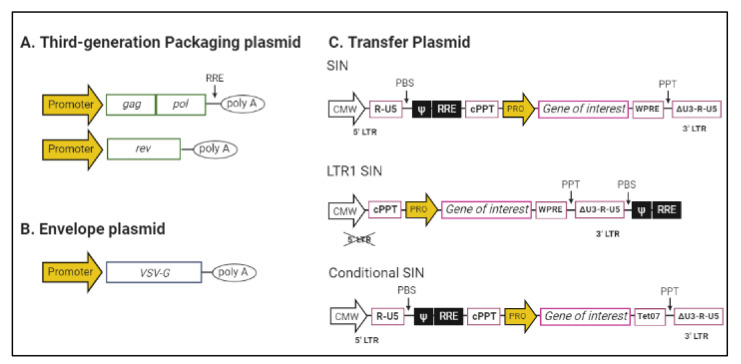
Figure 1
Figure 1
Plasmid designs for lentiviral vector (LV) production. (A) Third-generation LV has two separated packaging plasmids. (B) Vesicular stomatitis virus envelope glycoprotein (VSV-G) envelope protein is used for pseudotype LV to avoid cytotoxicity. (C) Transfer plasmids. Self-inactivating (SIN) plasmids to avoid long terminal repeat (LTR) promoter/enhancer activity. LTR1 reduces the total human immunodeficiency virus 1 (HIV-1) content. Conditional SIN: the plasmid expression is induced by the addition of doxycycline and cumate. Ψ: RNA packaging signal; ΔU3: SIN deletion in the U3 region of 3′ LTR; CMV: cytomegalovirus immediate-early promoter; cPPT: central purine tract; PBS: primer binding site; Poly A: poly (A) tail of multiple adenosine monophosphates; PPT: polypurine tract; Pro: internal promoter for transgene expression; RRE: rev response element; Tet07: tetracycline (Tet)-dependent regulatory system; U3-R-U5: U3, R and U5 regions from HIV-LTRs for efficient cleavage process; WPRE: woodchuck hepatitis virus post-transcriptional regulatory element.
Figure 2
Figure 2
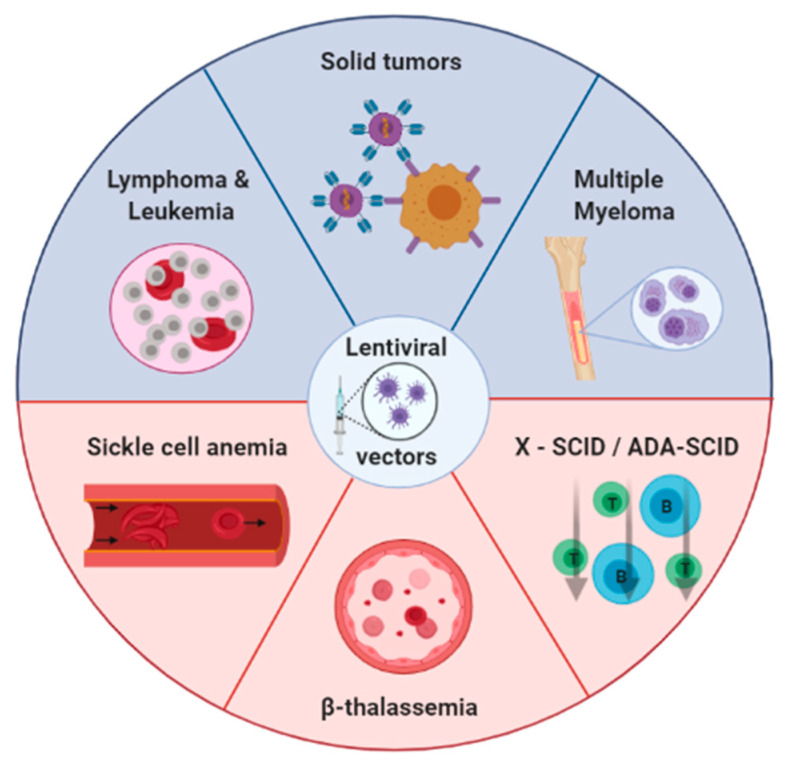
Main diseases with the highest number of active clinical trials using lentiviral vectors up to September 2020.
Figure 3
Figure 3
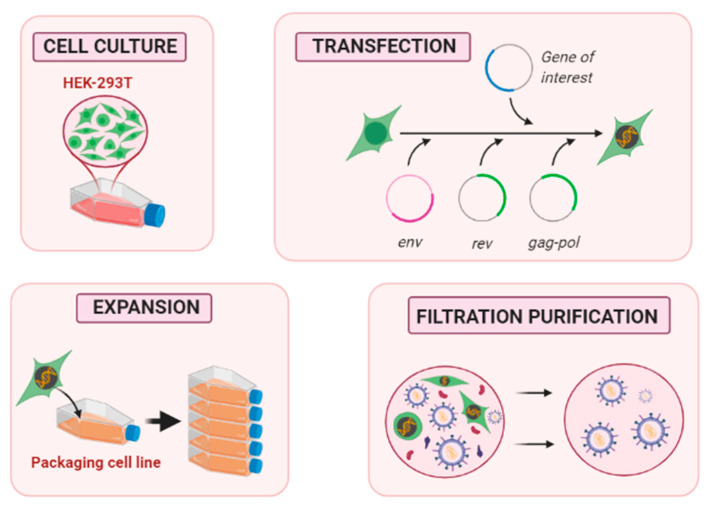
Proposed steps for lentiviral vector production in a packaging cell line.
Figure 4
Figure 4
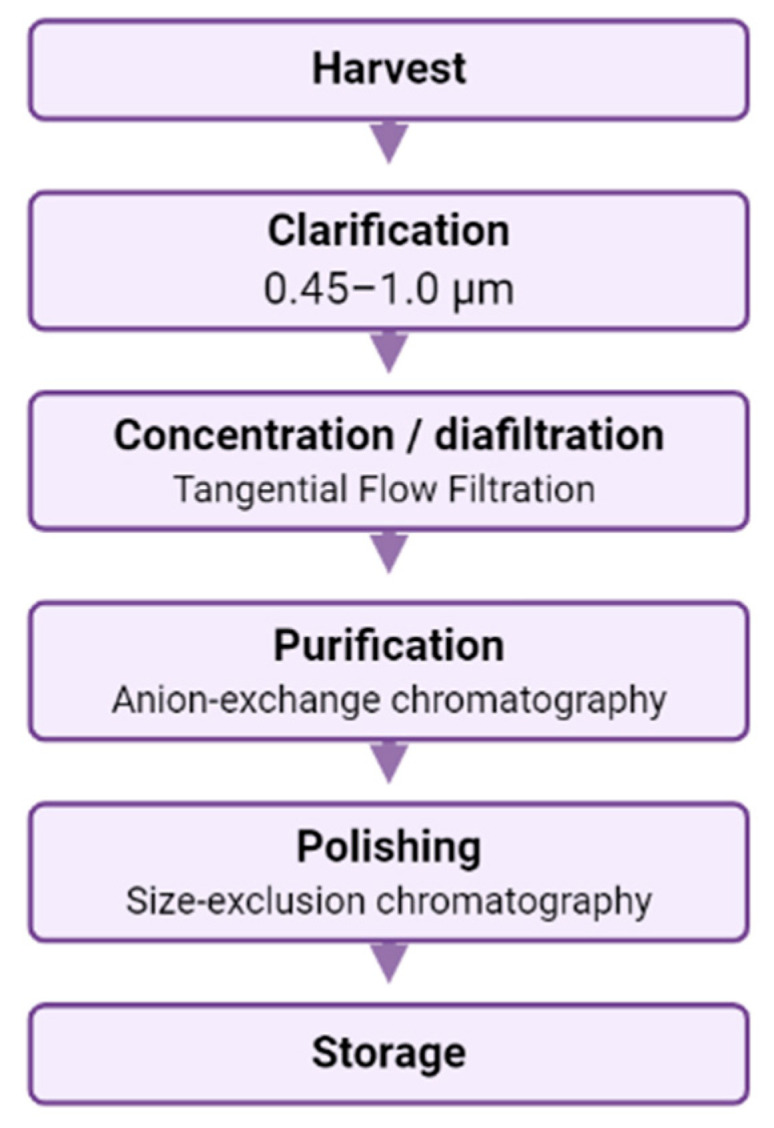
Flow chart of an example of downstream processing lentiviral vectors from harvested material.

References

    1. Anguela X.M., High K.A. Entering the Modern Era of Gene Therapy. Annu. Rev. Med. 2019;70:273–288. doi: 10.1146/annurev-med-012017-043332. - DOI - PubMed
    1. Áyen Á., Jiménez Martínez Y., Marchal J., Boulaiz H. Recent Progress in Gene Therapy for Ovarian Cancer. Int. J. Mol. Sci. 2018;19:1930. doi: 10.3390/ijms19071930. - DOI - PMC - PubMed
    1. Navarro S.A., Carrillo E., Griñán-Lisón C., Martín A., Perán M., Marchal J.A., Boulaiz H. Cancer Suicide Gene Therapy: A Patent Review. Expert Opin. Ther. Pat. 2016;26:1095–1104. doi: 10.1080/13543776.2016.1211640. - DOI - PubMed
    1. Áyen Á., Jiménez Martínez Y., Boulaiz H. Targeted Gene Delivery Therapies for Cervical Cancer. Cancers. 2020;12:1301. doi: 10.3390/cancers12051301. - DOI - PMC - PubMed
    1. Ramírez A., Conejo-García A., Griñán-Lisón C., López-Cara L.C., Jiménez G., Campos J.M., Marchal J.A., Boulaiz H. Enhancement of Tumor Cell Death by Combining Gef Gene Mediated Therapy and New 1,4-Benzoxazepin-2,6-Dichloropurine Derivatives in Breast Cancer Cells. Front. Pharmacol. 2018;9:798. doi: 10.3389/fphar.2018.00798. - DOI - PMC - PubMed