. 2020 Nov 5;20(1):336.
doi: 10.1186/s12866-020-01992-4.

The pelvis urinary microbiome in patients with kidney stones and clinical associations

Affiliations

The pelvis urinary microbiome in patients with kidney stones and clinical associations

Fengping Liu et al. BMC Microbiol. .

Abstract

Background: The long-held notion that, without urinary tract or circulatory infection, bladder urine and blood are sterile biofluids has been disproven. There have been no previous reports on the kidney pelvis urinary microbiome after bladder disinfection in kidney stone patients. This study aimed to determine whether a kidney pelvis urinary microbiome is present after eliminating the influence of the bladder urinary microbiome, whether the microbiome composition is different in patients with stone kidney pelvis (SKP) and non-stone kidney pelvis (NSKP), and the correlation between SKP and patient clinical characteristics.

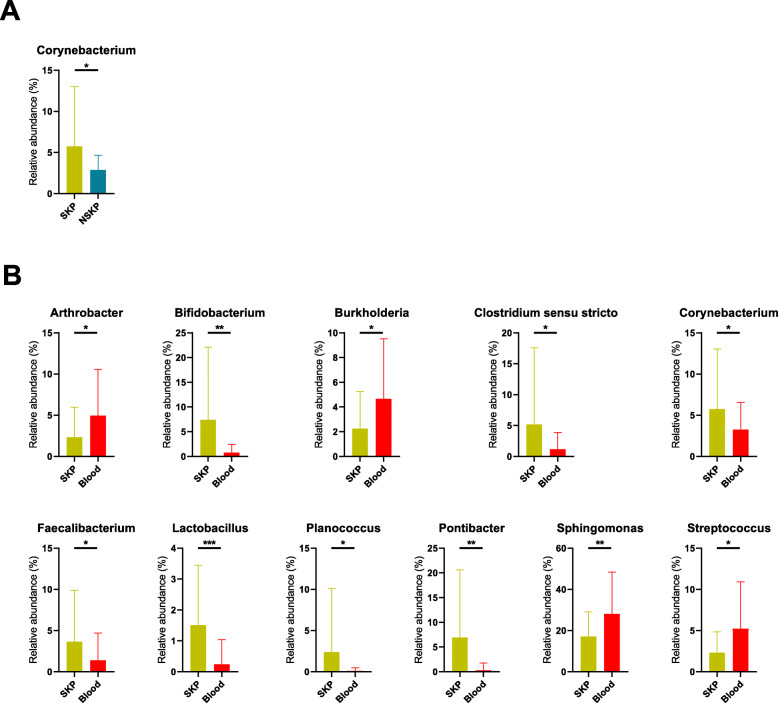
Results: Comparisons of bacterial diversity and community structure exhibited that urine in bladder was similar to SKP and NSKP. However, the comparisons showed that urine samples were different from blood. The most common operational taxonomic units were shared by all three types of urine samples. Corynebacterium was significantly higher in SKP compared to NSKP. Several bacteria were associated with patient characteristics, including Lactobacillus, which was positively correlated with fasting blood glucose, and Prevotella was negatively correlated with BMI. Lactobacillus was significantly higher in SKP compared to blood but not in NSKP compared to blood.

Conclusions: The composition of the kidney pelvis urinary microbiome after disinfection of the bladder and its similarity to the bladder microbiome indicate that bladder urine can be used to replace kidney pelvis urine in microbiome research. Additionally, the comparison of SKP and NSKP and clinical associations suggest that the occurrence of kidney stones is responsible for the SKP urinary microbiome.

Keywords: Bladder urinary microbiome; Blood microbiome; Kidney function; Kidney pelvis urinary microbiome; Kidney stone.


Conflict of interest statement

There are no conflicts of interest.

Figures
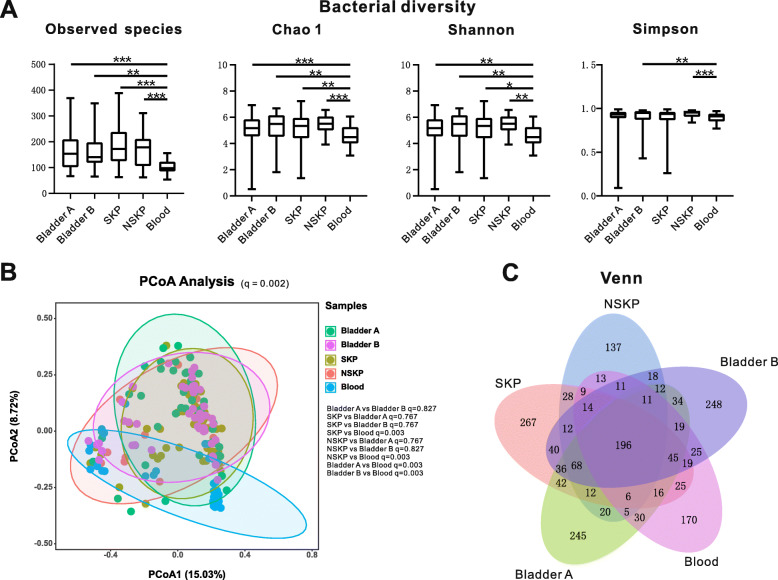
Fig. 1
Fig. 1
Bacterial diversity and structure among the groups. a Comparison of alpha diversity (Observed species, Chao1, Shannon index, and Simpson’s index) between the urinary microbiome of the Bladder A, Bladder B, SKP, NSKP and Blood samples illustrates lower bacterial richness and diversity in Blood samples than the other groups. b PCoA shows the bacterial composition clustering of the Bladder A, Bladder B, SKP, NSKP and Blood samples based on Bray–Curtis distances, with each point corresponding to a patient and colored according to the sample type (Bladder A, Bladder B, SKP, NSKP or Blood). PERMANOVA indicated that the bacterial communities between SKP vs Bladder A/Bladder B/ NSKP were non-significantly different (p > 0.05), whereas SKP vs Blood was significantly different (p = 0.003); Bladder A/Bladder B vs NSKP were non-significantly different (p > 0.05), whereas NSKP vs Blood was significantly different (p = 0.003); Bladder A vs Bladder B was non-significantly different (p > 0.05), whereas Bladder A vs Blood was significantly difference (0.003); Bladder B vs Blood was significantly different (p = 0.003). c Venn diagram showing that the number of shared OTUs by the KP (including SKP and NSKP) and Blood samples is lower than that shared by the Bladder A/B and KP samples. In addition, the number of shared OTUs by the Bladder A/B and SKP samples is lower than those shared by the Bladder A/B samples and NSKP. Abbreviations: NSKP, non-stone kidney pelvis; OTUs, operational taxonomic units; PCoA, principal coordinates analysis; PERMANOVA, permutational multivariate analysis of variance; SKP: SKP, stone kidney pelvis
Fig. 2
Fig. 2
Bacterial genera distribution among the groups. The relative abundances of the major bacterial genera, as determined by 16S rDNA gene sequencing, in the SKP and NSKP samples were more similar to the Bladder A samples than the Blood samples. “Others” includes all detected bacteria. Abbreviations: NSKP, non-stone kidney pelvis; SKP, stone kidney pelvis
Fig. 3
Fig. 3
Bacterial abundance showing significant difference between SKP and other samples. White’s non-parametric t-test was used to compare the difference of abundance between two groups. *, **, *** means p < 0.05, p < 0.01, p < 0.001, respectively. Abbreviations: NSKP, non-stone kidney pelvis; SKP, stone kidney pelvis
Fig. 4
Fig. 4
Bacterial abundance showing significant difference between NSKP and other samples. White’s non-parametric t-test was used to compare the difference of abundance between two groups. *, **, *** means p < 0.05, p < 0.01, p < 0.001, respectively. Abbreviations: NSKP, non-stone kidney pelvis

References

    1. Scales CD, Smith AC, Hanley JM, Saigal CS. Prevalence of kidney stones in the United States. Eur Urol. 2012;62(1):160–165. doi: 10.1016/j.eururo.2012.03.052. - DOI - PMC - PubMed
    1. Fink HA, Wilt TJ, Eidman KE, Garimella PS, MacDonald R, Rutks IR, Brasure M, Kane RL, Ouellette J, Monga M. Medical management to prevent recurrent nephrolithiasis in adults: a systematic review for an American College of Physicians Clinical Guideline. Ann Intern Med. 2013;158(7):535. doi: 10.7326/0003-4819-158-7-201304020-00005. - DOI - PubMed
    1. Khan SR, Pearle MS, Robertson WG, Gambaro G, Canales BK, Doizi S, Traxer O, Tiselius H. Kidney stones. Nat Rev Dis Primers. 2016;2(1):1–50. doi: 10.1038/nrdp.2016.8. - DOI - PMC - PubMed
    1. Taylor EN. Dietary factors and the risk of incident kidney stones in men: new insights after 14 years of follow-up. J Am Soc Nephrol. 2004;15(12):3225–3232. doi: 10.1097/01.ASN.0000146012.44570.20. - DOI - PubMed
    1. Ticinesi A, Milani C, Guerra A, Allegri F, Lauretani F, Nouvenne A, Mancabelli L, Lugli GA, Turroni F, Duranti S, et al. Understanding the gut–kidney axis in nephrolithiasis: an analysis of the gut microbiota composition and functionality of stone formers. GUT. 2018;67(12):2097–2106. doi: 10.1136/gutjnl-2017-315734. - DOI - PubMed

Publication types

Substances

LinkOut - more resources