


Trends in antimicrobial resistance in Neisseria gonorrhoeae in Hanoi, Vietnam, 2017-2019
- PMID: 33153450
- PMCID: PMC7643326
- DOI: 10.1186/s12879-020-05532-3
Trends in antimicrobial resistance in Neisseria gonorrhoeae in Hanoi, Vietnam, 2017-2019
Abstract
Background: Antimicrobial resistance (AMR) in Neisseria gonorrhoeae is an emerging global health threat. Surveillance of AMR in N. gonorrhoeae in the Western Pacific Region is important, as resistant strains have typically emerged from this region. There are sparse data regarding antibiotic susceptibility of N. gonorrhoeae from Vietnam. This study aimed to provide updated data on antibiotic susceptibilities in N. gonorrhoeae isolates from Hanoi, Vietnam.
Methods: From 2017 to 2019, 409 N. gonorrhoeae clinical isolates were collected at the National Hospital for Venereology and Dermatology in Hanoi, Vietnam. Antibiotic susceptibility testing was performed by disk diffusion method according to the Clinical and Laboratory Standards Institute (CLSI) protocol. The zone diameters of inhibition were recorded and interpreted according to standard CLSI criteria, except for azithromycin, due to the absence of CLSI interpretation. Categorical variables were analyzed by Chi-square and Fisher's exact tests. Linear regression was used to evaluate zones of inhibition by year.
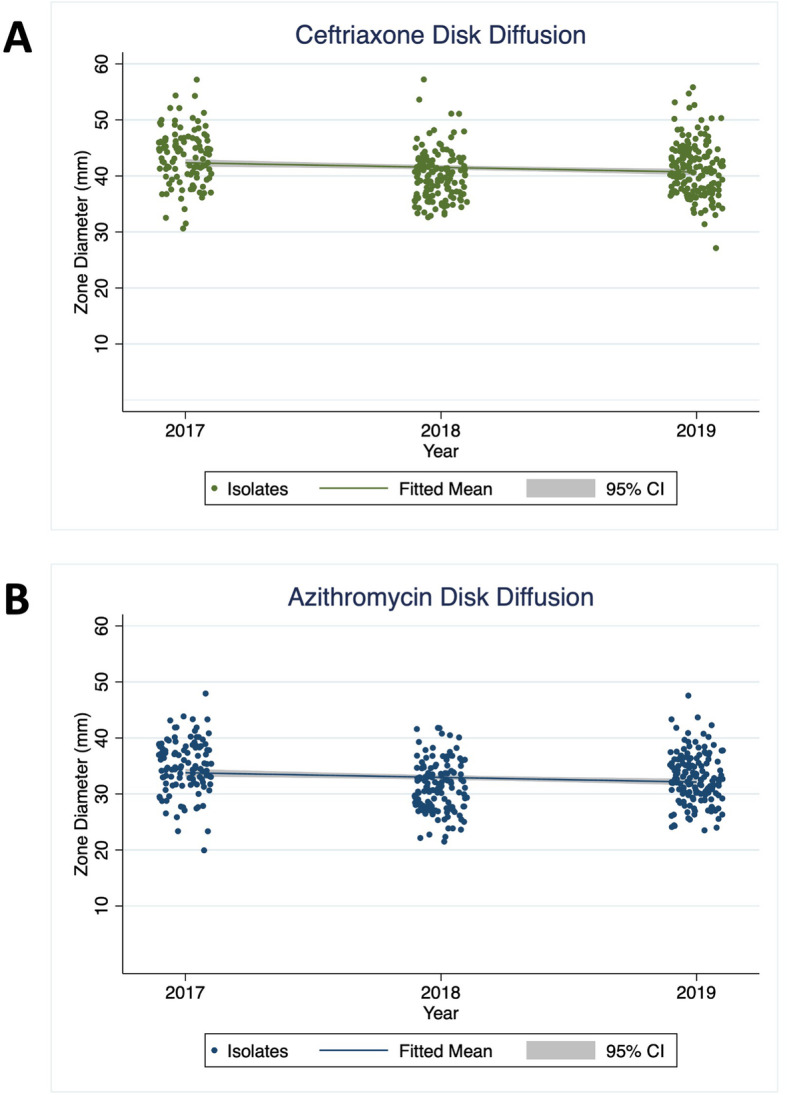
Results: Among the 409 isolates, no isolates were susceptible to penicillin, 98.3% were resistant to ciprofloxacin, and all isolates were susceptible to spectinomycin. There were 122/407 (30.0%) isolates resistant to azithromycin and there was an association between resistance and year (p < 0.01), ranging from 15.3% of isolates in 2017 to 46.7% of the isolates in 2018. Resistance to cefixime was found in 13/406 (3.2%) of isolates and there was no association by year (p = 0.30). Resistance to ceftriaxone occurred in 3/408 (0.7%) of isolates. Linear regression indicated the zone of inhibition diameters decreased by 0.83 mm each year for ceftriaxone (95% CI: - 1.3, - 0.4; p < 0.01) and decreased by 0.83 mm each year (95% CI: - 1.33, - 0.33; p < 0.01) for azithromycin; the association was not significant for cefixime (p = 0.07).
Conclusions: We found decreasing susceptibility of N. gonorrhoeae to ceftriaxone and azithromycin, as well as a high prevalence of resistance to azithromycin, among isolates in Hanoi, Vietnam from 2017 to 2019. The trends of decreasing susceptibility to first-line treatments are concerning and highlight the urgency of addressing antimicrobial resistance in N. gonorrhoeae. Expanded surveillance efforts within the Western Pacific Region are critical to monitoring trends and informing treatment guidelines.
Keywords: Anti-bacterial agents; Azithromycin; Ceftriaxone; Drug resistance, bacterial; Gonorrhea; Neisseria gonorrhoeae.
Conflict of interest statement
The authors declare that they have no competing interests.
Figures
References
-
- Tacconelli E, Carrara E, Savoldi A, Harbarth S, Mendelson M, Monnet DL, Pulcini C, Kahlmeter G, Kluytmans J, Carmeli Y, et al. Discovery, research, and development of new antibiotics: the WHO priority list of antibiotic-resistant bacteria and tuberculosis. Lancet Infect Dis. 2018;18(3):318–327. doi: 10.1016/s1473-3099(17)30753-3. - DOI - PubMed
-
- Centers for Disease Control and Prevention. Antibiotic resistance threats in the United States, 2019. Atlanta; 2019. 10.15620/cdc:82532.
MeSH terms
Substances
Grants and funding
LinkOut - more resources
Full Text Sources
Medical
Molecular Biology Databases
