Novel electronic adherence monitoring devices in children with asthma: a mixed-methods study
- PMID: 33154086
- PMCID: PMC7646352
- DOI: 10.1136/bmjresp-2020-000589
Novel electronic adherence monitoring devices in children with asthma: a mixed-methods study
Abstract
Introduction: Adherence monitoring to inhaled corticosteroids is an essential component of asthma management. Electronic monitoring devices (EMD) provide objective data on date, time and number of actuations. However, most give no information on inhalation. Novel EMD (NEMD) platforms have the potential to monitor both activation and inhalation.
Aim: To assess the feasibility of NEMDs, in terms of usability, acceptability to patients and healthcare professionals and accuracy.
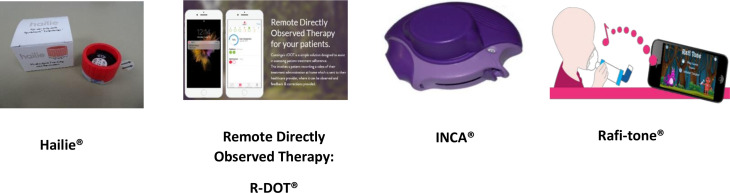
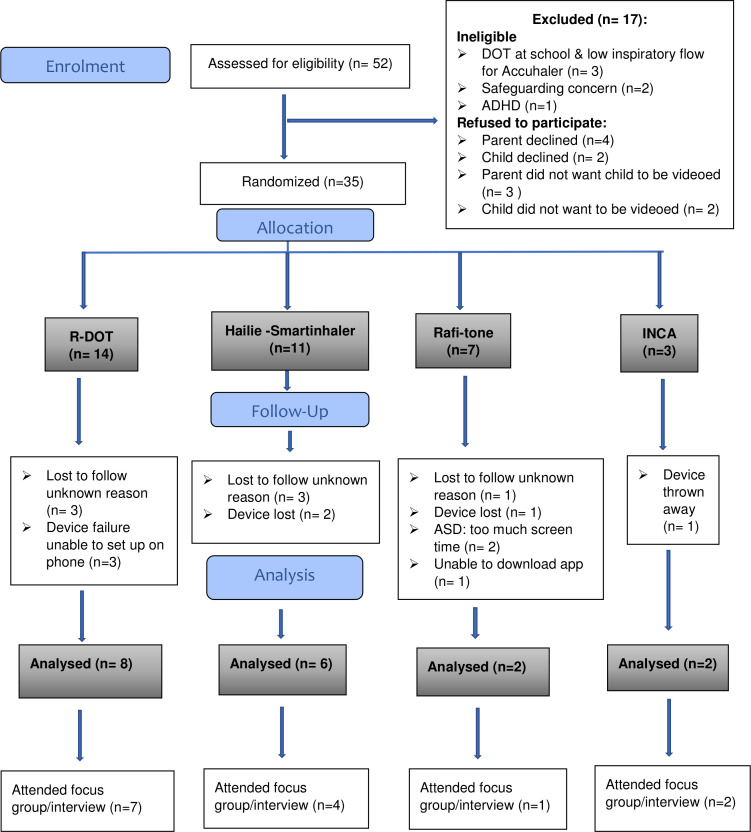
Methods: This was an open-label, prospective, mixed-methods, pragmatic randomised study. Children with asthma attending specialist tertiary care were randomised to one of four NEMD: Remote Directly Observed Therapy (R-DOT), Hailie Smartinhaler, INhaler Compliance Assessment device (INCA) and the Rafi-tone App. Following monitoring, participants were invited to focus groups or one-to-one interviews. Usability and acceptability were evaluated using themes identified from the focus groups and interviews. Adherence accuracy was determined using adherence data from each NEMD.
Results: Thirty-five children were recruited; 18 (51%), (11 males, median age 13.5 (7-16) years) completed monitoring, 14 (78%) provided feedback. Participants identified various features such as ease of use and minimal effort as desirable criteria for an NEMD. The Hailie and INCA fulfilled these criteria and were able to record both actuation and inhalation. Negative themes included a 'Big Brother' effect and costs.
Conclusion: There was no 'one size fits all', as participants identified advantages and disadvantages for each NEMD. Devices that can easily calculate adherence to activation and inhalation have the potential to have greatest utility in clinical practice. Each NEMD has different functionality and therefore choice of platform should be determined by the needs of the patient and healthcare professional.
Keywords: asthma; inhaler devices; paediatric asthma.
© Author(s) (or their employer(s)) 2020. Re-use permitted under CC BY-NC. No commercial re-use. See rights and permissions. Published by BMJ.
Conflict of interest statement
Competing interests: None declared.
Figures
References
-
- AsthmaUK Time to take action on asthma. AsthmaUK 2014;6:3–14.
-
- Asthma UK Uk asthma death rates among worst in Europe. AsthmaUK 2017.
-
- Shah R, Hagell A, Cheung R. International comparisons of health and wellbeing in adolescence and early adulthood 2019;78.
-
- Levy M, Andrews R, Buckingham R, et al. Why asthma still kills: report from the National review of asthma deaths (NRAD). Healthc Qual Improv Partnersh 2014.