. 2020 Nov 5;10(1):19415.
doi: 10.1038/s41598-020-73078-0.

Chi hotspot control of RecBCD helicase-nuclease by long-range intramolecular signaling

Affiliations

Chi hotspot control of RecBCD helicase-nuclease by long-range intramolecular signaling

Susan K Amundsen et al. Sci Rep. .

Abstract

Repair of broken DNA by homologous recombination requires coordinated enzymatic reactions to prepare it for interaction with intact DNA. The multiple activities of enterobacterial RecBCD helicase-nuclease are coordinated by Chi recombination hotspots (5' GCTGGTGG 3') recognized during DNA unwinding. Chi is recognized in a tunnel in RecC but activates the RecB nuclease, > 25 Ǻ away. How the Chi-dependent signal travels this long distance has been unknown. We found a Chi hotspot-deficient mutant in the RecB helicase domain located > 45 Ǻ from both the Chi-recognition site and the nuclease active site. This unexpected observation led us to find additional mutations that reduced or eliminated Chi hotspot activity in each subunit and widely scattered throughout RecBCD. Each mutation alters the intimate contact between one or another pair of subunits in crystal or cryoEM structures of RecBCD bound to DNA. Collectively, these mutations span a path about 185 Ǻ long from the Chi recognition site to the nuclease active site. We discuss these surprising results in the context of an intramolecular signal transduction accounting for many previous observations.


Conflict of interest statement

The authors declare no competing interests.

Figures

Figure 1
Figure 1
Model for homologous recombination and DNA break repair by RecBCD enzyme and its control by Chi hotspots. (A) Pathway of RecBCD-promoted recombination and DNA break repair,. RecBCD binds a ds DNA end (a) and unwinds the DNA, producing loop-tail structures (b) that are converted into twin-loop structures (c) by annealing of the tails. At Chi, RecBCD nicks the 3′-ended strand (d) and loads RecA (e); later, the RecBCD subunits disassemble (likely at the DNA end with purified components). The ssDNA-RecA filament invades intact homologous DNA to form a D-loop (f), which can be converted into a Holliday junction and resolved into reciprocal recombinants (g). Alternatively, the 3′-end in the D-loop can prime DNA synthesis and generate a non-reciprocal recombinant (h). See ref. for discussion of alternative models. (B) Atomic structure of RecBCD bound to DNA (PDB 1W36). RecB is orange, RecC blue, and RecD green. Yellow dashed line indicates the RecC tunnel in which Chi is recognized. Cyan indicates the RecC patch with differential trypsin-sensitivity during the RecBCD reaction cycle.
Figure 2
Figure 2
Contact points between RecBCD subunits tested for a role in Chi hotspot activity. Atomic structures of RecBCD showing contacts between RecB (orange), RecC (blue), and RecD (green); DNA is grey. Points of contact studied here are represented as spheres; the rest of the molecule is represented as cartoons (PyMol version 2.2.0). Note that the RecB-RecD contact points are separated by > 20 Ǻ in the crystal structure (dotted circle in A) PDB 1W36 but are close to each other in the cryoEM structure (solid circle in B) PDB 5LD2,. Note that, conversely, a domain of ~ 70 amino acids in RecD is ordered in the cryoEM structures but disordered in the crystal structures. (C) Contact point CD. C2 (amino acids QGEW at positions 541–544 of RecC) is yellow, and D2 (PTP at positions 97–99 of RecD) is red. Shown is part of the crystal structure PDB 1W36. (D) Contact point DB. B3 (DEHAWDVVVEEFD at positions 634–646 of RecB) is yellow, and D3 (amino acids SVQPSRLP at positions 521–528 of RecD) is red. Shown is part of the cryoEM structure PDB 5LD2. (E) Contact point BC. B4 (amino acids GHGIAQDLMP at positions 913–922 of RecB) is yellow, and C4 (amino acids FLPDAETEAA at positions 599–608 of RecC) is red. Shown is part of the crystal structure PDB 1W36. See Fig. S2 for additional views of each contact point.
Figure 3
Figure 3
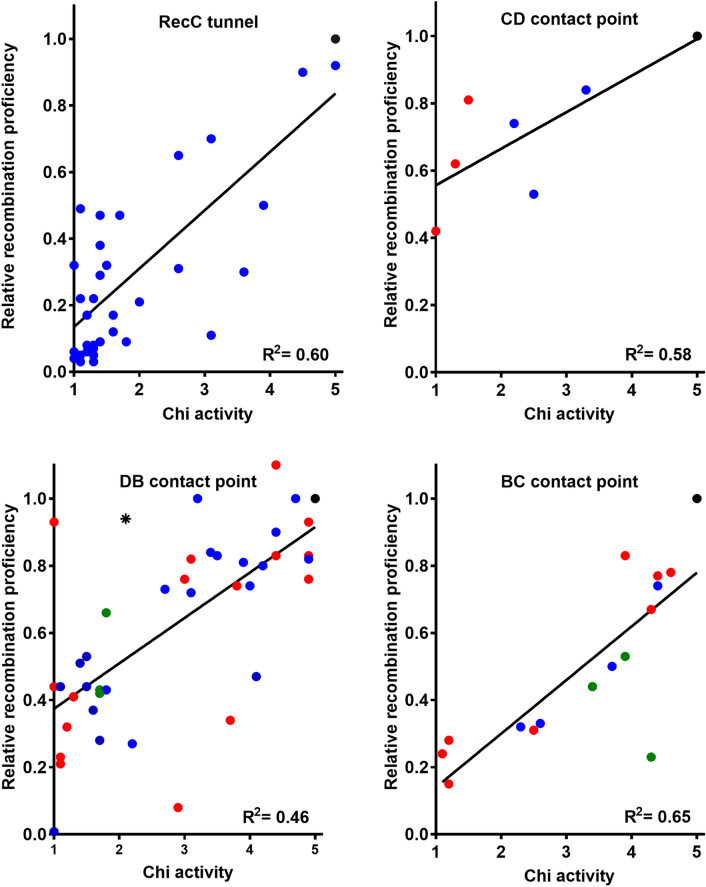
E. coli Hfr recombination proficiency is positively correlated with Chi hotspot activity. Red data points are for deletion mutants, blue for substitution mutants, and green for mutants with a substitution and deletion; black point is wild type, and star is recB344. Linear regression lines and the coefficient of determination (R2) are shown. Data are from Tables 1, 2, S1, S2, and S3 and refs.
Figure 4
Figure 4
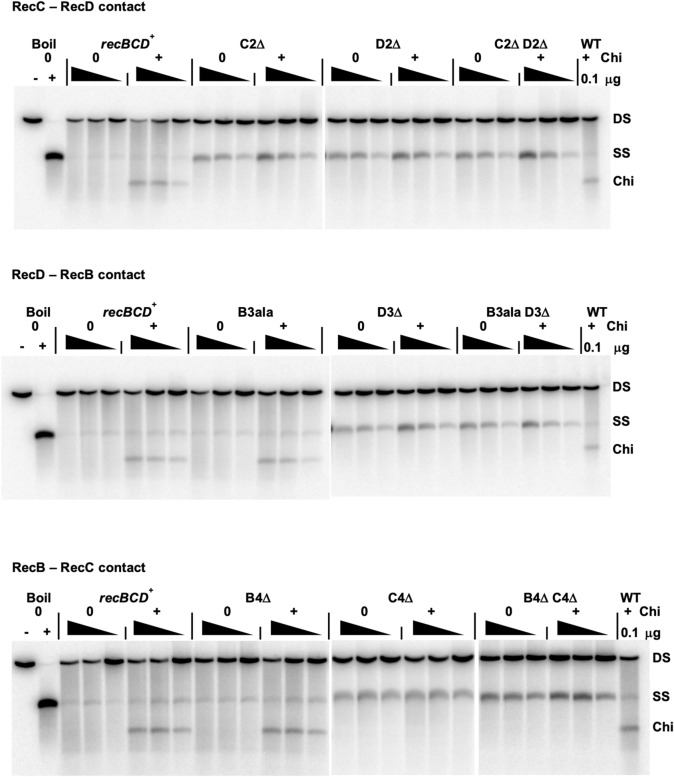
RecBCD contact-point mutants retain DNA unwinding activity but have reduced or undetectable cutting of DNA at Chi hotspots. Extracts of recBCD+ (wild type or WT; 0.3, 0.1 or 0.03 μg protein) and the indicated mutants (1, 0.3 or 0.1 μg protein) were assayed for unwinding and cutting of linear pBR322 DNA (4.3 kb long) with or without a Chi site (χ+F225) 1470 bp from the 5′ [32P]-labelled DNA end. Note that the Chi-cut species and ss DNA are reaction intermediates and their observed amount is not necessarily a linear function of enzyme amount. ds substrate (DS), unwound ss DNA (SS), and Chi-cut DNA (Chi) are indicated. Each right panel was run below the left panel on the same gel; the two are separated by a white space. Additional lanes were removed from the white space between C4Δ and B4Δ C4Δ.
Figure 5
Figure 5
Models for Chi hotspot control of RecBCD enzyme. (A) Signal transduction model for RecBCD regulation by Chi. (B) Nuclease swing model for Chi’s control of RecBCD. Cyan indicates the RecC patch that is differentially sensitive to proteases. Grey indicates the RecB nuclease domain and the tether connecting it to the RecB helicase domain; it was positioned by hand in the middle panel (b). (a) Before DNA is bound. (b) After DNA is bound but before Chi is encountered. (c) After Chi is encountered during unwinding. Modified from.

References

    1. Smith GR. How RecBCD and Chi promote DNA break repair and recombination—a molecular biologist’s view. Microbiol. Mol. Biol. Rev. 2012;76:217–228. doi: 10.1128/MMBR.05026-11. - DOI - PMC - PubMed
    1. McKittrick NH, Smith GR. Activation of Chi recombinational hotspots by RecBCD-like enzymes from enteric bacteria. J. Mol. Biol. 1989;210:485–495. doi: 10.1016/0022-2836(89)90125-3. - DOI - PubMed
    1. Smith GR, Kunes SM, Schultz DW, Taylor A, Triman KL. Structure of Chi hotspots of generalized recombination. Cell. 1981;24:429–436. doi: 10.1016/0092-8674(81)90333-0. - DOI - PubMed
    1. Schultz DW, Smith GR. Conservation of Chi cutting activity in terrestrial and marine enteric bacteria. J. Mol. Biol. 1986;189:585–595. doi: 10.1016/0022-2836(86)90489-4. - DOI - PubMed
    1. Smith GR. Conjugational recombination in E. coli: Myths and mechanisms. Cell. 1991;64:19–27. doi: 10.1016/0092-8674(91)90205-D. - DOI - PubMed

Publication types

MeSH terms

LinkOut - more resources