


Current status on the adoption of high energy devices in Italy: An Italian Society for Endoscopic Surgery and New Technologies (SICE) national survey
- PMID: 33155075
- PMCID: PMC7644118
- DOI: 10.1007/s00464-020-08117-y
Current status on the adoption of high energy devices in Italy: An Italian Society for Endoscopic Surgery and New Technologies (SICE) national survey
Abstract
Background: In the past three decades, different High Energy Devices (HED) have been introduced in surgical practice to improve the efficiency of surgical procedures. HED allow vessel sealing, coagulation and transection as well as an efficient tissue dissection. This survey was designed to verify the current status on the adoption of HED in Italy.
Methods: A survey was conducted across Italian general surgery units. The questionnaire was composed of three sections (general information, elective surgery, emergency surgery) including 44 questions. Only one member per each surgery unit was allowed to complete the questionnaire. For elective procedures, the survey included questions on thyroid surgery, lower and upper GI surgery, proctologic surgery, adrenal gland surgery, pancreatic and hepatobiliary surgery, cholecystectomy, abdominal wall surgery and breast surgery. Appendectomy, cholecystectomy for acute cholecystitis and bowel obstruction due to adhesions were considered for emergency surgery. The list of alternatives for every single question included a percentage category as follows: " < 25%, 25-50%, 51-75% or > 75%", both for open and minimally-invasive surgery.
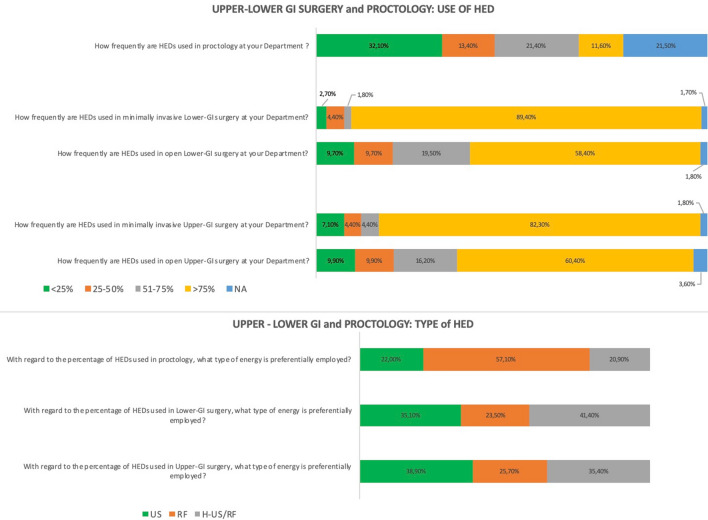
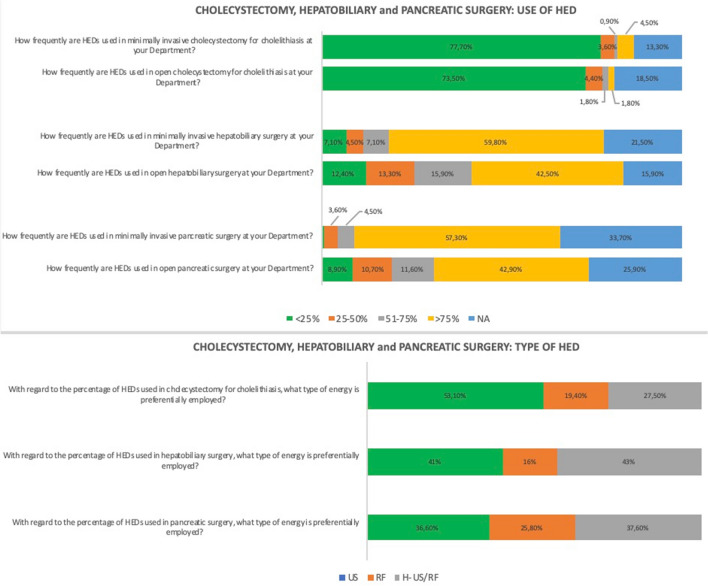
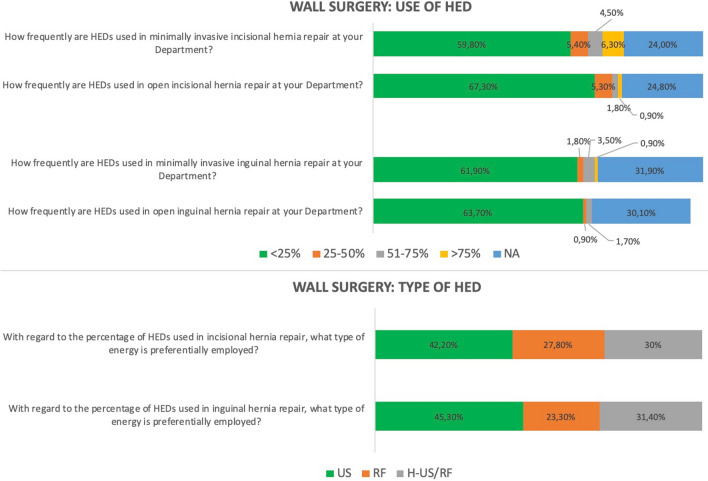
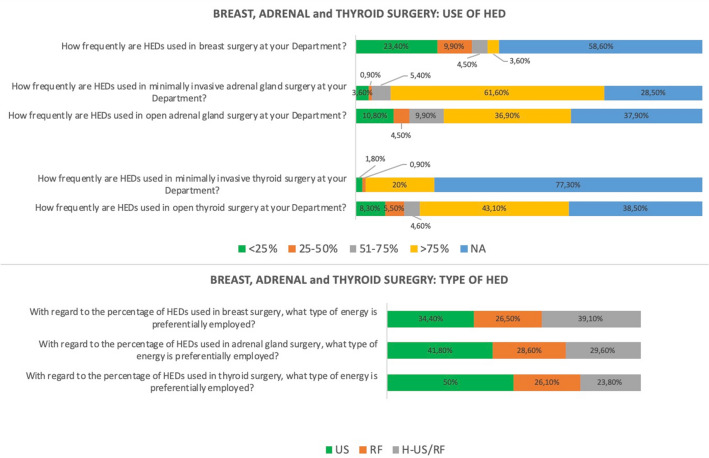
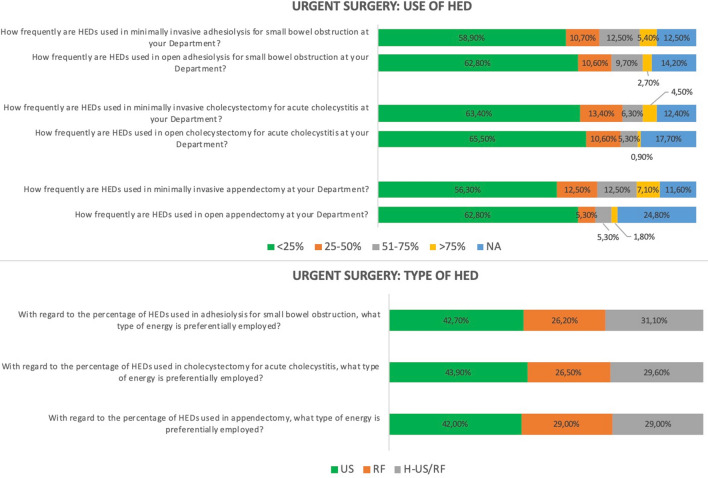
Results: A total of 113 surgical units completed the questionnaire. The reported use of HED was high both in open and minimally-invasive upper and lower GI surgery. Similarly, HED were widely used in minimally-invasive pancreatic and adrenal surgery. The use of HED was wider in minimally-invasive hepatic and biliary tree surgery compared to open surgery, whereas the majority of the respondents reported the use of any type of HED in less than 25% of elective cholecystectomies. HED were only rarely employed also in the majority of emergency open and laparoscopic procedures, including cholecystectomy, appendectomy, and adhesiolysis. Similarly, very few respondents declared to use HED in abdominal wall surgery and proctology. The distribution of the most used type of HED varied among the different surgical interventions. US HED were mostly used in thyroid, upper GI, and adrenal surgery. A relevant use of H-US/RF devices was reported in lower GI, pancreatic, hepatobiliary and breast surgery. RF HED were the preferred choice in proctology.
Conclusion: HED are extensively used in minimally-invasive elective surgery involving the upper and lower GI tract, liver, pancreas and adrenal gland. Nowadays, reasons for choosing a specific HED in clinical practice rely on several aspects, including surgeon's preference, economic features, and specific drawbacks of the energy employed.
Keywords: Bipolar vessels sealing systems; Electrosurgery; Harmonic scalpel; High energy devices; Radiofrequency electrosurgery; Survey.
© 2020. Springer Science+Business Media, LLC, part of Springer Nature.
Conflict of interest statement
Emanuele Botteri, Mauro Podda, Alberto Arezzo, Nereo Vettoretto, Alberto Sartori, Antonino Agrusa, Marco Ettore Allaix,Gabriele Anania, Riccardo Brachet Contul, Valerio Caracino, Elisa Cassinotti, Diego Cuccurullo, Giancarlo D’Ambrosio, Marco Milone, Irnerio Muttillo, Wanda Luisa Petz, Marcello Pisano, Mario Guerrieri, Gianfranco Silecchia and Ferdinando Agresta have no conflicts of interest or financial ties to disclose.
Figures
References
-
- Kennedy J, Buysse S, Lawes K, et al. Recent innovations in bipolar electrosurgery. Minim Invasive Ther Allied Technol. 1999;8:95–99. doi: 10.3109/13645709909153141. - DOI
-
- Person B, Vivas DA, Ruiz D, Talcott M, et al. Comparison of four energy-based vascular sealing and cutting instruments: a porcine model. SurgEndosc. 2008;22:534–538. - PubMed
-
- Harold KL, Pollinger H, Matthews BD, et al. Comparison of ultrasonic energy, bipolar thermal energy, and vascular clips for the hemostasis of small-, medium-, and large-sized arteries. SurgEndosc. 2003;17:1228–1230. - PubMed
MeSH terms
LinkOut - more resources
Full Text Sources
Miscellaneous
