


Effect of the COVID-19 Epidemic on Physical Activity in Community-Dwelling Older Adults in Japan: A Cross-Sectional Online Survey
- PMID: 33155619
- PMCID: PMC7597428
- DOI: 10.1007/s12603-020-1424-2
Effect of the COVID-19 Epidemic on Physical Activity in Community-Dwelling Older Adults in Japan: A Cross-Sectional Online Survey
Abstract
Objectives: The objective of this study was to investigate changes in physical activity (PA) between January (before the COVID-19 epidemic) and April (during the COVID-19 epidemic) 2020 in community-dwelling older adults in Japan.
Design: Cross-sectional online survey.
Setting and subjects: From April 23 to 27, 2020, an online survey was completed by 1,600 community-dwelling older adults in Japan.
Methods: We assessed the frailty status using the Kihon checklist, and other demographics and asked questions regarding PA at two time points: January and April 2020. We defined the total PA time (minutes) per week based on activity frequency and time.
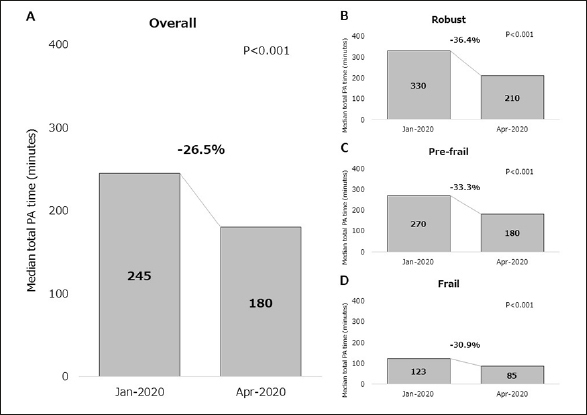
Results: The study participants' mean age, proportion of women, and prevalence of frailty were 74.0±5.6 years, 50% (n=800), and 24.3% (n=388), respectively. We found a significant decrease in total PA time in April 2020 (median [interquartile range (IQR)], 180 [0 to 420]) when compared to January 2020 (median [IQR], 245 [90 to 480]) (P<0.001). We also performed a subgroup analysis according to the frailty category; total PA time significantly decreased in April 2020 when compared to January 2020 for all frailty categories (P<0.001).
Conclusion: In conclusion, due to the COVID-19 epidemic, the total PA time in April 2020 significantly decreased compared to that in January 2020 in older adults. This finding may lead to a higher incidence of disability in the near future in older people.
Keywords: COVID-19; older adults; physical activity.
Conflict of interest statement
None
Figures
Comment in
-
Recovery from or progression to frailty during the second year of the COVID-19 pandemic.Geriatr Gerontol Int. 2022 Aug;22(8):681-682. doi: 10.1111/ggi.14421. Epub 2022 Jun 17. Geriatr Gerontol Int. 2022. PMID: 35715977 Free PMC article. No abstract available.
References
-
- Fried LP, Tangen CM, Walston J, et al. Frailty in older adults: evidence for a phenotype. J Gerontol A Biol Sci Med Sci. 2001;56:M146–56. 10.1093/gerona/56.3.M146 PubMed PMID: 11253156. - DOI - PubMed
-
- Ensrud KE, Ewing SK, Taylor BC, et al. Comparison of 2 frailty indexes for prediction of falls, disability, fractures, and death in older women. Arch Intern Med. 2008;168:382–389. 10.1001/archinternmed.2007.113 PubMed PMID: 18299493. - DOI - PubMed
-
- García-Hermoso A, Ramirez-Vélez R, Sáez de Asteasu ML, et al. Safety and Effectiveness of Long-Term Exercise Interventions in Older Adults: A Systematic Review and Meta-analysis of Randomized Controlled Trials. Sports Med 2020 [Epub ahead of print]. - PubMed
-
- Saint-Maurice PF, Troiano RP, Bassett DR, Jr, et al. Association of Daily Step Count and Step Intensity With Mortality Among US Adults. JAMA. 2020;323:1151–1160. 10.1001/jama.2020.1382 PubMed PMID: 32207799, PMCID 7093766. - DOI - PMC - PubMed
-
- Tomata Y, Suzuki Y, Kawado M, et al. Long-term impact of the 2011 Great East Japan Earthquake and tsunami on functional disability among older people: A 3-year longitudinal comparison of disability prevalence among Japanese municipalities. Soc Sci Med. 2015;147:296–299. 10.1016/j.socscimed.2015.11.016 PubMed PMID: 26613535. - DOI - PubMed
Publication types
MeSH terms
LinkOut - more resources
Full Text Sources
Medical
Miscellaneous
