. 2021 Apr;49(4):469-477.
doi: 10.1016/j.ajic.2020.10.019. Epub 2020 Nov 4.

Unintended consequences of infection prevention and control measures during COVID-19 pandemic

Affiliations

Unintended consequences of infection prevention and control measures during COVID-19 pandemic

Liang En Ian Wee et al. Am J Infect Control. 2021 Apr.

Abstract

Background: In the current COVID-19 pandemic, aggressive Infection Prevention and Control (IPC) measures have been adopted to prevent health care-associated transmission of COVID-19. We evaluated the impact of a multimodal IPC strategy originally designed for the containment of COVID-19 on the rates of other hospital-acquired-infections (HAIs).

Methodology: From February-August 2020, a multimodal IPC strategy was implemented across a large health care campus in Singapore, comprising improved segregation of patients with respiratory symptoms, universal masking and heightened adherence to Standard Precautions. The following rates of HAI were compared pre- and postpandemic: health care-associated respiratory-viral-infection (HA-RVI), methicillin-resistant Staphylococcus aureus, and CP-CRE acquisition rates, health care-facility-associated C difficile infections and device-associated HAIs.

Results: Enhanced IPC measures introduced to contain COVID-19 had the unintended positive consequence of containing HA-RVI. The cumulative incidence of HA-RVI decreased from 9.69 cases per 10,000 patient-days to 0.83 cases per 10,000 patient-days (incidence-rate-ratio = 0.08; 95% confidence interval [CI] = 0.05-0.13, P< .05). Hospital-wide MRSA acquisition rates declined significantly during the pandemic (incidence-rate-ratio = 0.54, 95% CI = 0.46-0.64, P< .05), together with central-line-associated-bloodstream infection rates (incidence-rate-ratio = 0.24, 95% CI = 0.07-0.57, P< .05); likely due to increased compliance with Standard Precautions. Despite the disruption caused by the pandemic, there was no increase in CP-CRE acquisition, and rates of other HAIs remained stable.

Conclusions: Multimodal IPC strategies can be implemented at scale to successfully mitigate health care-associated transmission of RVIs. Good adherence to personal-protective-equipment and hand hygiene kept other HAI rates stable even during an ongoing pandemic where respiratory infections were prioritized for interventions.

Keywords: Healthcare associated infections; MRSA; SARS-CoV-2; Surveillance; infection control.


Figures

Fig 1
Fig 1
Rates of health care-associated infections prior to and during COVID-19 pandemic across a large health care system in Singapore. (a) Number of health care-associated respiratory viral infections (HA-RVI). (b) MRSA acquisition rate (per 10,000 patient-days). (c) CP-CRE acquisition rate (per 1,000 patient days). (d) Number of multidrug-resistant (MDR) and extensively drug-resistant (XDR) P aeruginosa (PsA) infections.
Fig 2
Fig 2
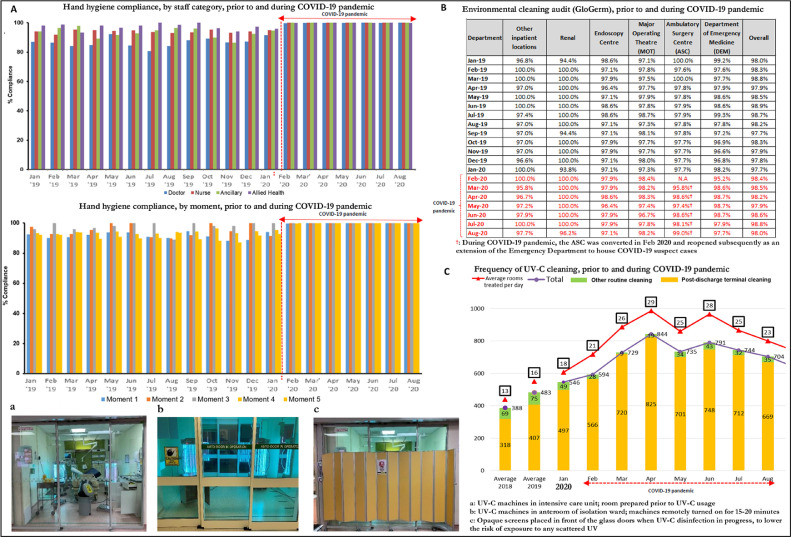
Hand hygiene compliance, environmental cleaning audit and personal-protective-equipment consumption, prior to and during COVID-19 pandemic across a large health care system in Singapore. (a) Hand hygiene compliance, prior to and during COVID-19 pandemic across a large health care system in Singapore. (b) Environment cleaning audit, prior to and during COVID-19 pandemic across a large health care system in Singapore. (c) Frequency of UV-C cleaning, prior to and during COVID-19 pandemic across a large health care system in Singapore. (d) Consumption of alcohol handrub and personal protective equipment, prior to and during COVID-19 pandemic across a large health care system in Singapore.
Fig 2
Fig 2
Hand hygiene compliance, environmental cleaning audit and personal-protective-equipment consumption, prior to and during COVID-19 pandemic across a large health care system in Singapore. (a) Hand hygiene compliance, prior to and during COVID-19 pandemic across a large health care system in Singapore. (b) Environment cleaning audit, prior to and during COVID-19 pandemic across a large health care system in Singapore. (c) Frequency of UV-C cleaning, prior to and during COVID-19 pandemic across a large health care system in Singapore. (d) Consumption of alcohol handrub and personal protective equipment, prior to and during COVID-19 pandemic across a large health care system in Singapore.
Fig 3
Fig 3
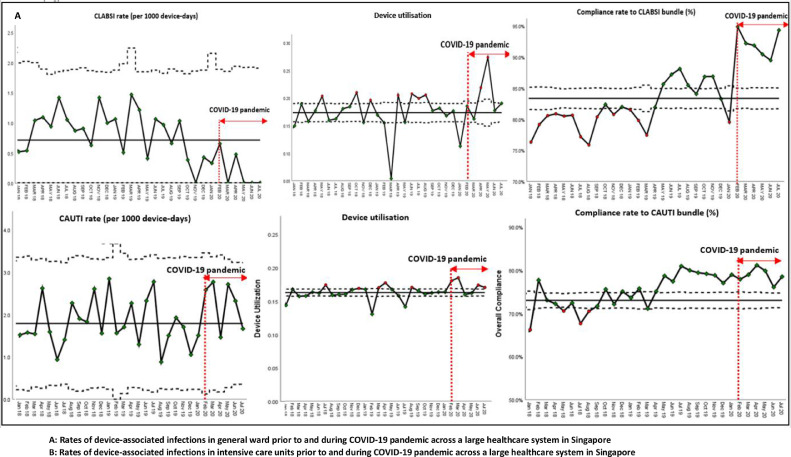
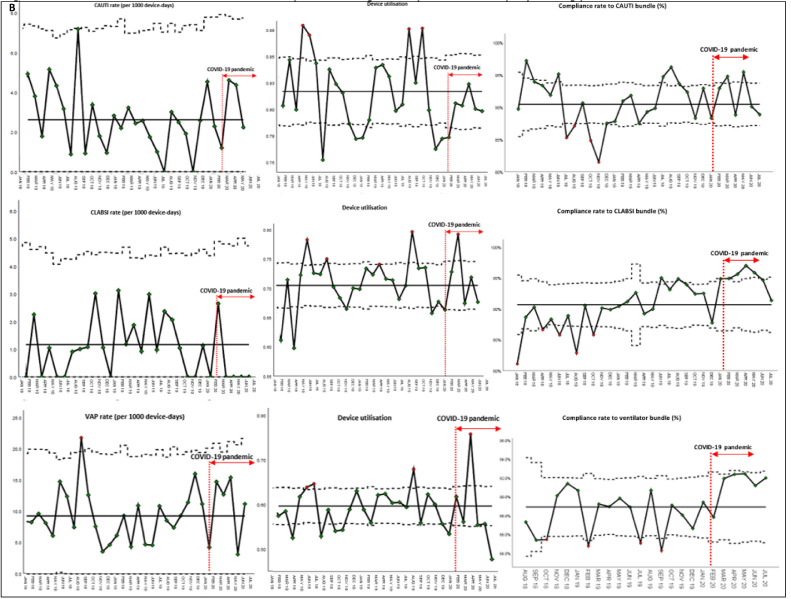
Rates of device-associated infections in general wards and intensive care units, prior to and during COVID-19 pandemic across a large health care system in Singapore. (a) Rates of device-associated infections in general ward prior to and during COVID-19 pandemic across a large health care system in Singapore. (b) Rates of device-associated infections in intensive care units prior to and during COVID-19 pandemic across a large health care system in Singapore.
Fig 3
Fig 3
Rates of device-associated infections in general wards and intensive care units, prior to and during COVID-19 pandemic across a large health care system in Singapore. (a) Rates of device-associated infections in general ward prior to and during COVID-19 pandemic across a large health care system in Singapore. (b) Rates of device-associated infections in intensive care units prior to and during COVID-19 pandemic across a large health care system in Singapore.

References

    1. Rhee C, Baker MA, Klompas M. The COVID-19 infection control arms race. Infect Control Hosp Epidemiol. 2020:1–3. - PMC - PubMed
    1. Wang X, Ferro EG, Zhou G, Hashimoto D, Bhatt DL. Association between universal masking in a health care system and SARS-CoV-2 positivity among health care workers. JAMA. 2020;324:703–704. - PMC - PubMed
    1. Liu YA, Hsu YC, Lin MH, et al. Hospital visiting policies in the time of coronavirus disease 2019: a nationwide website survey in Taiwan. J Chin Med Assoc. 2020;83:566–570. - PMC - PubMed
    1. Wee LE, Conceicao EP, Sim XYJ, Ko KKK, Ling ML, Venkatachalam I. Reduction in healthcare-associated respiratory viral infections during a COVID-19 outbreak. Clin Microbiol Infect. 2020;26:1579–1581. - PMC - PubMed
    1. Mermel LA, Jefferson JA, Smit MA, Auld DB. Prevention of hospital-acquired respiratory viral infections: assessment of a multimodal intervention program. Infect Control Hosp Epidemiol. 2019;40:362–364. - PubMed

MeSH terms