. 2020 Nov 4;12(11):1052.
doi: 10.3390/pharmaceutics12111052.

Liquid and Solid Self-Emulsifying Drug Delivery Systems (SEDDs) as Carriers for the Oral Delivery of Azithromycin: Optimization, In Vitro Characterization and Stability Assessment

Affiliations

Liquid and Solid Self-Emulsifying Drug Delivery Systems (SEDDs) as Carriers for the Oral Delivery of Azithromycin: Optimization, In Vitro Characterization and Stability Assessment

Reem Abou Assi et al. Pharmaceutics. .

Abstract

Azithromycin (AZM) is a macrolide antibiotic used for the treatment of various bacterial infections. The drug is known to have low oral bioavailability (37%) which may be attributed to its relatively high molecular weight, low solubility, dissolution rate, and incomplete intestinal absorption. To overcome these drawbacks, liquid (L) and solid (S) self-emulsifying drug delivery systems (SEDDs) of AZM were developed and optimized. Eight different pseudo-ternary diagrams were constructed based on the drug solubility and the emulsification studies in various SEDDs excipients at different surfactant to co-surfactant (Smix) ratios. Droplet size (DS) < 150 nm, dispersity (Đ) ≤ 0.7, and transmittance (T)% > 85 in three diluents of distilled water (DW), 0.1 mM HCl, and simulated intestinal fluids (SIF) were considered as the selection criteria. The final formulations of L-SEDDs (L-F1(H)), and S-SEDDs (S-F1(H)) were able to meet the selection requirements. Both formulations were proven to be cytocompatible and able to open up the cellular epithelial tight junctions (TJ). The drug dissolution studies showed that after 5 min > 90% and 52.22% of the AZM was released from liquid and solid SEDDs formulations in DW, respectively, compared to 11.27% of the pure AZM, suggesting the developed SEDDs may enhance the oral delivery of the drug. The formulations were stable at refrigerator storage conditions.

Keywords: Caco-2 cell; MTT assay; cytotoxicity; drug delivery; liquid SEDDs; self-emulsifying; solid SEDDs; stability; tight junctions.


Conflict of interest statement

The authors declare no conflict of interest.

Figures
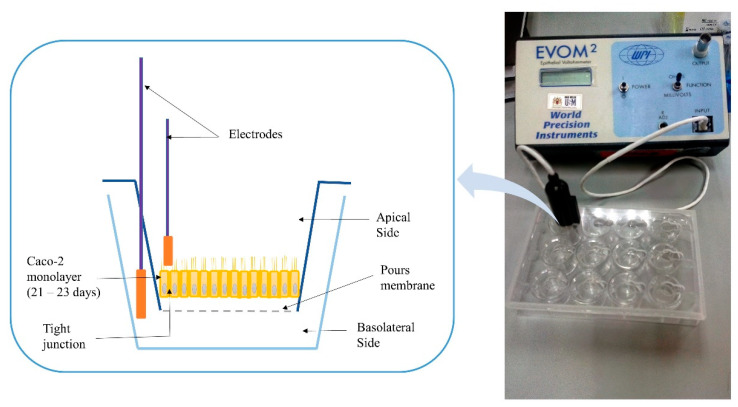
Figure 1
Figure 1
Schematic diagram for the measuring procedure of transepithelial electrical resistance (TEER).
Figure 2
Figure 2
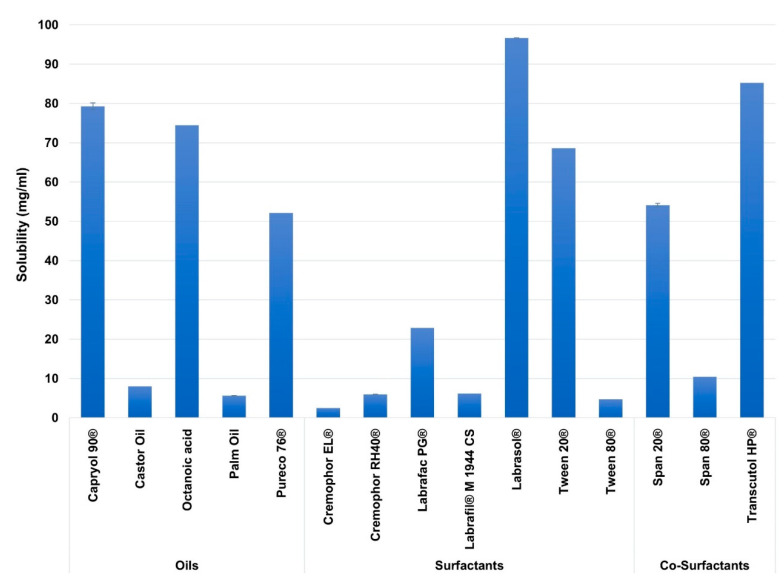
The solubility of Azithromycin (AZM) in the different screened excipients. Mean ± SD, n = 3.
Figure 3
Figure 3
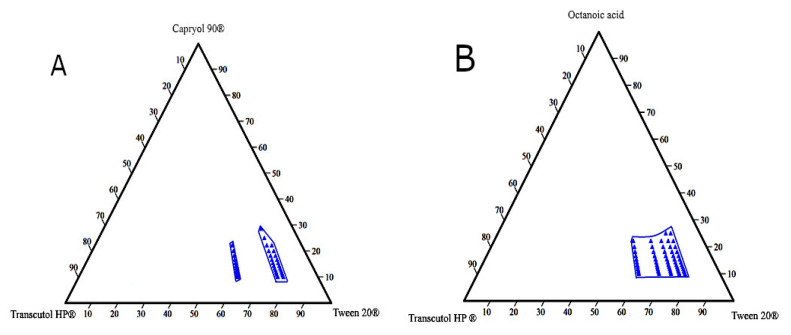
The pseudo-ternary diagram plots for the L-SEDDs formulations. (A) For the L-SEDDs formulation composed of Capryol 90® (oil), Tween 20® (surfactant), and Transcutol HP® (co-surfactant) at different Smix ratios. (B) For the L-SEDDs formulations composed of Octanoic acid (oil), Tween 20® (surfactant), and Transcutol HP® (co-surfactant) at different Smix ratios.
Figure 4
Figure 4
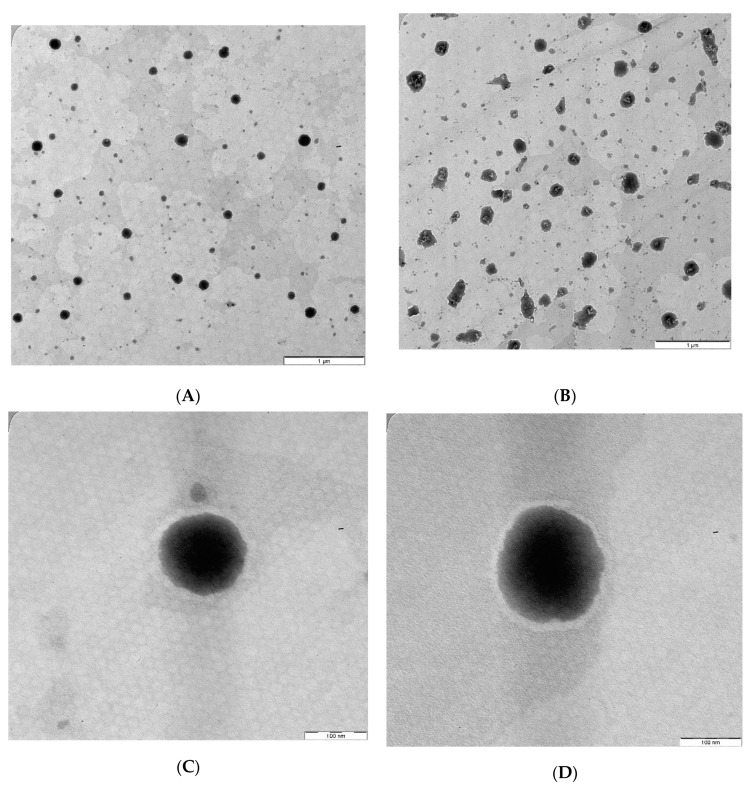
TEM images of the optimized AZM-loaded liquid and solid SEDDs formulations. (A) AZM-L-F1(H) Dispersion; (B) AZM-S-F1(H) Dispersion; (C) Individual droplet of AZM-L-F1(H); (D) Individual droplet of AZM-S-F1(H).
Figure 5
Figure 5
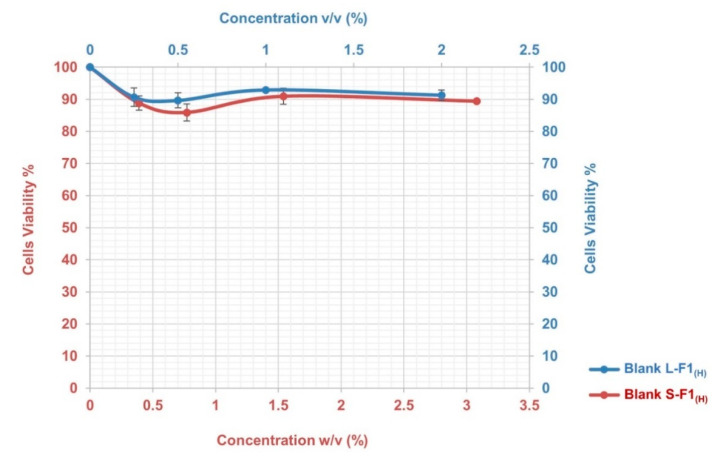
The cytotoxicity profile of Blank L-F1(H), and Blank S-F1(H) formulations at different concentrations. Mean ± SEM, n = 3.
Figure 6
Figure 6
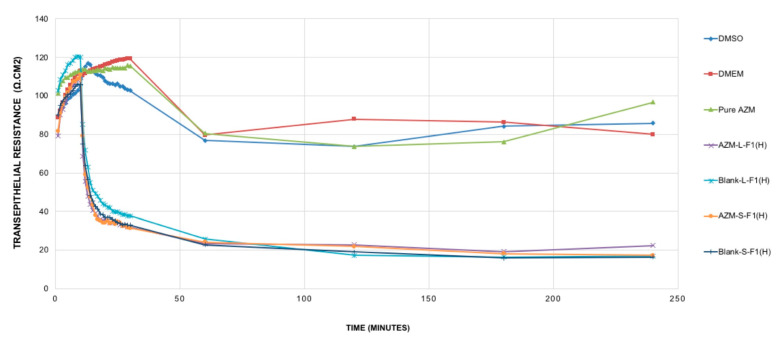
TEER resistance of the studied samples. Mean ± SEM, n = 3. DMSO: dimethyl sulfoxide, DMEM: Dulbecco’s modified eagle’s medium, AZM-L-F1(H): Azithromycin-loaded liquid SEDDs, Blank L-F1(H): Blank liquid SEDDS, Pure AZM: Pure Azithromycin, AZM-S-F1(H): Azithromycin-loaded solid SEDDs, Blank S-F1(H): Blank solid SEDDS.
Figure 7
Figure 7
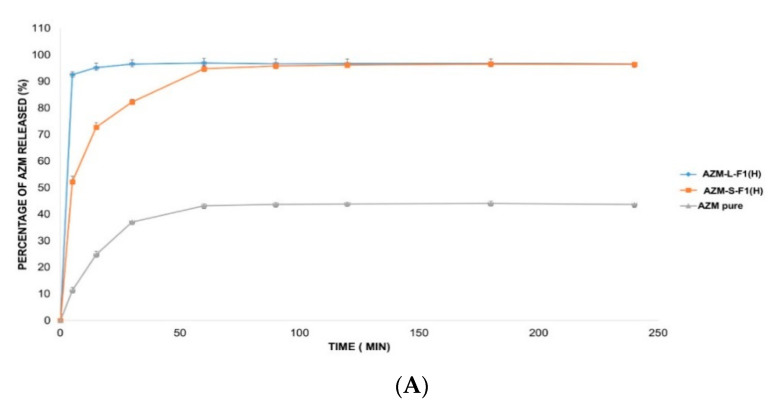
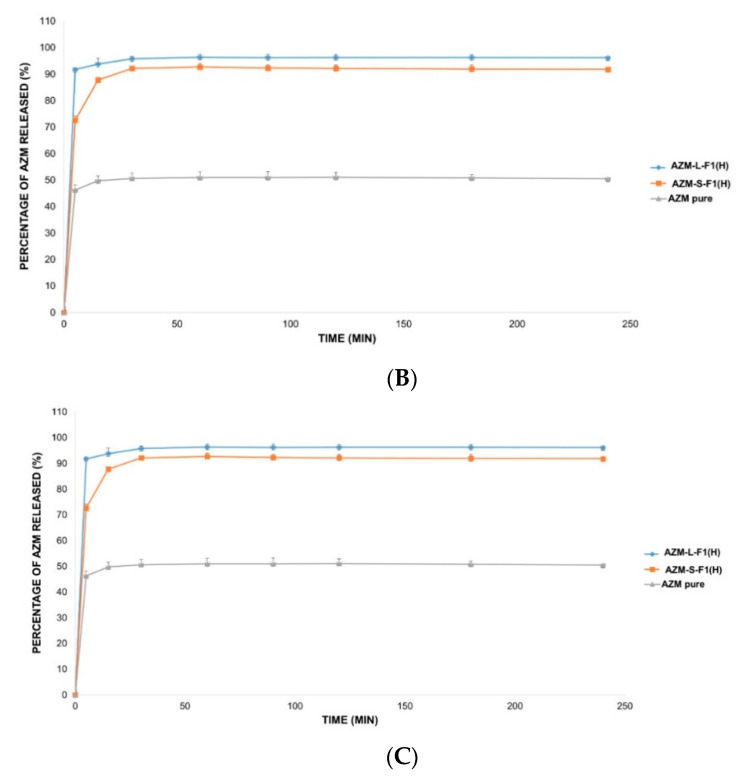
The in vitro release profile of AZM-L-F1(H), AZM-S-F1(H) formulations, and pure AZM in DW, HCl, and SIF, respectively. (A) The in vitro release profile in DW. (B) The in vitro release profile in 0.1 mM HCl (pH = 4). (C) The in vitro release profile in SIF pH = (6.8).
Figure 7
Figure 7
The in vitro release profile of AZM-L-F1(H), AZM-S-F1(H) formulations, and pure AZM in DW, HCl, and SIF, respectively. (A) The in vitro release profile in DW. (B) The in vitro release profile in 0.1 mM HCl (pH = 4). (C) The in vitro release profile in SIF pH = (6.8).

References

    1. Al-Achi A., Gupta M.R., Stagner W.C. Integrated Pharmaceutics: Applied Preformulation, Product Design, and Regulatory Science. Wiley; Hoboken, NJ, USA: 2013. pp. 163–164.
    1. Torne S.R., Sheela A., Sarada N.C. A Review on Oral Liquid as an Emerging Technology in Controlled Drug Delivery System. Curr. Pharm. Des. 2018;24:1349–1356. doi: 10.2174/1381612824666171204102800. - DOI - PubMed
    1. Ghasemiyeh P., Mohammadi-Samani S. Solid lipid nanoparticles and nanostructured lipid carriers as novel drug delivery systems: Applications, advantages and disadvantages. Res. Pharm. Sci. 2018;13:288–303. doi: 10.4103/1735-5362.235156. - DOI - PMC - PubMed
    1. Laksitorini M., Prasasty V.D., Kiptoo P.K., Siahaan T.J. Pathways and progress in improving drug delivery through the intestinal mucosa and blood-brain barriers. Ther. Deliv. 2014;5:1143–1163. doi: 10.4155/tde.14.67. - DOI - PMC - PubMed
    1. The United States Pharmacopoeia and National Formulary. 38th ed. Volume 39. The United States Pharmacopeial Convention; Rockville, MD, USA: 2015. p. 2339.

LinkOut - more resources