. 2020 Nov 4;12(11):3254.
doi: 10.3390/cancers12113254.

The CHEK2 Variant C.349A>G Is Associated with Prostate Cancer Risk and Carriers Share a Common Ancestor

Andreia Brandão  1 Paula Paulo  1 Sofia Maia  1 Manuela Pinheiro  1 Ana Peixoto  2 Marta Cardoso  1 Maria P Silva  1 Catarina Santos  2 Rosalind A Eeles  3   4 Zsofia Kote-Jarai  3 Kenneth Muir  5   6 Ukgpcs Collaborators  7 Johanna Schleutker  8   9 Ying Wang  10 Nora Pashayan  11   12 Jyotsna Batra  13   14 Apcb BioResource  13   14 Henrik Grönberg  15 David E Neal  16   17   18 Børge G Nordestgaard  19   20 Catherine M Tangen  21 Melissa C Southey  22   23   24 Alicja Wolk  25   26 Demetrius Albanes  27 Christopher A Haiman  28 Ruth C Travis  29 Janet L Stanford  30   31 Lorelei A Mucci  32 Catharine M L West  33 Sune F Nielsen  19   20 Adam S Kibel  34 Olivier Cussenot  35   36 Sonja I Berndt  27 Stella Koutros  27 Karina Dalsgaard Sørensen  37   38 Cezary Cybulski  39 Eli Marie Grindedal  40 Jong Y Park  41 Sue A Ingles  42 Christiane Maier  43 Robert J Hamilton  44   45 Barry S Rosenstein  46   47 Ana Vega  48   49   50 The Impact Study Steering Committee And Collaborators  7 Manolis Kogevinas  51   52   53   54 Fredrik Wiklund  15 Kathryn L Penney  55 Hermann Brenner  56   57   58 Esther M John  59 Radka Kaneva  60 Christopher J Logothetis  61 Susan L Neuhausen  62 Kim De Ruyck  63 Azad Razack  64 Lisa F Newcomb  30   65 Canary Pass Investigators  30   65 Davor Lessel  66 Nawaid Usmani  67   68 Frank Claessens  69 Manuela Gago-Dominguez  70   71 Paul A Townsend  72 Monique J Roobol  73 The Profile Study Steering Committee  74 The Practical ConsortiumManuel R Teixeira  1   2   6   75
Affiliations

The CHEK2 Variant C.349A>G Is Associated with Prostate Cancer Risk and Carriers Share a Common Ancestor

Andreia Brandão et al. Cancers (Basel). .

Abstract

The identification of recurrent founder variants in cancer predisposing genes may have important implications for implementing cost-effective targeted genetic screening strategies. In this study, we evaluated the prevalence and relative risk of the CHEK2 recurrent variant c.349A>G in a series of 462 Portuguese patients with early-onset and/or familial/hereditary prostate cancer (PrCa), as well as in the large multicentre PRACTICAL case-control study comprising 55,162 prostate cancer cases and 36,147 controls. Additionally, we investigated the potential shared ancestry of the carriers by performing identity-by-descent, haplotype and age estimation analyses using high-density SNP data from 70 variant carriers belonging to 11 different populations included in the PRACTICAL consortium. The CHEK2 missense variant c.349A>G was found significantly associated with an increased risk for PrCa (OR 1.9; 95% CI: 1.1-3.2). A shared haplotype flanking the variant in all carriers was identified, strongly suggesting a common founder of European origin. Additionally, using two independent statistical algorithms, implemented by DMLE+2.3 and ESTIAGE, we were able to estimate the age of the variant between 2300 and 3125 years. By extending the haplotype analysis to 14 additional carrier families, a shared core haplotype was revealed among all carriers matching the conserved region previously identified in the high-density SNP analysis. These findings are consistent with CHEK2 c.349A>G being a founder variant associated with increased PrCa risk, suggesting its potential usefulness for cost-effective targeted genetic screening in PrCa families.

Keywords: CHEK2; cancer predisposition; founder variant; prostate cancer.


Conflict of interest statement

The authors declare no conflict of interest. The funders had no role in the design of the study; in the collection, analyses, or interpretation of data; in the writing of the manuscript, or in the decision to publish the results.

Figures
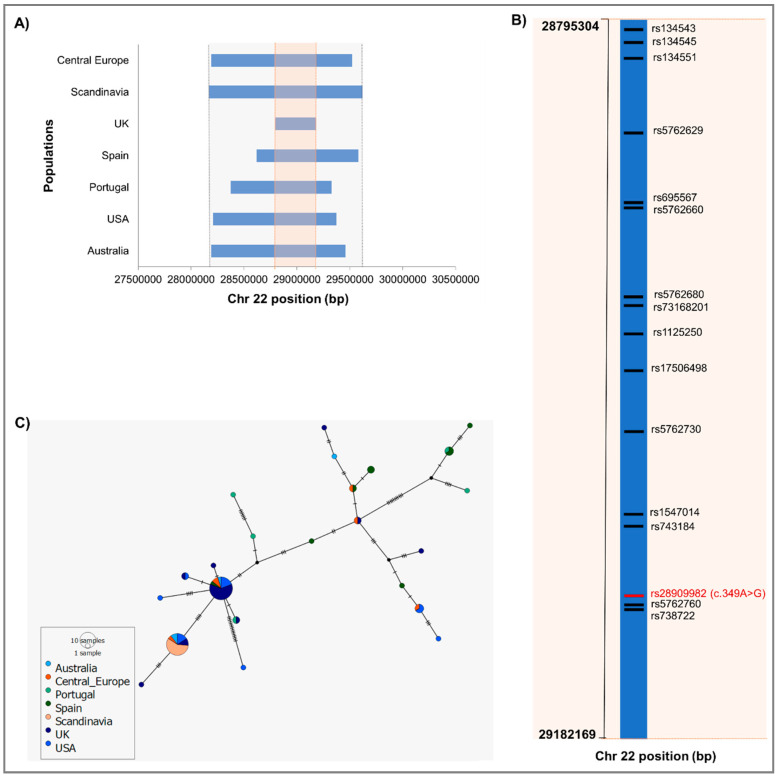
Figure 1
Figure 1
Shared identity-by-descent (IBD) haplotype between all carriers of the CHEK2 variant c.349A>G. (A). Shared IBD segments by populations: Australia, Portugal, Scandinavia (Denmark and Sweden), Spain, Western/Central Europe populations (Belgium, France, Germany and Netherlands), UK, and U.S. (B) Characterisation of IBD core segment shared by all carriers (≈0.4 Mb in detail, represented in light orange in Figure 1A). (C) Median joining phylogenetic tree of the largest shared haplotype region flanking the CHEK2 variant c.349A>G between all carriers (indicated in light grey in Figure 1A).
Figure 2
Figure 2
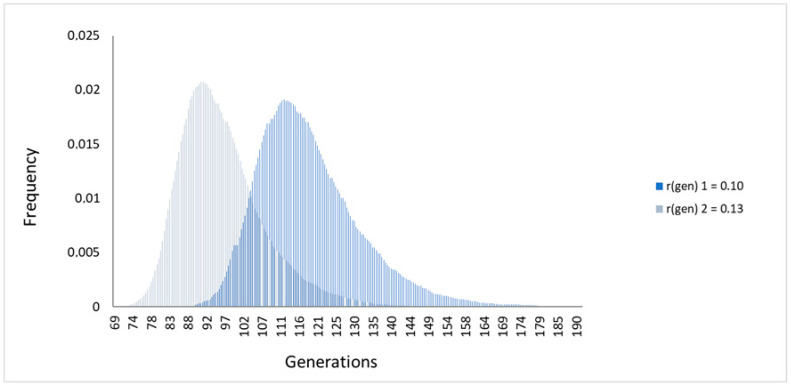
Overall age estimation of the CHEK2 variant c.349A>G using the DMLE+2.3 software, considering the 70 carriers. Distribution of the posterior probability for the age estimation, assuming 0.00028 as the proportion of variant-carrying chromosomes and the two population growth rates 0.10 and 0.13.
Figure 3
Figure 3
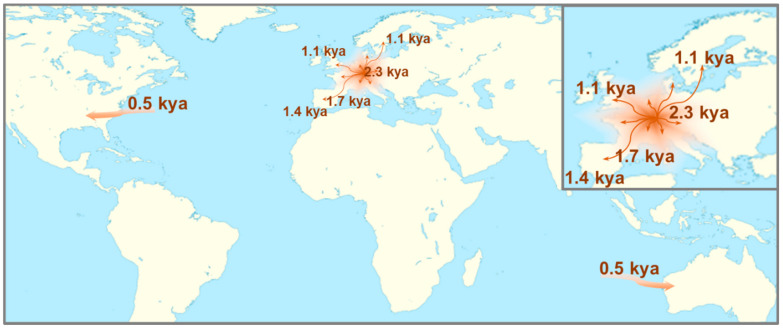
Possible geographic dispersal scenario inferred from present data of the populations carrying CHEK2 variant c.349A>G, with the average age estimates obtained by DMLE+2.3, using the two population growth rates. Background map adapted from the map outline published under the terms of the GNU Free Documentation License, Version 1.2 [28].

References

    1. Bray F., Ferlay J., Soerjomataram I., Siegel R.L., Torre L.A., Jemal A. Global cancer statistics 2018: GLOBOCAN estimates of incidence and mortality worldwide for 36 cancers in 185 countries. CA Cancer J. Clin. 2018;68:394–424. doi: 10.3322/caac.21492. - DOI - PubMed
    1. Bashir M.N. Epidemiology of prostate cancer. Asian Pac. J. Cancer Prev. 2015;16:5137–5141. doi: 10.7314/APJCP.2015.16.13.5137. - DOI - PubMed
    1. Al Olama A.A., Kote-Jarai Z., Schumacher F.R., Wiklund F., Berndt S.I., Benlloch S., Giles G.G., Severi G., Neal D.E., Hamdy F.C., et al. A meta-analysis of genome-wide association studies to identify prostate cancer susceptibility loci associated with aggressive and non-aggressive disease. Hum. Mol. Genet. 2013;22:408–415. doi: 10.1093/hmg/dds425. - DOI - PMC - PubMed
    1. Schumacher F.R., Al Olama A.A., Berndt S.I., Benlloch S., Ahmed M., Saunders E.J., Dadaev T., Leongamornlert D., Anokian E., Cieza-Borrella C., et al. Association analyses of more than 140,000 men identify 63 new prostate cancer susceptibility loci. Nat. Genet. 2018;50:928–936. doi: 10.1038/s41588-018-0142-8. - DOI - PMC - PubMed
    1. Al Olama A.A., Kote-Jarai Z., Giles G.G., Guy M., Morrison J., Severi G., Leongamornlert D.A., Tymrakiewicz M., Jhavar S., Saunders E., et al. Multiple loci on 8q24 associated with prostate cancer susceptibility. Nat. Genet. 2009;41:1058–1060. doi: 10.1038/ng.452. - DOI - PubMed

LinkOut - more resources