Review
. 2020 Nov 4;12(11):3264.
doi: 10.3390/cancers12113264.

Non-Coding RNAs: Uncharted Mediators of Thyroid Cancer Pathogenesis

Affiliations
Review

Non-Coding RNAs: Uncharted Mediators of Thyroid Cancer Pathogenesis

Hossein Tabatabaeian et al. Cancers (Basel). .

Abstract

Thyroid cancer is the most prevalent malignancy of the endocrine system and the ninth most common cancer globally. Despite the advances in the management of thyroid cancer, there are critical issues with the diagnosis and treatment of thyroid cancer that result in the poor overall survival of undifferentiated and metastatic thyroid cancer patients. Recent studies have revealed the role of different non-coding RNAs (ncRNAs), such as microRNAs (miRNAs), long non-coding RNAs (lncRNAs) and circular RNAs (circRNAs) that are dysregulated during thyroid cancer development or the acquisition of resistance to therapeutics, and may play key roles in treatment failure and poor prognosis of the thyroid cancer patients. Here, we systematically review the emerging roles and molecular mechanisms of ncRNAs that regulate thyroid tumorigenesis and drug response. We then propose the potential clinical implications of ncRNAs as novel diagnostic and prognostic biomarkers for thyroid cancer.

Keywords: drug resistance; non-coding RNA; prognosis; radioactive iodine; thyroid carcinoma.


Conflict of interest statement

The authors declare no conflicts of interest.

Figures
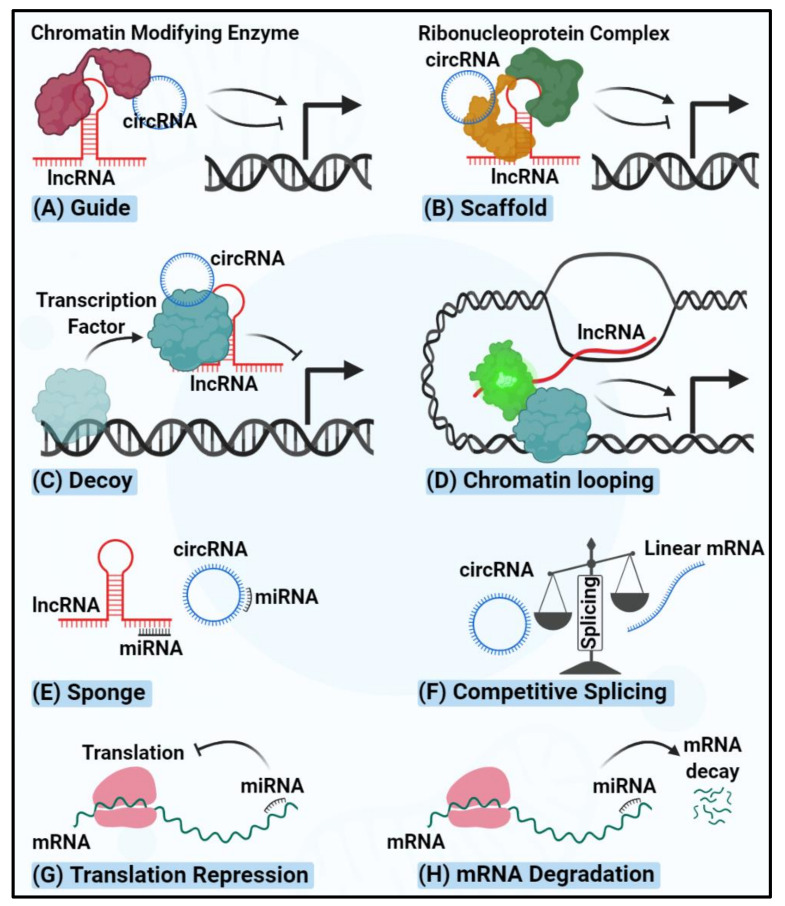
Figure 1
Figure 1
The schematic of mechanisms of action of ncRNAs. (A) lncRNAs and circRNAs can guide chromatin remodeling factors to either activate or repress the transcription of target genes. (B) lncRNAs and circRNAs, as scaffolds, can facilitate the assembly of ribonucleoprotein complexes to either activate or repress the transcription of target genes. (C) lncRNAs and circRNAs can sponge the transcription factors to repress the transcription of the target genes. (D) Upon transcription, lncRNAs can facilitate the formation of regulatory complexes and loop the DNA, thereby priming long-range gene transcription. (E) lncRNAs and circRNAs can sponge the miRNAs, thereby rescuing the miRNA target transcripts. (F) circRNAs can compete with the linear mRNA(s) transcribed from their host gene and repress the canonical splicing over the back splicing. (G) miRNAs bind to their target mRNAs and repress the translation efficiency upon non-perfect complementation between the seed region and targeted binding site. (H) miRNAs bind to their target mRNAs and result in transcript degradation upon perfect complementation between the seed region and targeted binding site.
Figure 2
Figure 2
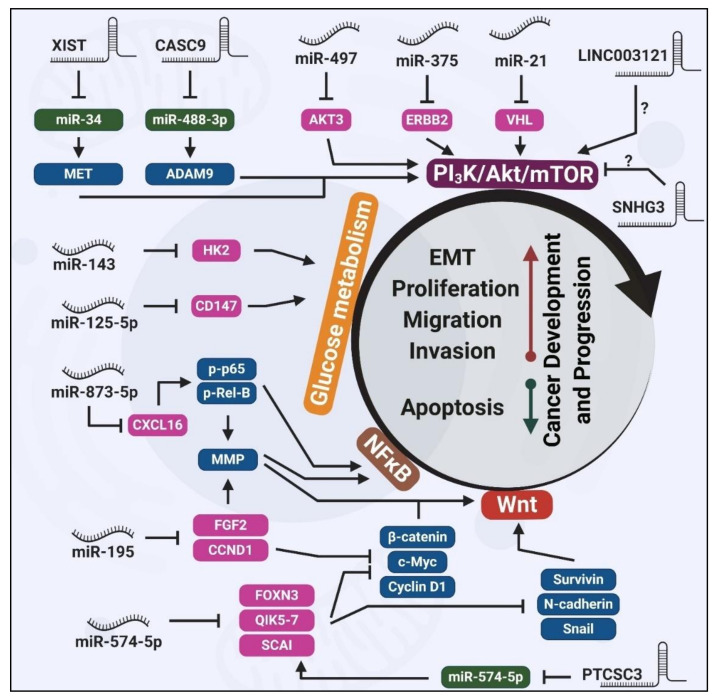
Schematic overview of ncRNA involvement in thyroid cancer-related signaling pathways. Key components of the PI3K/Akt/mTOR pathway, such as AKT3, ERBB2 and VHL, are regulated by different miRNAs and lncRNAs in thyroid cancer. The metabolism of glucose is regulated by miR-143 and miR-125-5p. Well-known cancer-related pathways, NFκB and Wnt, are tightly regulated by miRNAs and lncRNAs in thyroid cancer. Dysregulation of these miRNAs and lncRNAs in various types of thyroid cancer eventually results in the induction of proliferation, migration and invasion, while apoptosis is suppressed. Note: Pink represents direct targets of miRNAs, green represents direct miRNA targets of lncRNAs and blue represents the indirect target of miRNA or lncRNAs.
Figure 3
Figure 3
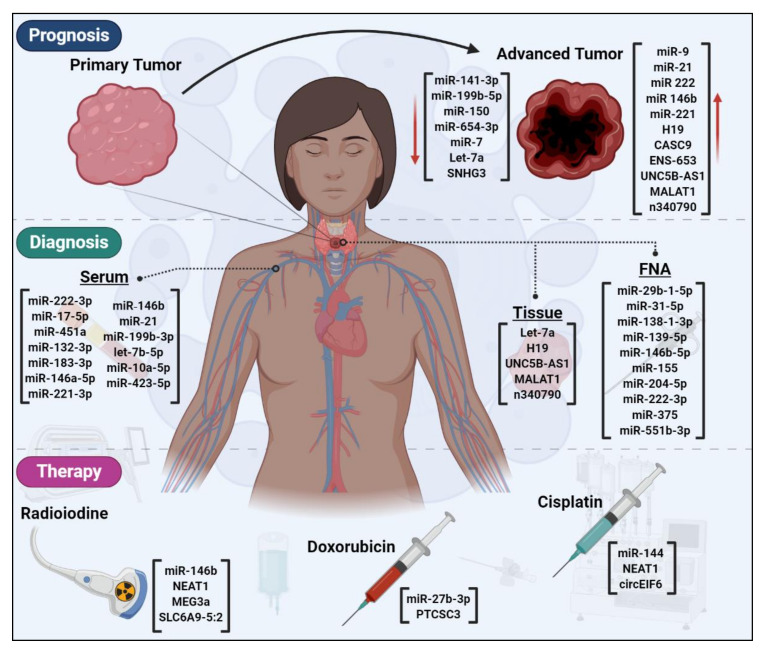
The diagnostic, prognostic and therapeutic significance of dysregulated ncRNAs in thyroid cancer. A variety of ncRNAs are dysregulated during primary to advanced tumor progression. These ncRNAs could have implications for the prognosis of thyroid cancer patients. The expression levels of ncRNAs could distinguish normal from tumor thyroid cells, therefore, acting as diagnostic biomarkers. Several ncRNAs may determine the response/resistance to the routine thyroid cancer treatment options of radioiodine and/or chemotherapy. FNA: fine needle aspiration.

References

    1. Katoh H., Yamashita K., Enomoto T., Watanabe M. Classification and general considerations of thyroid cancer. Ann. Clin. Pathol. 2015;3:1045.
    1. James B.C., Mitchell J.M., Jeon H.D., Vasilottos N., Grogan R.H., Aschebrook-Kilfoy B. An update in international trends in incidence rates of thyroid cancer, 1973–2007. Cancer Causes Control. 2018;29:465–473. doi: 10.1007/s10552-018-1023-2. - DOI - PubMed
    1. Bray F., Ferlay J., Soerjomataram I., Siegel R.L., Torre L.A., Jemal A. Global cancer statistics 2018: GLOBOCAN estimates of incidence and mortality worldwide for 36 cancers in 185 countries. CA Cancer J. Clin. 2018;68:394–424. doi: 10.3322/caac.21492. - DOI - PubMed
    1. Davies L., Morris L., Hankey B. Increases in thyroid cancer incidence and mortality. JAMA. 2017;318:389–390. doi: 10.1001/jama.2017.7906. - DOI - PubMed
    1. National Cancer Institute Surveillance, Epidemiology and End Results (SEER) Program. [(accessed on 4 October 2020)]; Available online: https://seer.cancer.gov/statfacts/html/thyro.htm.

LinkOut - more resources