Review
. 2020 Nov 7;12(1):169.
doi: 10.1186/s13148-020-00962-x.

Epigenetic alterations and advancement of treatment in peripheral T-cell lymphoma

Affiliations
Review

Epigenetic alterations and advancement of treatment in peripheral T-cell lymphoma

Ping Zhang et al. Clin Epigenetics. .

Abstract

Peripheral T-cell lymphoma (PTCL) is a rare and heterogeneous group of clinically aggressive diseases associated with poor prognosis. Except for ALK + anaplastic large-cell lymphoma (ALCL), most peripheral T-cell lymphomas are highly malignant and have an aggressive disease course and poor clinical outcomes, with a poor remission rate and frequent relapse after first-line treatment. Aberrant epigenetic alterations play an important role in the pathogenesis and development of specific types of peripheral T-cell lymphoma, including the regulation of the expression of genes and signal transduction. The most common epigenetic alterations are DNA methylation and histone modification. Histone modification alters the level of gene expression by regulating the acetylation status of lysine residues on the promoter surrounding histones, often leading to the silencing of tumour suppressor genes or the overexpression of proto-oncogenes in lymphoma. DNA methylation refers to CpG islands, generally leading to tumour suppressor gene transcriptional silencing. Genetic studies have also shown that some recurrent mutations in genes involved in the epigenetic machinery, including TET2, IDH2-R172, DNMT3A, RHOA, CD28, IDH2, TET2, MLL2, KMT2A, KDM6A, CREBBP, and EP300, have been observed in cases of PTCL. The aberrant expression of miRNAs has also gradually become a diagnostic biomarker. These provide a reasonable molecular mechanism for epigenetic modifying drugs in the treatment of PTCL. As epigenetic drugs implicated in lymphoma have been continually reported in recent years, many new ideas for the diagnosis, treatment, and prognosis of PTCL originate from epigenetics in recent years. Novel epigenetic-targeted drugs have shown good tolerance and therapeutic effects in the treatment of peripheral T-cell lymphoma as monotherapy or combination therapy. NCCN Clinical Practice Guidelines also recommended epigenetic drugs for PTCL subtypes as second-line therapy. Epigenetic mechanisms provide new directions and therapeutic strategies for the research and treatment of peripheral T-cell lymphoma. Therefore, this paper mainly reviews the epigenetic changes in the pathogenesis of peripheral T-cell lymphoma and the advancement of epigenetic-targeted drugs in the treatment of peripheral T-cell lymphoma (PTCL).

Keywords: Epigenetic drugs; Epigenetics; Pathogenesis; Peripheral T-cell lymphoma; Therapy progressions.


Conflict of interest statement

The authors declare that they have no competing interests.

Figures
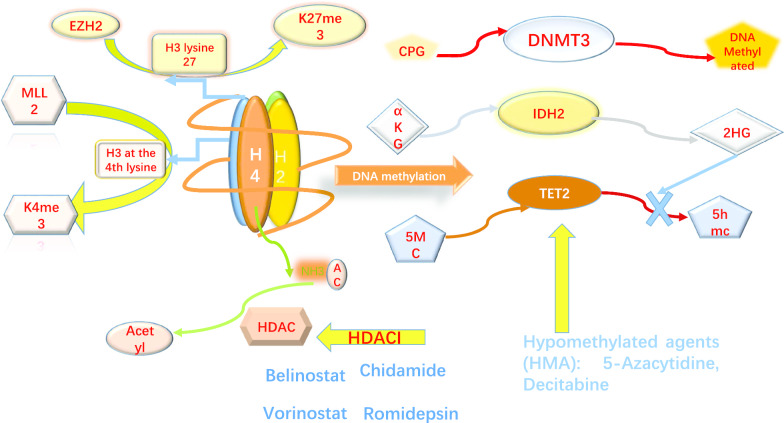
Fig. 1
Fig. 1
Epigenetics alteration and mechanism in PTCL. MLL2:MLL2 can activate the transcription of genes by methylating histone H3 at the 4th lysine (H3K4me).EZH2:EZH2 inhibits gene expression by catalysing trimethylation of lysine 27 of histone H3 (H3K27m3).HDAC : HATs catalyse the transfer of an acetyl group from acetyl- CoA to the NH2 group of lysine residues of histone H3 and histone H4 while HDACs remove it. DNMTs: DNMTs catalyse the transfer of methyl groups to cytosine nucleotides of CpG island DNA.TET2: encodes TET which converts 5-methylcytosine (5mC) to 5-hydroxymethylcytosine (5hmC). When TET2 is mutated, there is a pathogenic decrease in 5hmC leading to suppression of gene transcription.IDH2: Mutations of IDH2, such as gain-of-function R140 and R172 substitutions, lead to toxic 2-hydroxyglutarate (2HG) accumulate; which inhibits TET and decreases the levels of 5hmC. TET: ten eleven translocation protein; 2HG: 2-hydroxyglutarate; IDH2:isocitrate dehydrogenase 2; 5hmC: 5-hydroxymethylcytosine; EZH2: enhancer of zeste 2; K27me3: trimethylation at lysine 27 of histone 3 (H3K27me3); K4me3: trimethylation at lysine 4 of histone 3 (H3K4me3)
Fig. 2
Fig. 2
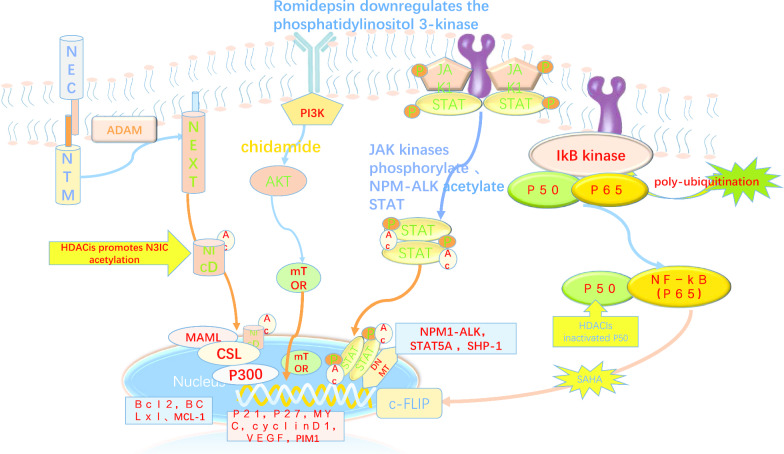
HDACis affect signalling pathways and oncogenes in PTCL. HDACI-mediated c-FLIP downregulation was related to NF-Κb members P50 inactivation via interrupting p50 interaction with c-FLIP. HDACIs inactivated P50 through inhibiting HDAC1.Romidepsin、chidamide downregulates (PI3K-AKT-mTOR) pathway by decreasing the phosphorylation of the p85 regulatory subunit of PI3K, which correlates with the observed decrease in the phosphorylation status of AKT. Histone acetyltransferase p300–mediated Stat3 acetylation on Lys685,STAT3 acetylation mediates the STAT3–DNMT1 interaction to regulate tumour suppressor gene promoter methylation. Acetylated STAT3 mediates epigenetic tumour suppressor gene (TSG) silencing, SHP-1. Notch3 intracellular domain (N3IC) is acetylated and deacetylated at lysines 1692 and 1731 by p300 and HDAC1, this modification reduces Notch3 protein stability. HDACi trichostatin (TSA) promotes N3IC acetylation ,leading to N3IC proteasomal degradation and downregulating N3IC-triggered signalling. downstream of the pathway pro-apoptotic and anti-apoptotic genes are affected

References

    1. Swerdlow SH, Campo E, Pileri SA, et al. The 2016 revision of the World Health Organization classification of lymphoid neoplasms. Blood. 2016;127(20):2375–2390. doi: 10.1182/blood-2016-01-643569. - DOI - PMC - PubMed
    1. Bellei M, Chiattone CS, Luminari S, et al. T-cell lymphomas in South America and Europe. Rev Bras Hematol Hemoter. 2012;34(1):42–47. doi: 10.5581/1516-8484.20120013. - DOI - PMC - PubMed
    1. NCCN Clinical Practice Guidelines in Oncology Version 1.2020 T-Cell Lymphomas.
    1. Broccoli A, Zinzani PL. Peripheral T-cell lymphoma, not otherwise specified. Blood. 2017;129(9):1103–1112. doi: 10.1182/blood-2016-08-692566. - DOI - PubMed
    1. Cao C, Feng J, Gu H, et al. Distribution of lymphoid neoplasms in Northwest China: analysis of 3244 cases according to WHO classification in a single institution. Ann Diagn Pathol. 2018;34:60–65. doi: 10.1016/j.anndiagpath.2017.05.005. - DOI - PubMed

Publication types

MeSH terms