


Performance of the cuff leak test in adults in predicting post-extubation airway complications: a systematic review and meta-analysis
- PMID: 33160405
- PMCID: PMC7648377
- DOI: 10.1186/s13054-020-03358-8
Performance of the cuff leak test in adults in predicting post-extubation airway complications: a systematic review and meta-analysis
Abstract
Background: Clinical practice guidelines recommend performing a cuff leak test in mechanically ventilated adults who meet extubation criteria to screen those at high risk for post-extubation stridor. Previous systematic reviews demonstrated excellent specificity of the cuff leak test but disagreed with respect to sensitivity. We conducted a systematic review and meta-analysis to assess the diagnostic accuracy of the cuff leak test for predicting post-extubation airway complications in intubated adult patients in critical care settings.
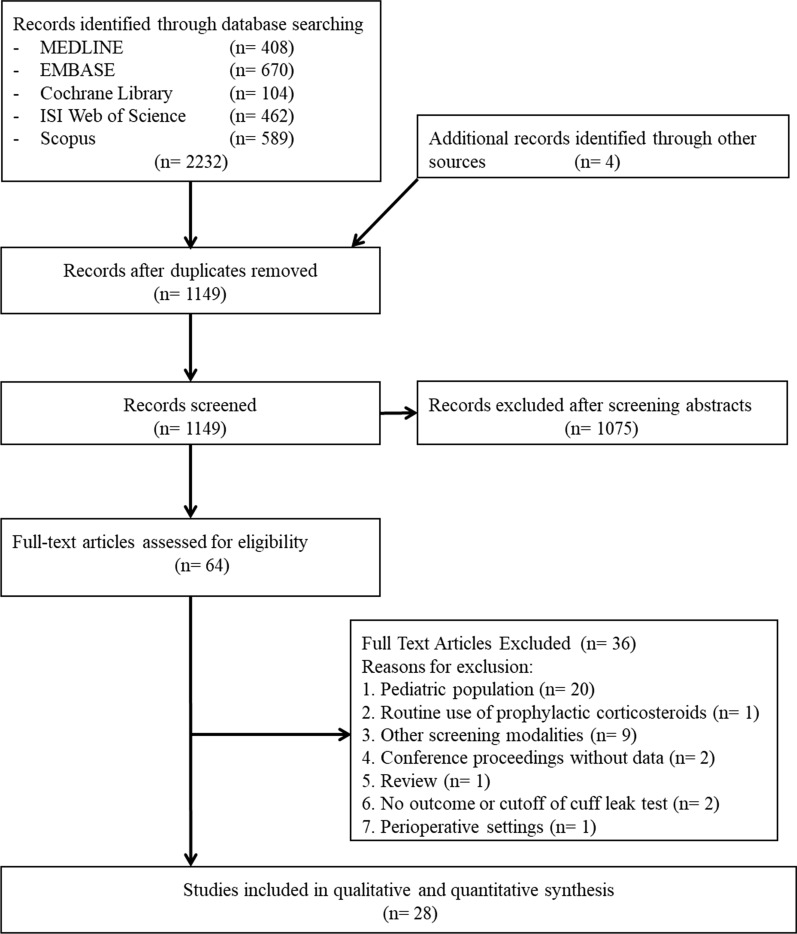
Methods: We searched Medline, EMBASE, Scopus, ISI Web of Science, the Cochrane Library for eligible studies from inception to March 16, 2020, without language restrictions. We included studies that examined the diagnostic accuracy of cuff leak test if post-extubation airway obstruction after extubation or reintubation was explicitly reported as the reference standard. Two authors in duplicate and independently assessed the risk of bias using the Quality Assessment for Diagnostic Accuracy Studies-2 tool. We pooled sensitivities and specificities using generalized linear mixed model approach to bivariate random-effects meta-analysis. Our primary outcomes were post-extubation airway obstruction and reintubation.
Results: We included 28 studies involving 4493 extubations. Three studies were at low risk for all QUADAS-2 risk of bias domains. The pooled sensitivity and specificity of cuff leak test for post-extubation airway obstruction were 0.62 (95% CI 0.49-0.73; I2 = 81.6%) and 0.87 (95% CI 0.82-0.90; I2 = 97.8%), respectively. The pooled sensitivity and specificity of the cuff leak test for reintubation were 0.66 (95% CI 0.46-0.81; I2 = 48.9%) and 0.88 (95% CI 0.83-0.92; I2 = 87.4%), respectively. Subgroup analyses suggested that the type of cuff leak test and length of intubation might be the cause of statistical heterogeneity of sensitivity and specificity, respectively, for post-extubation airway obstruction.
Conclusions: The cuff leak test has excellent specificity but moderate sensitivity for post-extubation airway obstruction. The high specificity suggests that clinicians should consider intervening in patients with a positive test, but the low sensitivity suggests that patients still need to be closely monitored post-extubation.
Keywords: Airway extubation; Airway obstruction; Cuff leak test; Guidelines; Meta-analysis; Sensitivity and specificity.
Conflict of interest statement
The authors declare that they have no competing interests.
Figures


References
-
- Torres A, Gatell JM, Aznar E, el-Ebiary M, Puig de la Bellacasa J, Gonzalez J, Ferrer M, Rodriguez-Roisin R. Re-intubation increases the risk of nosocomial pneumonia in patients needing mechanical ventilation. Am J Respir Crit Care Med. 1995;152(1):137–141. doi: 10.1164/ajrccm.152.1.7599812. - DOI - PubMed
Publication types
MeSH terms
LinkOut - more resources
Full Text Sources
