


Patient and counselor satisfaction with structured contraceptive counseling by health center staff in federally qualified health centers
- PMID: 33160909
- PMCID: PMC7856096
- DOI: 10.1016/j.contraception.2020.10.020
Patient and counselor satisfaction with structured contraceptive counseling by health center staff in federally qualified health centers
Abstract
Objectives: To characterize patient and counselor satisfaction with structured, tier-based contraceptive counseling provided by a nonclinician.
Study design: We conducted a planned secondary analysis of patient and counselor surveys from a study that enrolled women in 2 contraceptive care programs. All participants received structured contraceptive counseling from trained staff members. Women and counselors completed a confidential post-visit survey regarding satisfaction with counseling and medical mistrust. We used univariate and multivariable regressions to examine differences in high satisfaction with counseling (top score), perceived counselor influence, and perceived counselor judgment by participant characteristics.
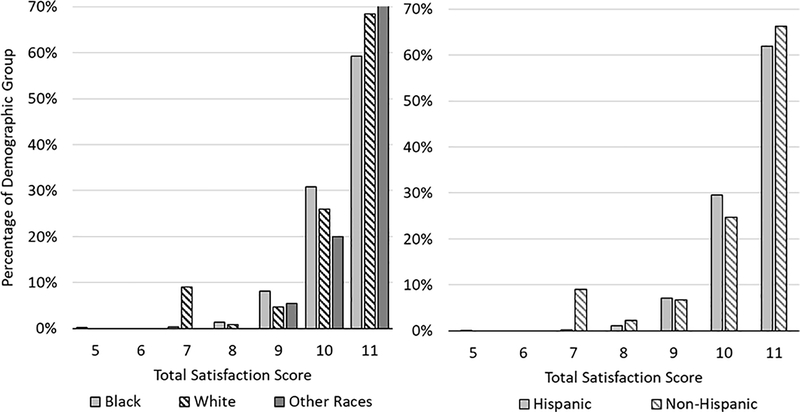
Results: Nine hundred forty-two participants completed surveys; most reported they felt respected (100.0%), trusted the counseling information (99.5%), and that counseling helped them choose a contraceptive method (83.8%). Black race, high school education, public insurance, an income below the federal poverty level, and enrollment site were associated with high medical mistrust. Participants with high medical mistrust were less likely to be highly satisfied with counseling (adjusted relative risk (RR) 0.72; 95% confidence interval [CI] 0.63-0.82), more likely to perceive influence (RR 1.77; 95% CI 1.37-2.28), and more likely to perceive judgment (adjusted odds ratio 8.91; 95% CI 3.61-22.01). Mostly, counselors felt they were able to answer participant questions (98.8%), establish good rapport (95.9%), and that participants understood the information presented (98.0%).
Conclusions: Overall, participants were satisfied with tier-based contraceptive counseling delivered by nonclinician staff members. Those with high levels of medical mistrust were less likely to be satisfied. The majority of women found the information beneficial in contraceptive decision making.
Implications: Overall, women reported high satisfaction with tier-based contraceptive counseling delivered by a nonclinician in 3 federally qualified health centers. However, women with high medical mistrust were less likely to report high levels of satisfaction and more likely to report perceived influence or judgment from the counselor.
Keywords: Contraceptive counseling; Federally qualified health center; Medical mistrust; Patient satisfaction; Tier-based contraceptive counseling.
Copyright © 2020. Published by Elsevier Inc.
Conflict of interest statement
Conflicts of Interest
Dr. Madden serves on a data safety monitoring board for phase 4 safety studies of Bayer contraceptive products. The other authors do not have any potential conflicts of interest to report.
Figures
References
-
- World Health Organization Department of Reproductive Health and Research (WHO/RHR), Johns Hopkins Bloomberg School of Public Health/Center for Communication Programs (CCP) Knowledge for Health Project. Family planning: a global handbook for providers: evidence-based guidance developed through worldwide collaboration. 3rd ed. Baltimore and Geneva: CCP and WHO; 2018.
Publication types
MeSH terms
Substances
Grants and funding
LinkOut - more resources
Full Text Sources
Other Literature Sources
