Review
. 2021 Mar;40(1):153-171.
doi: 10.1007/s10555-020-09940-4. Epub 2020 Nov 8.

Cyclin-dependent kinase inhibitors in head and neck cancer and glioblastoma-backbone or add-on in immune-oncology?

Affiliations
Review

Cyclin-dependent kinase inhibitors in head and neck cancer and glioblastoma-backbone or add-on in immune-oncology?

Christin Riess et al. Cancer Metastasis Rev. 2021 Mar.

Abstract

Cyclin-dependent kinases (CDK) control the cell cycle and play a crucial role in oncogenesis. Pharmacologic inhibition of CDK has contributed to the recent clinical approval of dual CDK4/6 inhibitors for the treatment of breast and small cell lung cancer. While the anticancer cell effects of CDK inhibitors are well-established, preclinical and early clinical studies describe additional mechanisms of action such as chemo- and radiosensitization or immune stimulation. The latter offers great potential to incorporate CDK inhibitors in immune-based treatments. However, dosing schedules and accurate timing of each combination partner need to be respected to prevent immune escape and resistance. In this review, we provide a detailed summary of CDK inhibitors in the two solid cancer types head and neck cancer and glioblastoma multiforme; it describes the molecular mechanisms of response vs. resistance and covers strategies to avoid resistance by the combination of immunotherapy or targeted therapy.

Keywords: CDK4/6 inhibitors; Combination strategies; Immune activation; Predictive biomarker; Resistance mechanisms.


Conflict of interest statement

The authors declare that they have no conflict of interest.

Figures
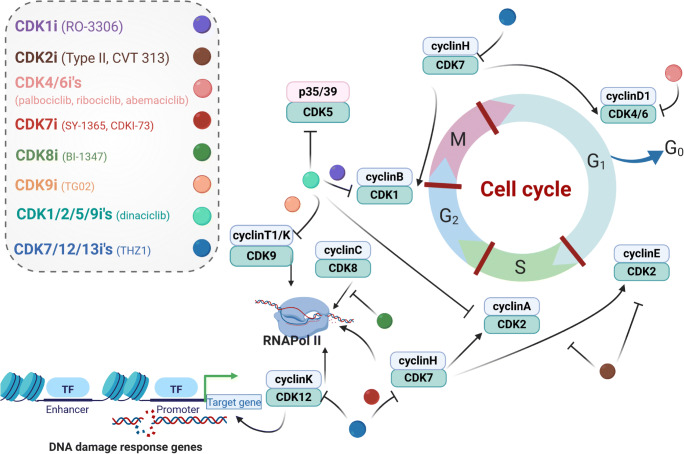
Fig. 1
Fig. 1
Cell cycle regulation and inhibitors targeting specific interphase CDKs. The cell cycle is tightly regulated by specific CDKs, a group of protein kinases. CDKs are constantly formed and degraded during the cell cycle. To become fully activated, a CDK binds to a cyclin protein and is being phosphorylated by another kinase. This complex also regulates downstream effects including transcription regulation, mRNA processing, and cellular differentiation
Fig. 2
Fig. 2
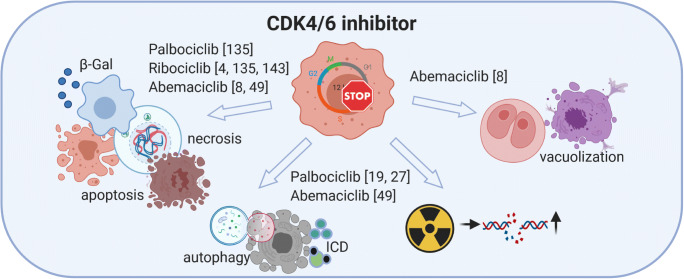
Direct effects of CDK4/6 inhibition on tumor cells. Different CDK4/6i’s inhibit cell growth and induce cell death. Despite overlapping effects, there are some characteristics unique to a specific CDKi, such as induction of vacuolization by abemaciclib. b-Gal, beta-galactosidase; ICD, immunogenic cell death. References indicate study results depicted in the figure. Created with BioRender.com
Fig. 3
Fig. 3
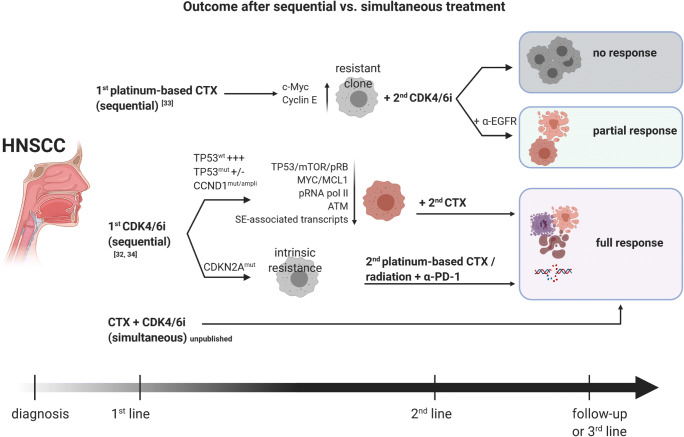
Relevance of timing on treatment response to CDK4/6i-based combination therapy. First-line therapy with platinum-based chemotherapy (CTX) triggers resistance and impedes response to CDKi (upper part). Addition of EGFR-blocking antibody cetuximab can partially suspend resistance. However, in case of first-line (middle part) or simultaneous (lower part) CDKi, developing resistance can be prevented in TP53-mutated cells, resulting in effective tumor growth control [33, 34]. ATM, ataxia telangiectasia mutated; CDK, cyclin-dependent kinase; pRNA pol II, phospho RNA polymerase II; SE-associated, super-enhancer-associated. Response includes objective response rate and complete response rate. Created with BioRender.com
Fig. 4
Fig. 4
Effects of CDK inhibitors on HNSCC. Dependent on the target, single or global CDKi alone and in combination with chemo- or radiotherapy increases effects of the monotherapy to control tumor growth. In most cases, HPV-negative/TP53mut cases respond better than HPV-positive/TP53wt tumors. Pan-CDK1/2/5/7/9i inhibition is an exception in HPV-related cancer [67]. Pan-CDKi induces DNA damage followed by p53-dependent cell death in HPV-positive, but not HPV-negative HNSCC. HPV-positive cells respond with accumulation of replication protein A complex accompanied by increases in γ-H2AX levels and apoptosis. SE-associated, super-enhancer-associated; IDO1, indoleamine 2,3-dioxygenase. Response includes objective response rate and complete response rate. Created with BioRender.com
Fig. 5
Fig. 5
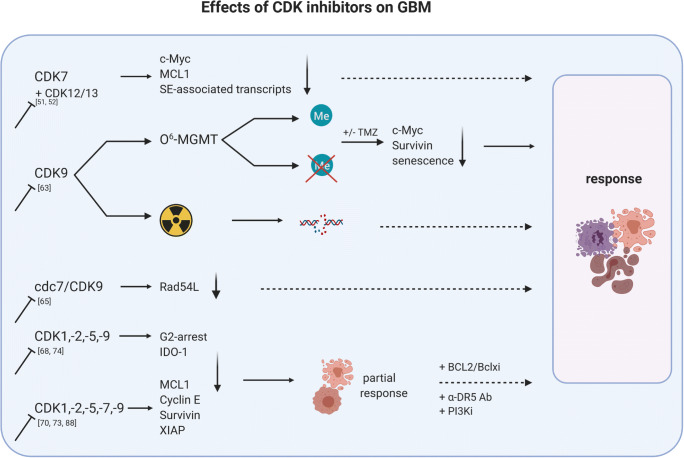
Effects of CDK inhibitors on GBM. Dependent on the target, single or global CDKi alone and in combination with chemo- or radiotherapy increases effects of the monotherapy to control tumor growth. Generally, effects of the monotherapy are increased by applying specific anti-apoptosis or PI3K inhibitors [–73]. Of note, CDK9i is effective in both MGMT-methylated and unmethylated GBM [63], while global CDKi interferes with IDO1 to reduce immunosuppressive activity [68]. SE-associated, super-enhancer-associated; MGMT, O(6)-methylguanine-DNA methyltransferase; ME, methylated; XIAP, X-linked inhibitor of apoptosis protein. Response includes objective response rate and complete response rate. Created with BioRender.com
Fig. 6
Fig. 6
Immune modulatory effects of CDKi and strategies to improve outcome. CDKi treatment induces an IFNγ response, accompanied by MHC I/II upregulation but also stabilization of PD-L1 on the tumor cells’ surface. Addition of immune-checkpoint inhibitors may prevent resistance. This in turn suppresses regulatory T cells and induces cytotoxic T cell expansion, leading to efficient tumor cell killing and clinical response. Because of emerging resistance, either by selecting rare tumor cells with preexisting mutations (de novo) or selecting cells with new mutations (acquired), patients frequently relapse. To prevent metastasis, molecular targeted therapy is indicated. Most resistant tumor cells activate or upregulate specific pathways; hence, resistance may in this case present a specific target for PI3K/mTOR and MET/TRK inhibitors. Created with BioRender.com

References

    1. Hanahan D, Weinberg RA. Hallmarks of cancer: The next generation. Cell. 2011;144(5):646–674. doi: 10.1016/j.cell.2011.02.013. - DOI - PubMed
    1. Jardim, D. L., Millis, S. Z., Ross, J. S., Woo, M. S.-A., Ali, S. M., & Kurzrock, R. (2020). Cyclin pathway genomic alterations across 190,247 solid tumors: Leveraging large-scale data to inform therapeutic directions. Oncologist. 10.1634/theoncologist.2020-0509. - PMC - PubMed
    1. Economopoulou, P., Kotsantis, J., Psyrri, A. (2020). Special issue about head and neck cancers: HPV positive cancers. Review International Journal of Molecular Sciences, 21(9), 3388. 10.3390/ijms21093388. - PMC - PubMed
    1. Chong Q-Y, Kok Z-H, Bui N-L-C, Xiang X, Wong AL-A, Yong W-P, et al. A unique CDK4/6 inhibitor: Current and future therapeutic strategies of abemaciclib. Pharmacological Research. 2020;156:104686. doi: 10.1016/j.phrs.2020.104686. - DOI - PubMed
    1. Cen L, Carlson BL, Schroeder MA, Ostrem JL, Kitange GJ, Mladek AC, et al. p16-Cdk4-Rb axis controls sensitivity to a cyclin-dependent kinase inhibitor PD0332991 in glioblastoma xenograft cells. Neuro-oncology. 2012;14(7):870–881. doi: 10.1093/neuonc/nos114. - DOI - PMC - PubMed

Publication types

MeSH terms

Substances